Utilities are investing billions to upgrade their systems and enhance grid resiliency in the face of hurricanes, wildfires and heat waves, even as shifting federal priorities have deemphasized climate mitigation.
The risk from natural disasters is compounded by rising demand for power that threatens to put additional strain on the grid, as well as cyber and physical attacks on critical infrastructure.
In response, some utilities, grid operators, regulators and lawmakers are implementing new strategies: They're incentivizing distributed generation and storage, restricting energy usage during times of crisis, expediting power line undergrounding, applying new resilience metrics and deploying artificial intelligence to improve grid management.
In the meantime, regulators and courts continue to weigh competing claims over who should shoulder thecosts of disaster prevention and response.
The stories below offer a window into the complex dynamics affecting grid resiliency.
PJM gets emergency approval to curtail data centers, large loads during hot weather
Under the Department of Energy order, the PJM Interconnection can curtail power to data centers with backup generation as a last resort before instituting rolling blackouts.
By: Ethan Howland• Published May 19, 2026
The PJM Interconnection can curtail data centers and other large loads that have backup generation under an emergency order issued Monday by the U.S. Department of Energy.
PJM on Sunday asked to be able to direct transmission owners and electric utilities in its Mid-Atlantic and Midwest footprint for permission to curtail those facilities if needed for three days starting May 18 because of hot weather combined with planned power plant maintenance outages.
PJM said it expected to have less than 5,800 MW of reserves during its May 18 peak, and that Maryland and Virginia could be especially stressed by the unseasonably hot weather.
Power plant and transmission owners often take their facilities offline in the spring for maintenance so they are prepared for the summer, PJM noted. The grid operator said it expected power plants totaling more than 40 GW would be offline for planned outages on May 18.
“The projected level of generation outages coupled with the forecasted demand raises a significant risk of emergency conditions that could jeopardize electric reliability and public safety,” PJM said.
The curtailments would be a last resort before ordering rolling blackouts, according to the DOE’s order, issued under the Federal Power Act’s section 202(c). Only large energy consumers with backup generation would be affected.
“The employment of this backup generationis expected to reduce stress on the grid,” the DOE said. “This will permit orderly, safe, and secure operations during PJM’s hot weather conditions.”
There are significant amounts of backup generation in the United States that have remained largely untapped during grid emergencies, according to the DOE.
“Deployment of backup generation resources (whether auxiliary, standby, directly-connected, battery storage or other, and whether synchronized or not to the bulk power system) at data centers (including, but not limited to, hyperscaler facilities), and at other large load industrial and commercial customer sites, can prevent avoidable blackouts, thereby saving lives and reducing costs to the American people,” the department said.
PJM said on Monday that it had issued “maximum generation” and “load management” alerts for May 19, with a “hot weather” alert in place for most of the PJM footprint.
Also, the grid operator activated demand response customers in parts of the Mid-Atlantic and Dominion regions. The grid operator said it called on pre-emergency demand response for the Baltimore Gas and Electric, Dominion and Potomac Electric Power Co. areas on Monday to address local transmission constraints and to preserve the run-time of generators that will be needed for the hot weather and higher electricity demand expected on Tuesday and Wednesday.
For three days starting on Tuesday, PJM expected its peak load to hit 134,027 MW, 135,961 MW and 119,103 MW.
Article top image credit: Nathan Howard via Getty Images
NERC issues Level 3 alert, mandates action to address data center load losses
Computational loads pose “immediate risks,” the grid watchdog said. Certain grid participants must take seven actions by Aug. 3 in response.
By: Robert Walton• Published May 5, 2026• Updated May 5, 2026
The North American Electric Reliability Corp. on Monday issued a rare Level 3 alert — the watchdog’s highest level — following instances of data centers unexpectedly dropping load or oscillating demand rapidly, creating reliability concerns. The alert includes seven actions grid entities “must implement to address immediate risks posed by computational loads,” NERC said.
Transmission planners and operators, system planners and balancing authorities are among the entities that must act. The required actions address the modeling, study, operation, protection and control of computational loads, including artificial intelligence training and cryptocurrency mining.
“The grid faces unprecedented challenges from a surge in large power consumers,” NERC said in a statement. Summer peak demand across the bulk power system is expected to rise 24% in the next 10 years, with data centers accounting for most of the increase, the organization said in its most recent Long Term Reliability Assessment, published in January.
In the face of rising data center loads — and instances where they unexpectedly disconnected from the grid — NERC issued a Level 2 warning last year that elicited alarming responses from grid stakeholders, the reliability watchdog said.
“Entities generally did not have sufficient processes, procedures, or methods to address emerging computational loads,” NERC said in its Monday warning. The essential actions NERC calls for include the following:
Transmission planners and planning coordinators should develop a detailed list of modeling data, settings, and parameters needed from computational loads and distribute this to transmission operators in their footprint. Transmission operators should reflect this information in their facility interconnection requirements.
Transmission planners and planning coordinators should collect data from computational loads such as the expected minimum and maximum consumption in megawatts and the percentage of IT load vs. non-IT load (cooling, for instance), at various load levels.
Planning coordinators should revise definitions that trigger a review of local area protections, stability limits and other reliability studies to account for computational loads.
Transmission operators should establish a “commissioning process” for computational loads.
Where possible, the commissioning process transmission operators develop should include testing facilities at full load and at no load, and, if possible, with at least a 10% change from nominal voltage.
Transmission operators should install and utilize dynamic fault recording devices to understand computational load facility electrical performance during system disturbances.
Registered NERC entities must acknowledge receipt by May 11 and must respond by Aug. 3.
Grid instability issues caused by data centers "could become quite severe — to the the point of creating widespread blackouts," Ben Inskeep, program director for the Citizens Action Coalition, told Utility Dive in an email.
"It is critical that we have standards in place to protect all ratepayers from negative impacts to grid stability, reliability, and resiliency that are caused by data centers, especially given the rapid proliferation of these mega users across the country," Inskeep said.
NERC’s efforts to better align utility and data center operations may take longer than anticipated, Digital Power Optimization CEO and founder Andrew Webber told Utility Dive. The company builds and manages data centers.
“It will take years of coordinated effort in the drafting of new regulations, understanding limitations and opportunities related to physical equipment, understanding limitations and opportunities related to software and control systems, re-prioritizing various loads all throughout society, etc.,” Webber said in an email.
“Given the absolutely critical need [for data center developers] to source power for their developments, I found it quite interesting that FERC isn’t seeing more direct engagement from the data center industry,” Webber said. “I think it exemplifies the challenges NERC is also going to face in getting genuine buy-in and wholehearted acceptance by the data center industry as it pertains to grid reliability.”
“New evaluation paradigms will need to be created and worked through in partnership with the data center industry,” he said.
Article top image credit: Mario Tama via Getty Images
Extended heat wave could cripple New York’s grid this summer: NYISO
Electric reliability margins will be “the lowest ... in recent history” at just 417 MW available under baseline summer conditions, the New York Independent System Operator said Friday.
By: Robert Walton• Published April 28, 2026
Electric reliability margins this summer in New York will be “the lowest ... in recent history,” with extreme weather and an aging generation mix contributing to a risk of blackouts, the New York Independent System Operator said Friday.
“Coordination with generation owners, utility companies, neighboring grid operators, and government officials will be essential as we work to maintain grid reliability this summer,” Aaron Markham, ISO vice president of operations, said in a statement.
The ISO’s annual summer reliability assessment estimates 34,615 MW of power resources will be available this year to meet forecasted peak demand of 31,578 MW. The ISO said it is required to maintain 2,620 MW from the available resources in reserve, leaving a reliability margin of 417 MW under baseline summer conditions.
New York’s reliability margin has declined almost 80% since 2022, when it was 1,918 MW.
“This assessment reflects the challenges of the grid in transition — declining reliability margins, performance issues with aging generators, and an absence of new dispatchable resources,” Markham said.
In the event of a three-day or longer heat wave with average daily temperatures of 95 degrees, and absent emergency operating actions, NYISO said its capacity margin is forecasted to be -1,679 MW. If the average daily temperature reaches 98 degrees, the margin declines further to -3,370 MW.
The ISO can take emergency actions, including purchasing energy, calling for voluntary industrial curtailment and allowing a reduction in operating reserves, to produce 3,166 MW of additional headroom on the system, it said.
The ISO’s all-time peak demand record of 33,956 MW was set in July 2013.
The thin reliability margins build on previous warnings from the New York ISO. In November, the grid operator published its 2025 to 2034 Comprehensive Reliability Plan, which concluded that the state’s power system is at an “inflection point” as it deals with an aging generation fleet and increasing difficulty in deploying dispatchable resources amid rapid load growth.
New York may need several thousand megawatts of new dispatchable generation over the next 10 years, according to the assessment.
“The margin for error is extremely narrow, and most plausible futures point to significant reliability shortfalls within the next ten years,” it said.
A 20-year system outlook published in 2024 concluded total system demand could increase by 50% to 90% over the next two decades, driven by the electrification of heating and transportation and the development of energy-intensive projects and industry.
Article top image credit: Getty Images
Winter Storm Fern highlighted need for expanded interregional transmission, Senate hears
Some regions saw prices of hundreds of dollars per megawatt-hour, while neighboring areas experienced negative power prices, said Liza Reed of the Niskanen Center think tank.
By: Robert Walton• Published March 27, 2026
An additional 1 GW of interregional transmission capability could have saved U.S. consumers $183 million during Winter Storm Fern, Liza Reed, director of climate and energy policy at the Niskanen Center think tank, told the Senate Committee on Energy & Natural Resources Wednesday.
Some regions saw prices of hundreds of dollars per megawatt-hour during the multi-day storm from Jan. 23 to Feb. 3, while neighboring areas experienced negative power prices. “There was power not being used at all because the transmission was not available to move it to where it was needed,”said Reed.
Wednesday’s hearing to “examine the state of the bulk power system” focused on regulatory roadblocks to expanding the grid, including transmission, and the need for new technologies and market constructs. U.S. Sen. Alex Padilla, D-Calif., said he and other senators are developing legislation to help modernize transmission development and grow the use of grid enhancing technologies.
Electricity bills are up by as much as 13% since President Trump took office, Sen. Martin Heinrich, D-N.M., said in an opening statement, and the administration has threatened 116 GW of new clean energy capacity from coming online.
Transmission investment could address both rising demand and affordability, he said.
“We need to get more out of the grid that we have,” Heinrich said. “Grid enhancing technologies can unlock 20 to 100 GW of additional capacity when demand is highest. These solutions cost less than one quarter of the traditional upgrade costs and can be deployed in three to five years.”
Grid enhancing technology, such as dynamic line ratings and advanced power flow controls, “could reduce grid congestion by 40% or more, saving customers four to $8 billion a year,” he said.
Padilla said his draft legislation builds on the bipartisan Energy Permitting Reform Act of 2024, which passed out of committee but was never voted on by the full Senate.
The new bill will include additions to support implementation of advanced grid upgrades and high-voltage direct current lines, along with improving interconnection procedures and reauthorizing grid resilience grant programs, Padilla said.
“I believe our effort represents not just a common sense plan, but one that will build a cheaper, stronger, more reliable electrical grid that protects ratepayers,” he said.
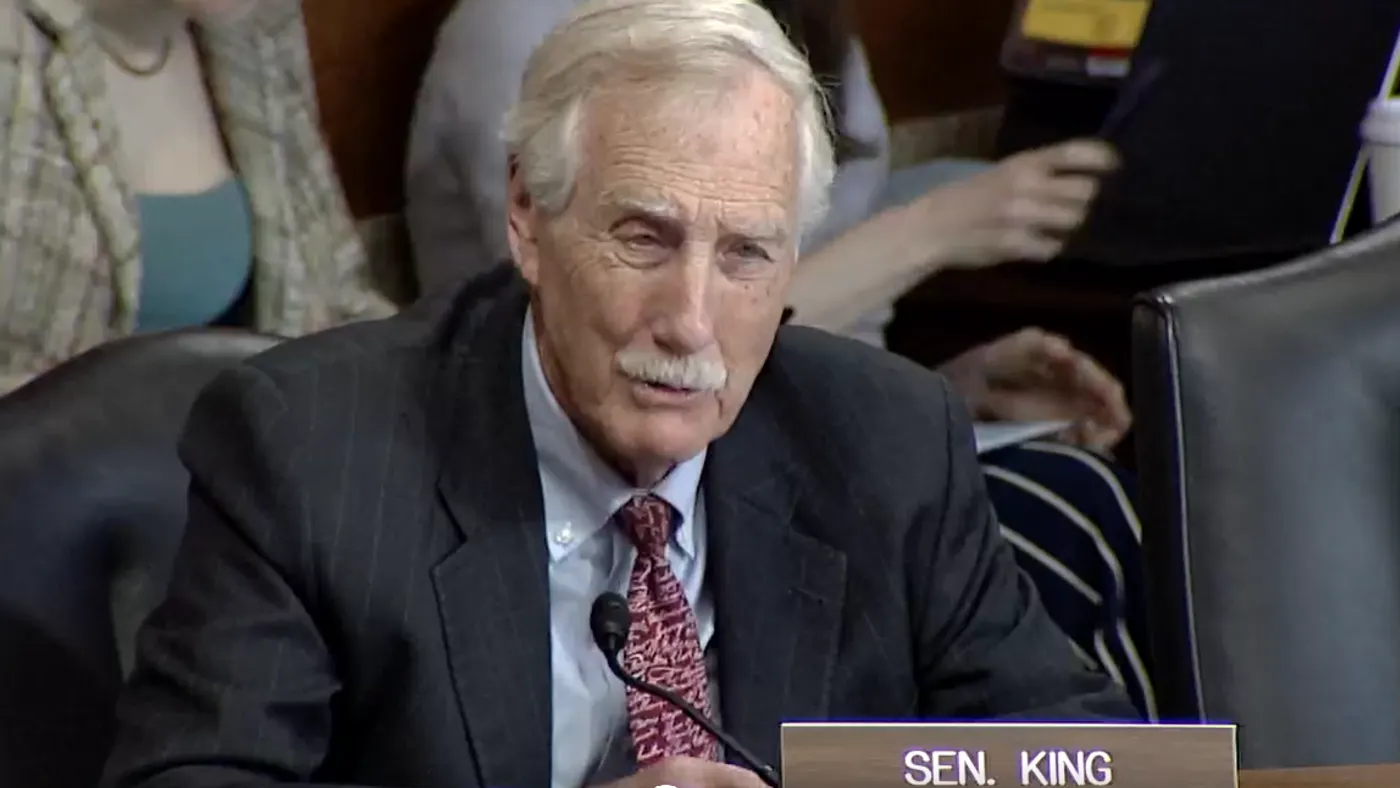
Other lawmakers involved in drafting the legislation are Sens. John Hickenlooper, D-Colo., Catherine Cortez Masto, D-Nev., Ruben Gallego, D-Ariz., and Angus King, I-Maine.
Sen. Mike Lee, R-Utah, said permitting delays are “slowing projects across all forms of energy infrastructure” while market distortions “are affecting investment decisions, and the pace of innovation in the electricity sector is not where it needs to be.”
“If we modernize permitting, and if we ensure that markets are truly competitive, we can solve this challenge,” Lee said. But if a lack of supply additions hold back demand growth, “the imbalance we're seeing today will become more severe, and the consequences will be felt by American households and businesses.”
King told the committee that he supports permitting reform efforts but will not participate in discussions “as long as the administration is arbitrarily putting its thumb on the scale and canceling wind and solar projects that, in many cases, have already been permitted. Then, permitting reform only benefits one side of the equation — that's fossil fuel. I'm not going to participate in that discussion.”
“I feel like I'd be dumb to agree to permitting reform which only affected one half of the equation,” King said.
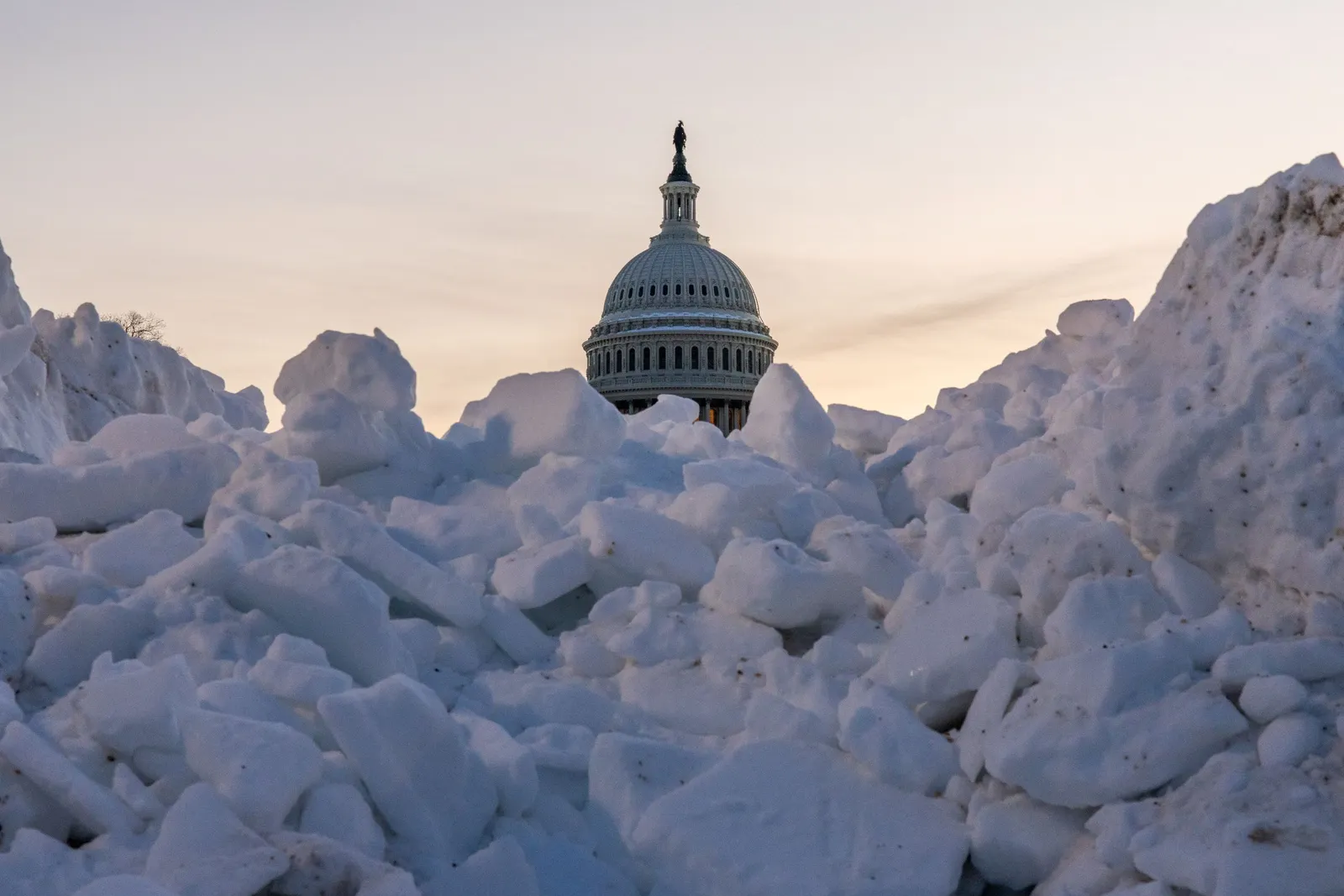
Snow is cleared and deposited near the United States Capitol reflecting pool on Jan. 31, 2026, in Washington, DC after a winter storm brought historic levels of sleet.
Alex Kent via Getty Images
The distribution system is another area where the power sector can get more capacity from existing infrastructure, Heinrich said. The U.S. already has 30 GW to 60 GW of distributed energy resources operating as virtual power plants, he said.
“Deploying another 60 GW could save consumers $20 billion by 2030,” Heinrich said. “But these aren't silver bullet-solutions for long-term growth. We must also build high voltage transmission lines to reduce congestion and reliability risks.”
Transmission congestion cost consumers $12.1 billion in 2024 alone, he noted, but interregional transmission made up only 2% of new circuit miles installed between 2011 and 2023.
NERC in 2024 recommended the addition of 35 GW of U.S. interregional transfer capability, a 40% boost to current capabilities. The U.S. needs “narrow and clear federal authority” to build interregional transmission, Reed said.
Instead, existing market structures create barriers to the deployment of new transmission technologies, Reed said. Grid operators do not compensate high-voltage direct-current transmission technology for some reliability services, she noted.
“China has built tens of thousands of miles of high capacity transmission in the last two decades to our hundreds,” she said. “We are behind on increasing capacity. We are behind on adopting modern technology. And this will put us behind on attracting and maintaining top industries. A shortage of grid capacity is the primary barrier to cost effective and swift deployment of AI in this country.”
Todd Snitchler, president and CEO of the Electric Power Supply Association, told lawmakers that one of the greatest risks to reliability and affordability is uncertainty around the demand growth associated with large loads.
“There's a wide disparity about just how much electricity will be needed, when the demand increases will be most prevalent and how quickly the predicted demand will actually materialize,” he said. That introduces the “danger of over- or under-producing capacity during a time of volatile demand projections.”
EPSA supports allowing large demand customers to procure their own new generation “to provide certainty over their supply cost,” Snitchler said. The growing interest in voluntary bilateral partnerships between power plants and large demand customers “embody the competitive characteristics and ratepayer protection that wholesale markets encourage.”
Travis Fisher, director of energy and environmental policy studies at the libertarian Cato Institute think tank, told lawmakers that Congress should enact a policy known as Consumer Regulated Electricity, or CRE, to allow off-grid electric utilities to serve new customers under voluntary contracts.
Those utilities would not be subject to economic regulation at the state or federal level because they do not connect to existing systems or pose a risk to existing customers, he said.
The approach “would enable speed to power for the customers who value it most while not burdening the existing grid,” Fisher said.
Article top image credit: Retrieved from U.S. Senate.
The test will use electric vehicle batteries for demand response and residential peak shaving while also making their storage capacity available during power outages.
By: Brian Martucci• Published March 24, 2026
Puget Sound Energy began testing vehicle-to-home technology in its service territory last month in the first bidirectional electric vehicle charging pilot of its kind in Washington state, the utility said on March 18.
Puget Sound Energy said it’s running the test in partnership with Ford, Kia, EV charging equipment provider Wallbox and ChargeScape, a vehicle-grid integration platform. Participating EV owners will use their vehicles’ batteries to provide backup home power “while simultaneously supporting grid reliability during peak demand periods,” the utility said.
In an email, ChargeScape CEO Joseph Vellone called the test a “technology demonstration” that will run through the first quarter of 2027. It includes three Ford F-150 Lightning and two Kia EV9 vehicles, he said.
Puget Sound Energy “will continue to explore opportunities to expand the demonstration scope as other [auto manufacturers’] and charging partners’ bidirectional capabilities advance,” Vellone said.
The utility said the demonstration will test two use cases. The first is time-of-use optimization, where participating vehicles charge during cheaper off-peak periods and discharge during higher-priced peak periods to reduce their owners’ electricity bills. The second is demand response, where Puget Sound Energy calls on the vehicles to help stabilize the grid by discharging during high-demand periods.
Active managed charging, where utilities or other intermediaries use software to control power flows to and from plugged-in EVs, can reduce peak charging demand by 50% or more and significantly reduce the associated system costs, according to a January study commissioned by EnergyHub. The study relied on a cohort of 58 drivers in Washington.
Using EV batteries for distributed energy storage also aligns with Puget Sound Energy’s clean energy goals, the utility said.
Though most of its sales already come from clean sources, Puget Sound Energy has identified demand response as a key lever for integrating more carbon-free power. In 2023, it announced a partnership with Autogrid — now part of Uplight — to deploy 100 MW of virtual power plant capacity within two years. More recently, it inked a deal with BrightNight and Cordelia Power to purchase power from a 200 MW/800 MWh battery facility that a utility spokesperson said would help alleviate grid congestion and integrate more clean energy when it comes online, likely next year.
As for the vehicle-to-home demonstration, Vellone said Puget Sound Energy will use its technical results and feedback from participants to “inform its future product development and deployment strategy.” That could include an expansion of the bidirectional charging program, which would require a filing with the Washington Utilities and Transportation Commission, he said.
Washington has one of the country’s most ambitious frameworks for electric vehicle adoption. It’s one of about a dozen states to adopt California’s Advanced Clean Cars II road map, which requires 100% of new light-duty vehicles sold in 2035 to meet zero-emissions standards. A state law passed in 2022 set a nonbinding target of 2030 for new vehicle sales to be 100% electric.
Recent sales trends suggest Washington will have a difficult time meeting the earlier target, according to an analysis from the Washington Policy Center, a free-market think tank. Sales data from the Alliance for Automotive Innovation, an automaker-backed trade group, shows EV sales growth in Washington stalling out in 2025 after brisk growth in 2024, consistent with national trends.
Article top image credit: Getty Images
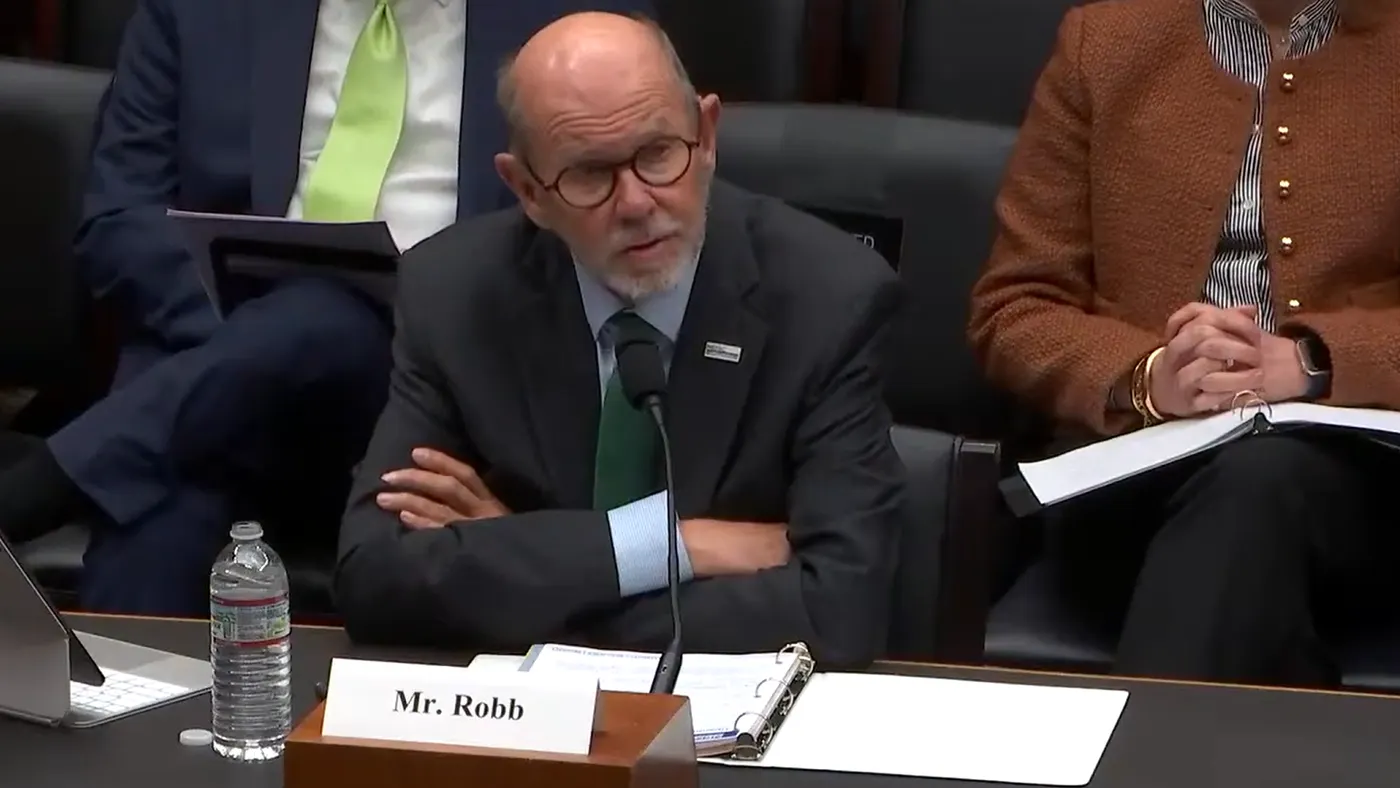
January’s Winter Storm Fern was ‘classic near-miss’ for US grid, says NERC’s Robb
“The system ran very close to the edge, leaving no room for error,” Jim Robb, president and CEO of the North American Electric Reliability Corp., told a House subcommittee.
By: Robert Walton• Published March 20, 2026
The U.S. grid withstood Winter Storm Fern in January without disruption to the bulk power system, but the electric sector cannot become complacent because reliability risks are rising, Jim Robb, president and CEO of the North American Electric Reliability Corp., told a House subcommittee on Tuesday.
Fern was a wide-area, multi-day, extreme weather event that left about 1 million people across the Midwest, Northeast and South without power — but largely due to local outages, such as from downed power lines. While ultimately there were sufficient energy resources available on the grid, Robb called the storm a “classic near-miss” that required extraordinary measures.
As demand forecasts for Winter Storm Fern surged, the electric sector activated emergency operating procedures to manage the reliability risk and the U.S. Department of Energy stepped in with emergency orders, Robb said. Gas, coal and nuclear resources provided most of the generation through the storm, but renewables also contributed, he said. Fuel oil and liquefied natural gas helped keep the lights on in New England.
Ultimately, the power sector caught a break when Fern’s temperatures were not as cold as forecast, Robb said.
The electric power sector has shown “commendable improvement in cold weather performance,” Robb said, compared with past events like Winter Storm Uri in 2021. “However, the system ran very close to the edge, leaving no room for error” during the January storm.
Even though grid metrics show strong performance, “risk is growing more acute,” Robb said. “Nearly two-thirds of the country is at elevated or high risk of energy shortfalls over the next five years.”
Three trends explain the growing risks, he said: demand growth, a changing resource mix and lagging supply additions.
“Electricity demand projections are higher than we've ever seen at any point in the last two decades,” Robb said. “These trends are driven by the proliferation of large industrial loads, particularly but not exclusively data centers, and expanding use of electric heating and electric vehicles.”
The rate of increase in electricity demand is “staggering,” he said. Summer peak demand is projected to rise by 200 GW, with winter demand growing faster. “That's 70% higher than what we projected at this time last year,” Robb said.
Older generators are being replaced by renewables and batteries, which leaves supply increasingly weather-dependent. There is also a decline in the essential reliability services necessary to support voltage, frequency and ramping needs, he said.
Over the next 10 years, coal and natural gas’ share of U.S. generation is projected to decline from 62% to 48%, while renewables and batteries will grow from supplying 12% to 34% of peak demand, Robb told lawmakers.
More supply is needed. “Projects need to get out of the queue and into the ground much more quickly,” he said.
EPB of Chattanooga deploys battery-based microgrids for savings, resilience
Within three years, the Tennessee distribution utility could have as much as 150 MW of energy storage on its system, representing more than 10% of peak load, an executive told Utility Dive.
By: Brian Martucci• Published March 11, 2026
EPB of Chattanooga has deployed five battery-based microgrids with 29 MW/58 MWh of combined capacity across two sites, the Tennessee public distribution utility said Tuesday.
Two more battery-based microgrids will follow “very soon” as EPB works to harden its grid and reduce demand charges levied by the Tennessee Valley Authority, its bulk power supplier, Ryan Keel, EPB’s president of energy and communications, said in an interview. EPB has 45 MW/95 MWh of front-of-the-meter energy storage in service today, including the new microgrids, and another 45 MW it expects to deploy over the next 12 months, Keel said.
Next year, EPB plans to deploy an advanced microgrid control platform developed by longtime partner Oak Ridge National Laboratory. The control platform will allow microgrid boundaries to expand or contract based on power demand and available supply, EPB said.
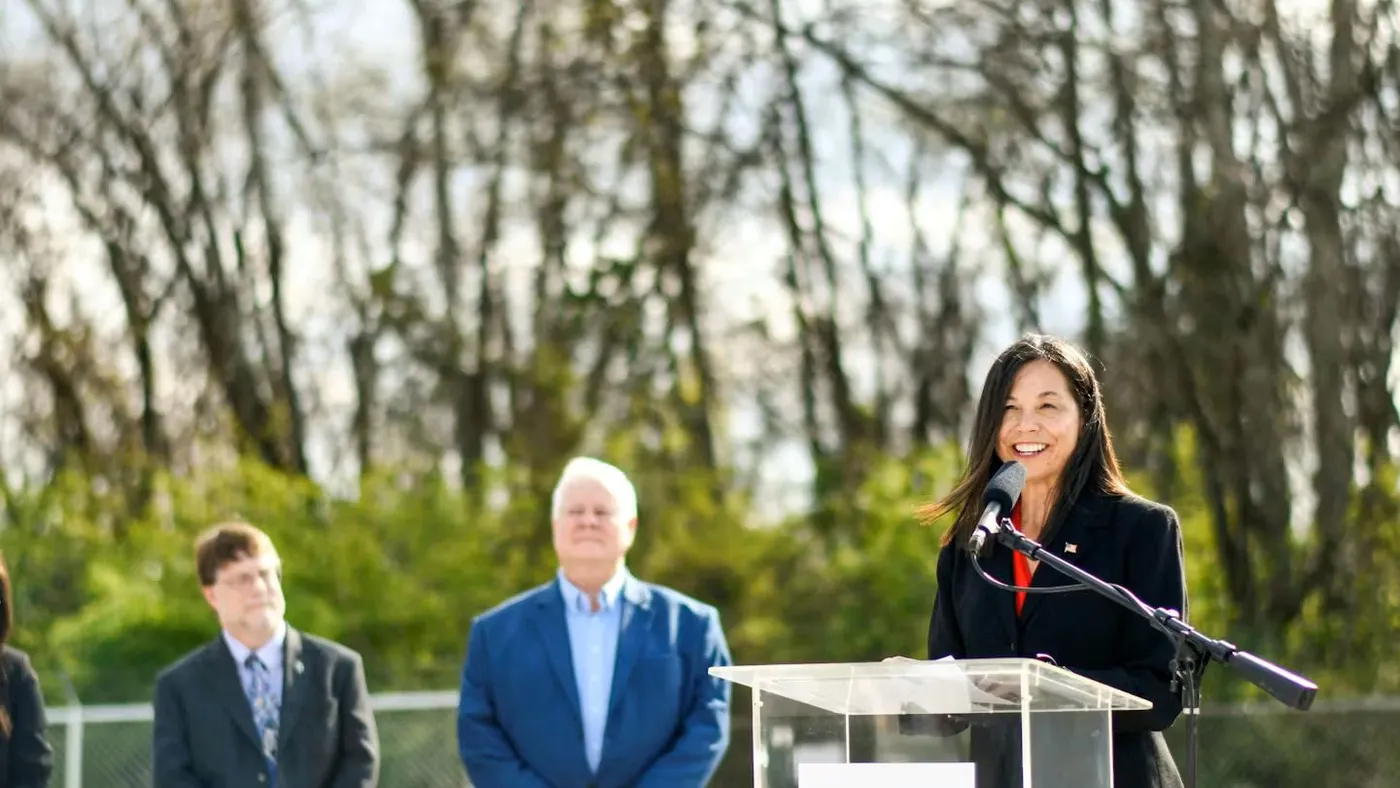
The microgrid project was supported by the U.S. Department of Energy’s Office of Electricity, EPB said. On Monday, Katie Jereza, assistant secretary for the office, appeared at events celebrating the microgrids and Oak Ridge’s new control system.
“Microgrids make electricity more dependable when it’s needed most and help reduce energy costs when demand spikes,” Jereza said in a statement.
The public utility’s service territory has about 200,000 customer meters and saw peak demand hit a new record of around 1,350 MW during a cold snap this January, Keel said. Its unique customer mix — spanning urban Chattanooga in the Tennessee River Valley and semi-rural areas in the city’s mountainous exurbs — makes it “almost a sort of hybrid of a municipal utility and a rural electric cooperative,” he said.
Keel said the two microgrid sites announced this week include 2-hour battery systems in urban Chattanooga. They, along with most other energy storage systems on EPB’s grid, will help offset monthly demand charges that can account for one-third of the utility’s total power purchase costs, he said.
That demand charge is set by the hour of each month with the highest demand, “so whenever that hour occurs, we have a financial incentive to reduce that peak with energy storage and other measures,” Keel said.
Under its agreement with TVA, energy storage does not count toward EPB’s self-generation limit of 5% of its own load, Keel said. EPB expects to have 100 MW to 150 MW of energy storage on its distribution system within “two to three years,” he added.
“It’s all front-of-meter from the customer’s perspective, but it’s all behind-the-meter when you’re talking about our relationship with TVA,” Keel said.
Though there’s always a risk that TVA’s posture toward energy storage could change, Keel sees that as relatively unlikely as the nation’s largest public utility grapples with surging power demand.
“The way we see it, this stuff only has increasing value to us and this area,” he said.
In addition to allowing microgrids to expand and contract as conditions change, Oak Ridge’s microgrid platform will enable “nested” microgrids that can provide critical support to EPB’s distribution system and improve reliability, the utility said.
Stephen Streiffer, Oak Ridge’s laboratory director, said in a statement that his organization’s work — and its relationships with utilities like EPB — will help mitigate the effects of extreme weather and other disruptions to the power system and the communities that depend on it.
“Microgrid innovations demonstrated through utility partnerships are enabling safeguards for critical infrastructure and community services in the face of disasters,” Streiffer said.
EPB is developing a smaller battery-based microgrid in a rural area near the end of a radial distribution line, Keel said. Its four-hour discharge capacity reflects the utility’s expectation that it will serve the resiliency needs of an area where power outages are more frequent, he said.
“This is more of an ‘end of our electric system’ residential setting where it will be used more frequently [and] isolated from the grid to serve customers,” Keel said.
The microgrids are part of a larger effort, supported by DOE, to improve grid reliability and resilience in the area.
In 2023, DOE said it would give EPB $32.3 million in matching funding to replace more than 1,300 utility poles, underground over 100 miles of power lines and deploy 15 MW of energy storage at six sites.
Keel said the utility’s work with Oak Ridge on energy storage began “years ago,” when battery technology was not as commercially viable as it is today.
“It has grown into this, but what Oak Ridge has done [in contributing] to our deployment today … goes back to our partnership over many years,” he said.
Article top image credit: Courtesy of EPB Chattanooga
Opinion: The rate case for grid resilience: Why climate change isn’t just about storms
Utilities that delay resilience investments hoping that global climate mitigation efforts will reduce the need for local hardening are taking a dangerous gamble, writes Kai Karlstrom of Repath.
By: Kai Karlstrom• Published Feb. 13, 2026
Kai Karlstrom is director of solutions engineering for Repath.
When we talk about physical climate risk in the utility sector, we almost exclusively picture the catastrophe as a category 5 hurricane snapping transmission towers, or an unprecedented freeze shutting down the grid. These events are tragic, visible and mobilize immediate regulatory support.
But while we prepare for the 1-in-100-year event, we’re bleeding cash on the 1-in-5-year reality.
Most utilities are currently mispricing physical risk because existing reliability models often treat weather as a static baseline. They assume that the "average" day in 2030 will look like the average day in 2000. It won't.
As heat and precipitation baselines shift, they create a "silent derating" of grid assets — eroding efficiency, increasing fault rates and driving up operating expenditures long before a named storm ever makes landfall.
We recently analyzed an approximately $1.5 billion grid portfolio in Europe comprised of 37,000 miles of overhead lines and 13 critical substations to quantify this financial impact. The data was stark: Under a "business as usual" climate scenario (RCP 8.5), climate hazards threaten to erode 30.57% of the portfolio’s gross value by 2050.
This value destruction doesn't happen all at once. It happens incrementally, accumulating as average annual loss, or AAL. Unlike a singular major event, AAL captures the steady financial drip of efficiency losses and minor outage repairs that fly under the radar until they impact the bottom line.
All emissions scenarios lead to higher costs
One of the most critical insights for utility planners is the divergence (or lack thereof) between climate scenarios. Often, utilities delay resilience investments hoping that global mitigation efforts will reduce the need for local hardening. Our analysis suggests this is a dangerous gamble.
In the analyzed portfolio, while the "business as usual" path leads to a ~30% value erosion, even the "climate protection" scenario (RCP 2.6) still results in a 21.54% value risk by 2050. The gap between these scenarios indicates the financial benefit of climate protection, but it also proves that significant physical risk is already baked into the system.
Whether we follow a high-emissions or low-emissions trajectory, the hazards arrive, differing primarily in their steepness and timing. For instance, operational expenditure losses under “business as usual” climb noticeably faster after the 2040s, mirroring increased interruptions and emergency maintenance. However, under both scenarios, the trajectory is upward. Waiting for global policy to solve local grid reliability is not a viable strategy; the "climate tax" is coming regardless of the emissions pathway.
The silent derating of the grid
The most dangerous risks are the ones current models don’t flag. Standard asset management often focuses on age-related degradation, but climate stress accelerates this aging.
Our analysis found that unadapted overhead lines were uniquely vulnerable. Heavy precipitation acts as a key trigger for outages, with chronic stresses like wind and heat modulating baseline fault rates across seasons. In our portfolio analysis, gross revenue losses driven by these hazards were projected to climb over 12,000% by 2050 compared to today’s baseline under a high-emissions scenario.
This isn't so much a storm problem as it is a conditions problem. For this operator, damp, heavy air increases vegetation contact and conductor clashes. While overhead lines drive the majority of operational loss through fault frequency and restoration time, substations bear the concentrated risk of catastrophic damage from flood inundation. If a utility’s rate case assumes historical fault averages rather than projected AAL, it is under-collecting on the true cost of future reliability.
The ROI of resilience
The good news is that unlike vague "climate mitigation" goals, adaptation has a calculated, defensible return on investment. When we move from generic "exposure heatmaps" to calculating the reductions in AAL, we can identify exactly when a resilience measure pays for itself.
However, utilities cannot simply harden everything. The capital constraints require a prioritization framework. In our study, we mapped adaptation measures on a scatter plot comparing implementation cost against technical benefit (reduction of faults). This revealed two distinct categories of investment that utilities should prioritize:
The "no regret" move: hardening overhead lines
For medium-voltage (15 kV) lines exposed to heavy precipitation, the fix is often converting bare conductors to semi-insulated compact conductors (AAC 95 mm²) or aerial bundled cables (ABC). This is not a massive engineering overhaul; it’s a targeted upgrade. In our analysis, specific "no regret" feeder segments showed a financial breakeven between year three and year five. The payback comes not from surviving a hurricane, but from the daily reduction in transient faults and the avoided penalties of energy not supplied.
The defensive asset: flood-proofing substations
Substations are capital-intensive nodes where risk is concentrated. Our modeling of specific substations exposed to 1-1.6 foot flood depths showed that relatively simple interventions such as raising foundations or installing deployable barriers cost between about $180,000 to $1.4 million (€150,000 to €1.2 million). Crucially, these investments showed a breakeven point around year six. By quantifying the AAL avoided by preventing these floods, we prove that these measures turn physical protection into a defensive financial asset.
Data-driven defense
The era of treating climate adaptation as a "nice-to-have" or a "storm surcharge" is ending. Regulators and investors are beginning to demand granular proof that capital plans are robust against future weather baselines.
For utilities, the path forward is to stop viewing resilience as a cost center. By quantifying the AAL on their portfolios, specifically the operational expenditure drag of silent derating and the capital expenditure risk of flash floods, they can build a rate case that is financially defensive and operationally prudent.
We have the technology to calculate the payback period of a thicker cable or a higher flood wall. It's time we started using it to justify a stronger, smarter grid.
Article top image credit: Melissa Sue Gerrits via Getty Images
Americans lost more power last year than any year in previous decade: EIA
The annual average of 11 hours of electricity interruptions was nearly double the annual average of the last ten years, with hurricanes a leading cause.
By: Diana DiGangi• Published Dec. 2, 2025
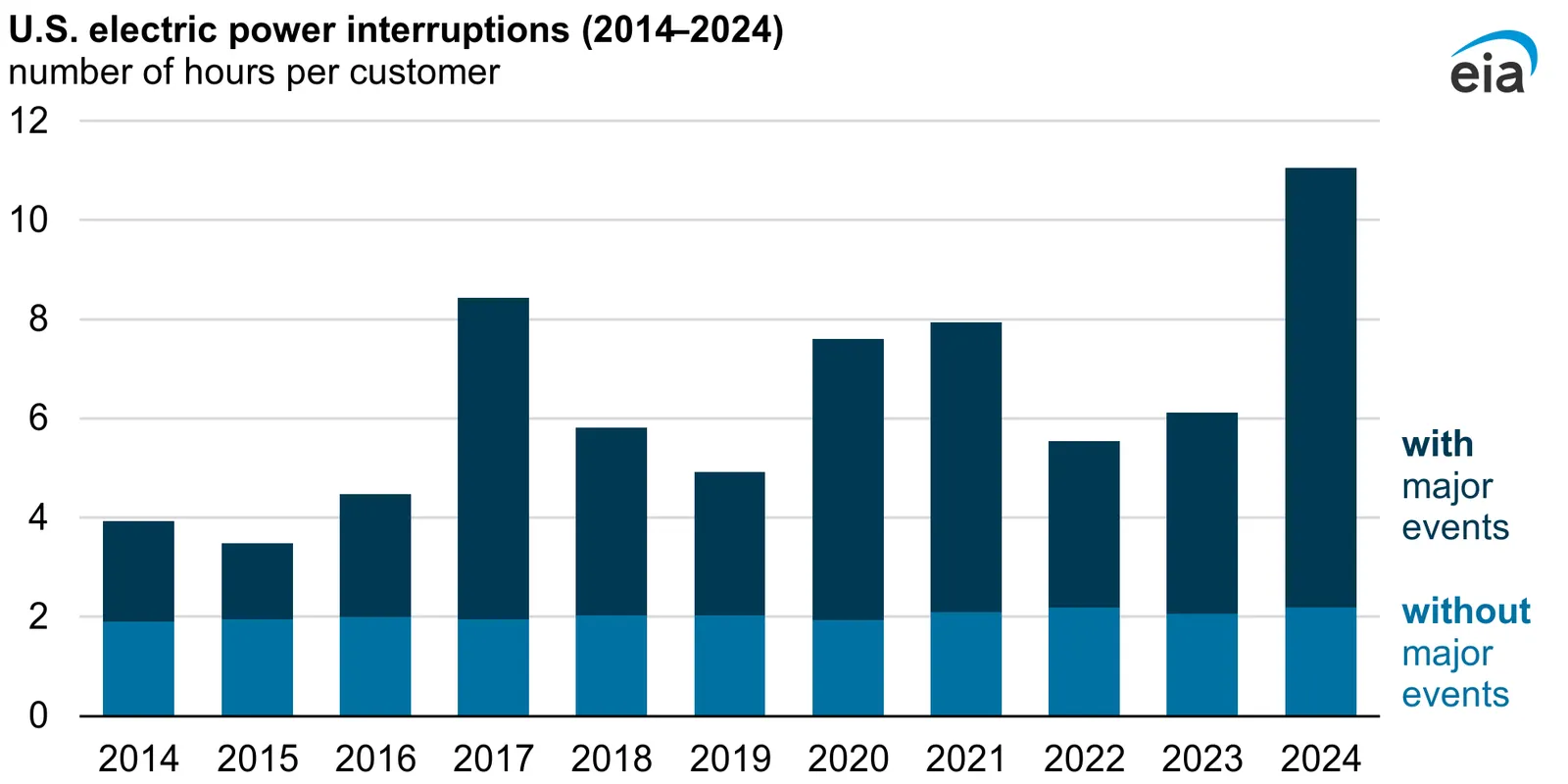
U.S. electricity customers experienced an average of 11 hours of power outages in 2024, nearly twice as many as the annual average across the previous decade, according to a new report from the Energy Information Administration.
Hurricanes accounted for 80% of those lost hours, with most of last year’s outages resulting frommajor weather events like hurricanes Beryl, Helene and Milton, EIA said in the report released Monday.
“Interruptions attributed to major events averaged nearly nine hours in 2024, compared with an average of nearly four hours per year in 2014 through 2023,” EIA said. “Service interruptions that aren’t triggered by major events routinely average about two hours per year.”
Courtesy of Energy Information Administration
Customers in South Carolina were significant outliers in terms of outage duration, the report said, experiencing an average of 53 hours of outages in 2024. Much of this was due to last September’s Hurricane Helene, which left 1.2 million customers in South Carolina without electricity.
The report appears to build on a growing body of evidence that extreme weather is taking a heavier toll on the electric power system in parts of the country. In October, JD Power released a report that found the average length of the longest outages are getting longer and concluded that disasters have become a “fact of life” for many utility customers.
Helene, in particular, caused severe damage to utility systems in the U.S. Southeast and Mid-Atlantic.
Duke Energy said after the hurricane that transmission infrastructure in upstate South Carolina “was severely damaged and, in many cases, destroyed” and would need to be entirely rebuilt.
Three days after the hurricane struck, 900,000 Duke customers remained without power across North Carolina and South Carolina, the utility said. Following hurricanes Helene and Milton, Duke reported needing to replace around 16,000 transformers — more transformers than utilities generally require in an entire year, WoodMac Senior Analyst Ben Boucher said in February.
South Carolina, along with North Carolina and Florida, “dealt with strong winds and flooding from Hurricane Helene that affected transmission and distribution power lines as well as substations leading to prolonged power outages,” EIA said. The following month, Hurricane Milton “left 3.4 million customers in Florida without power,” it added.
“In contrast, customers in states such as Arizona, South Dakota, North Dakota, and Massachusetts experienced, on average, less than two hours of service interruptions in 2024,” EIA said
While Hawaii averaged less than 10 hours of total outages throughout the year, the state saw more frequent interruptions — an average of 4.4 interruptions per customer, compared to the U.S. average of 1.5, “mainly due to adverse weather, volcanic activity, unexpected outages at oil-fired plants, and issues connecting new generating capacity,” EIA said.
Article top image credit: Joe Raedle via Getty Images
Power outages getting longer as extreme weather takes larger toll, report says
The average length of the longest power outage has increased in all regions since 2022, according to JD Power.
By: Meris Lutz• Published Nov. 17, 2025
Power outages across the United States are getting longer, according to a recent survey by JD Power, which cites “increased frequency and severity of extreme weather events.”
The average length of the longest power outage has increased in all regions since 2022, from 8.1 hours to 12.8 by the midpoint of 2025. Customers in the South reported the longest outages, averaging out at 18.2 hours, followed by the West at 12.4 hours, it said.
Mark Spalinger, director of utilities intelligence at J.D. Power, said in an interview that while the duration of outages is increasing, the number of customers experiencing them is not. In fact, over time, the percentage of people who experience “perfect power” without any interruptions is gradually rising. However, disasters like storms and fires “are becoming so much more extreme that it creates these longer outage events that utilities are now having to deal with,” he said.
Based on a survey, 45% of utility customers nationwide experienced a power outage in the first half of 2025, according to JD Power’s U.S. Electric Utility Residential Customer Satisfaction Study, which the company has been doing for over 20 years.
Of those outages, nearly half were due to extreme weather such as a hurricane, snowstorm, tornado or fire, and 17% of customers who were affected by a natural disaster said it was so severe they had to evacuate their homes.
JD Power’s U.S. Electric Utility Residential Customer Satisfaction Study shows power outages getting longer over time.
Permission granted by JD Power
Extreme weather isn’t the only problem, however. Spalinger said the subset of customers who experience outages are also reporting more frequent, shorter blackouts.
Part of that could be the rise of remote and digital work that makes people more sensitive to short outages they may not have noticed when they were working from an office, Spalinger said. But the impact of extreme events that cause longer outages is changing customer behavior, he added.
“Customers are now having to prepare and look for different solutions, whether it’s solar or generators,” he said. “It’s almost two-thirds of the customer base that’s really interested in some backup solution.”
Both the nature of outages and the customer response varies across the country. The South had more electricity loss than any other region. Seventy-seven percent of customers in the South lost power after an extreme weather event, with those outages lasting 95.2 hours on average.
However, the report found that “despite widespread outages, the South leads the nation” for customer satisfaction.
“Strong customer satisfaction scores among utilities in the Southern U.S. are being driven by high marks in safety, reliability, ease of service, trust, and digital experience,” it said. “Overall, more than half (57%) of customers feel their electric utility is the entity most responsible for educating the public on electric safety, and the region had the highest marks of customers receiving information from their utility on how to prepare for the disaster via text message (29%). This suggests that easy, accessible communication can move the needle on customer satisfaction, even in the face of loss of power, property and displacement.”
Schuyler Baehman, a spokesperson for Southern Company, which owns Alabama Power, Georgia Power and Mississippi Power, pointed to a number of initiatives the company has undertaken to support customers during emergencies. Those include text alerts and outage maps that can be accessed online or by phone.
“In terms of disasters, we like to say, ‘When things are at their worst, we are at our best,’” he wrote in an email.
Baehman did not respond to a question about whether JD Power’s data on increasing outages matched that of the company.
Article top image credit: Mario Tama via Getty Images
How utilities are ensuring grid resilience
As the risks from extreme weather events and cyber threats continue to grow, U.S. utilities are investing billions to enhance grid resilience. From the increased deployment of microgrids to under-grounding power lines, the energy sector is deploying a variety of measures to address the growing threats.
included in this trendline
PJM gets emergency approval to curtail data centers, large loads during hot weather
NERC issues Level 3 alert, mandates action to address data center load losses
Extended heat wave could cripple New York’s grid this summer: NYISO
Our Trendlines go deep on the biggest trends. These special reports, produced by our team of award-winning journalists, help business leaders understand how their industries are changing.