A poll from consumer advocacy group PowerLines found broad distrust of elected officials and limited understanding of utilities’ business models. Experts told Utility Dive the disconnect could worsen.
By: Brian Martucci• Published May 21, 2026
More than three-quarters – 76% – of Americans want elected officials to exercise stronger utility oversight, even though they appear to have little faith in those officials’ ability to prevent rising power bills, according to a new poll and report from consumer advocacy group PowerLines.
PowerLines said only 29% of respondents said they trusted their state governments to protect their interests in dealings with utilities, down from 38% in a similar poll last year. Public sentiment is souring as U.S. utilities filed $9.4 billion in rate increase requests impacting 81 million people just in the first quarter of this year, according to PowerLines.
David Springe, executive director of the National Association of State Utility Consumer Advocates, which was not involved in the report, said that utilities and elected officials are in a tough spot, with industry estimates projecting more than $1 trillion in utility spending over the next five years. “The big spending is just getting started and hasn’t hit the utility rate case cycle yet,” he told Utility Dive.
Although the reasons for rising electricity costs vary by region, nationally, much of utility spending is being driven by surging demand for power for artificial intelligence data centers.
“It’s pretty fair to say that large load demand is making everything else we need more expensive,” Springe said, adding that prices for gas turbines and transformers are rising as data center companies compete with utilities for scarce supply.
PowerLines’s polling revealed limited understanding among ratepayers of how utility businesses operate. Fifty-eight percent of respondents said they did not fully understand what drives their monthly bills. Respondents also grossly overestimated the reach of public power entities and drastically underestimated the reach of investor-owned utilities, which PowerLines said serve 72% of U.S. consumers. Another 28% didn’t know what kind of utility services their home.
Where rates are rising and why have been the subject of much study recently, with results showing complex regional factors. The PJM Interconnection's independent market monitor has said data centers drove huge capacity price increases in the country’s largest grid. In California, sharp price increases have been linked to wildfire costs.
The complexity of the problem — that no single factor is responsible for rising rates, and no single solution can bring them down — compounds the challenge for elected officials, regulators and utilities themselves, Springe said.
“There is a limited range of options that politicians have that can quickly change affordability in a meaningful way that a consumer can see … [a]nd it’s very difficult to communicate what any proposed changes may actually mean to a consumer in terms of bill changes,” he said.
Kent Chandler, former chair of the Kentucky Public Service Commission and nonresident senior fellow at the R Street Institute, a center-right think tank, said “inflation fatigue” can lead ratepayers to “feel” their bills are going up even when they aren’t. One 2025 study from the Lawrence Berkeley National Laboratory found that overall retail electricity prices fell in 31 states from 2019 to 2024 when adjusting for inflation.
Still, “as long as overall inflation occurs, utility rates are going to be in the news” unless utilities voluntarily pause hikes, Chandler told Utility Dive in an email.
PowerLines’ poll was conducted by Ipsos KnowledgePanel and surveyed 2,045 American adults and 1,912 electric ratepayers. It found that 68% of respondents’ gas or electric bills increased over the past year, 77% expect the increases to continue and 80% feel “powerless” about it, the group said.
PowerLines’s analysis of requested utility bill increases divided the United States into four broad regions.
Utilities in the South region, stretching from Delaware to Texas, made $2.7 billion in rate increase requests affecting 17.3 million customers — the highest per capita impact of any region. At $4.4 billion in increase requests affecting 44.3 million customers, the West region had the highest cumulative bill impact.
Within the South, the $912 million incremental rate request in Georgia was the highest requested increase in absolute terms of any state by far, according to the report.
Oklahoma came in second in the South region with $597 million in incremental requests, followed by South Carolina with $436 million, according to the report. Ratepayers in those less populous states would see greater individual bill impacts than those in Georgia if regulators approve the requests.
The Southern Alliance for Clean Energy, another utility watchdog, said in a report earlier this year that large utilities in Georgia, Alabama, Florida, Mississippi and other southeastern states underinvest in energy efficiency programs despite ample “low-hanging fruit” like home weatherization incentives.
Sour public sentiment around utility rates and regulation extends well beyond the southern U.S., PowerLines found. Only 16% of poll respondents across all regions said their utility puts customers’ interests ahead of its own, while 29% cited “a lack of transparency around costs” as the top concern with their utility.
The poll findings may not be news to utility leaders.
S&P Global, a market intelligence firm, said in a March report that mentions of “affordability” on investor-owned electric utilities’ earnings calls have increased 10-fold over the past five years. The same report called electricity affordability “a major obstacle to electrification, digital infrastructure growth and the broader energy transition.”
Chandler said utilities’ and public officials’ present predicament is a modern example of the timeworn political cliche: “If you’re explaining, you’re losing.”
“Trying to explain what [the PJM Interconnection] is, why its prices went up, how that affects retail prices, why rates would have gone absent intervention, etc. are all cold comfort for customers who feel their bills are going up,” Chandler said.
Chandler’s unsolicited advice to utilities: Talk less and do more.
“Utilities would be well-served to publicly show how they're efficiently or cost-effectively serving system needs, rather than just saying they are, including [by] conducting and making public analyses on least-cost solutions to pressing and prioritized needs,” he said. “Customers aren’t asking for hollow public relations jargon, they’re looking for confidence that utilities are good stewards of their money.”
Article top image credit: Justin Sullivan via Getty Images
Data centers are ready to negotiate flexibility for speed
Hyperscalers want their data centers online and utilities want to provide interconnections, but experts say both are still looking for common operating guidelines.
By: Herman K. Trabish• Published June 26, 2026
With the U.S. facing an electricity affordability crisis and demand rising quickly for the first time in decades, experts say the Federal Energy Regulatory Commission’s June 18 order to system operators to provide transmission for flexible large loadsunderscores the urgent need to implement data center load flexibility.
Just a 1% to 2% reduction in data center peak demand can reduce electricity rates 0.5% to 2.8% and protect reliability, according to a 2026 Duke University Nicholas Institute study. And pilots and analysis led by the Electric Power Research Institute, or EPRI, show how flexibility is within reach that can also get data centers interconnected faster.
Electricity demand by artificial intelligence, or AI, data centers is driving a global urgency, Nat Bullard, chief strategy officer of research group Halcyon, reported in May. From Q1 2025 to Q1 2026, Amazon Web Services’ cloud business grew 28%, Microsoft Azure grew 40% and Google Cloud revenues increased 63%, he reported.
“Growth rates this high in already-mature businesses mean total revenue doubles in two years (or less),” Bullard wrote. “That revenue can only be serviced with compute, and that compute can only serve when energized.”
Experts told Utility Dive that public opposition to data centers, focused on local electricity costs, can be addressed by flexibility. Data center flexibility can reduce electricity demand, which reduces the costs to ratepayers of investments to protect reliability, the North American Electric Reliability Corp. acknowledged in its 2026 large load risk mitigation guidelines.
Flexibility can get a data center interconnected faster, make it a benefit to system reliability and increase system utilization which lowers rates, utilities, researchers and analysts agree. The challenge remaining is to resolve control issues between risk-averse utilities and impatient data center operators, they also agree.
The flexibility framework
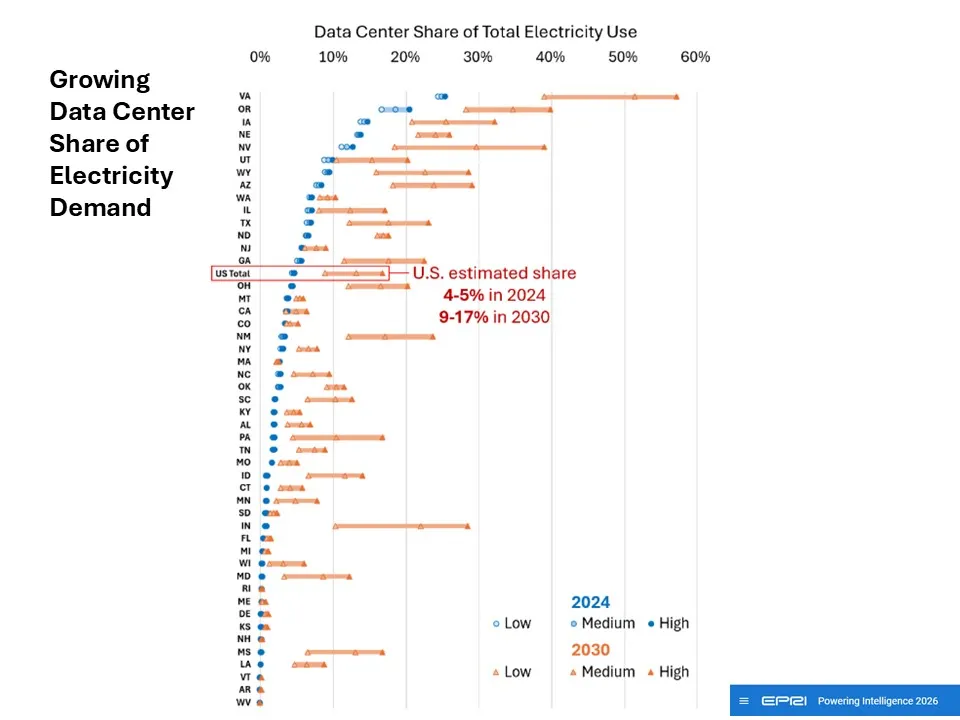
Power demand from U.S. data centers will reach 66 GW in 2027, up from 31 GW in 2025, with summer peaks growing to 8.5% in 2027 from 4.1% in 2025, Goldman Sachs reported May 20. Though AI proliferation is uncertain and growth will vary widely by state, data centers could consume as much as 17% of U.S. electricity usage by 2030, EPRI found.
Flexibility adds “headroom” to a power system by allowing system operators to add large loads and maintain reliability while minimizing rate raising infrastructure investments, EPRI’s FlexMosaic framework concluded. That is why data centers willing to be flexible can also maximize their “speed to power,” the institute’s analysis found.
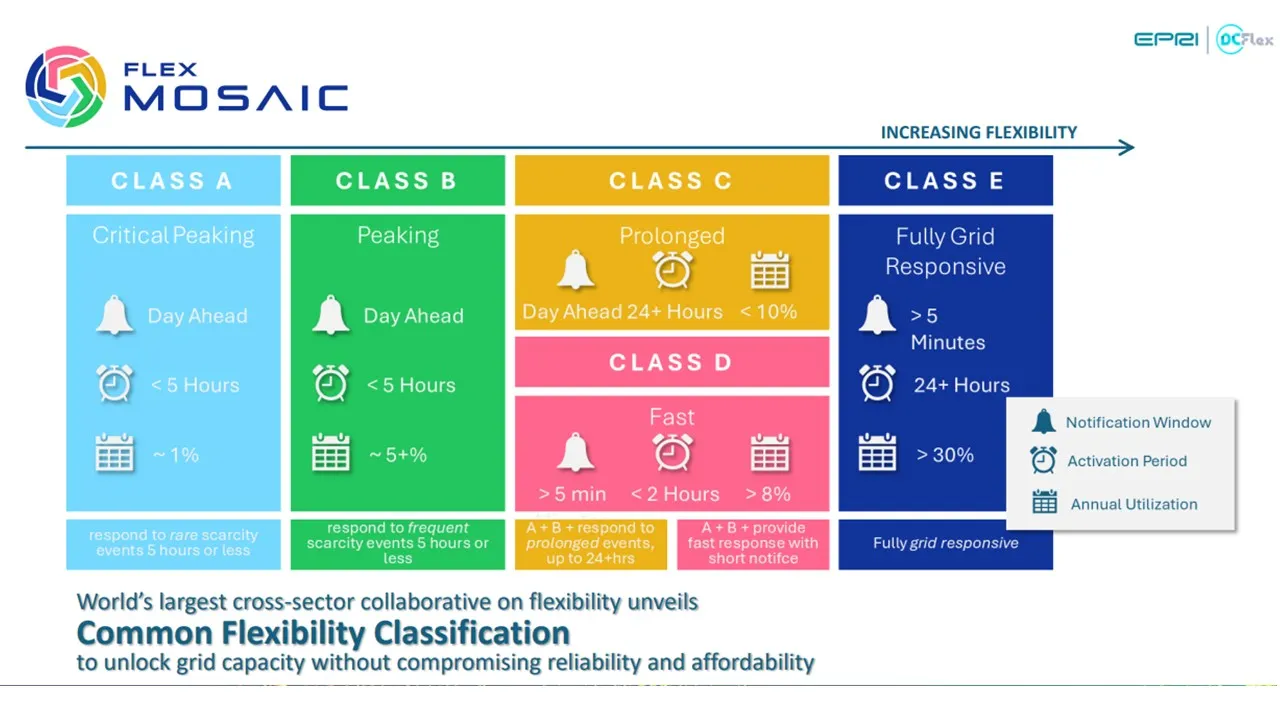
There are five flexibility “classes,” according to EPRI. Class A supports power systems during “infrequent extreme stresses” and Class B manages “daily or weekly” demand peaks. Class C meets long-lasting energy shortages, Class D protects in sudden supply or demand swings and Class E provides frequency stabilizing.
Key determinants of the flexibility class of a data center are the notification time it needs, the duration and frequency of its response, and the depth and quickness of its flexibility, FlexMosaic said.
FlexMosaic’s objective is to align incentives of data centers and utilities by linking faster and bigger data center interconnections with contractual agreements that protect utilities. Data centers with class D and E flexibilities that mitigate the local thermal overloads or voltage drops “unlock” the most system value, EPRI added.
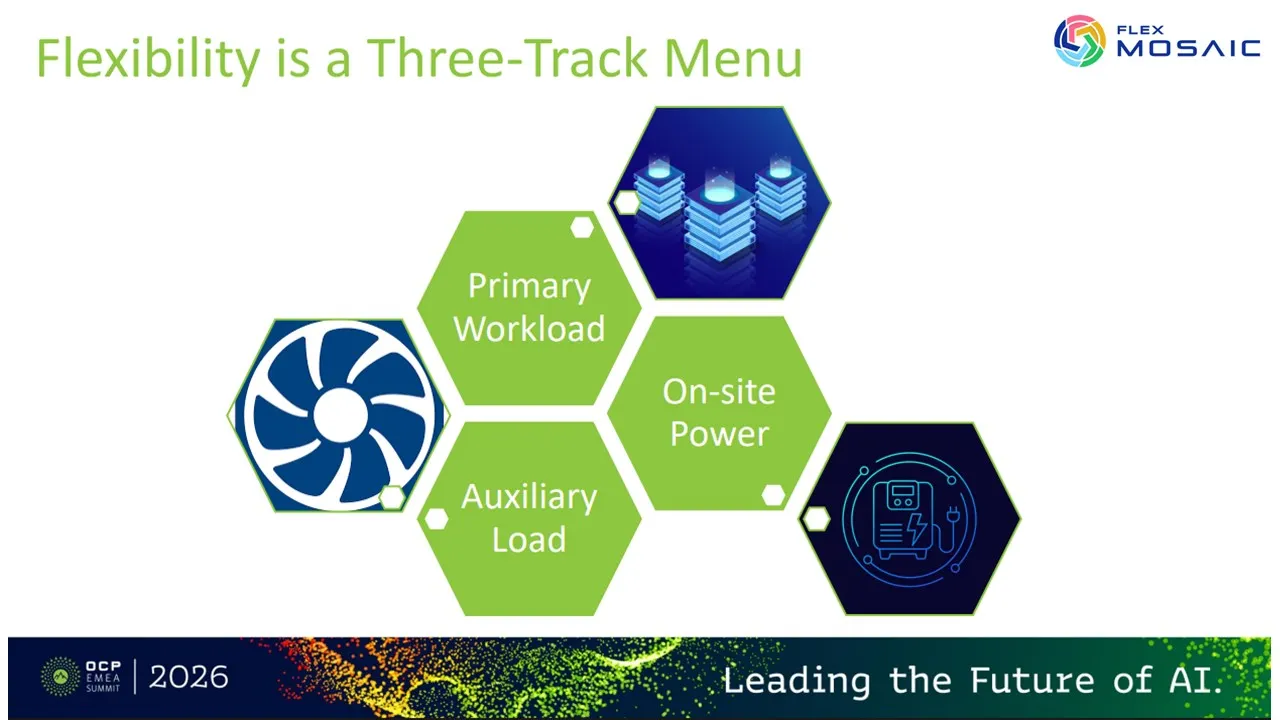
To be flexible, data centers can combine three flexibility pillars — managed workloads, reduced AI plant energy consumption and back-up power, said Anuja Ratnayake, the emerging technologies executive leading EPRI’s DCFlex Initiative. FlexMosaic’s aim is to standardize data center designs and utility programs that include flexibility, she added.
EPRI’s work contradicts the assertion that data centers cannot be flexible, said Ann Rendahl, president of the National Association of Regulatory Utility Commissioners and a Washington state utilities commissioner.
The findings from EPRI’s pilots and analysis will allow state regulators to require data centers to take the potential for flexibility seriously, Rendahl added.
Permission granted by EPRI
The flexibility breakthrough
Using onsite or stored power during system emergencies and reducing building electricity use at operator requests is not new for data centers and other large loads. But FlexMosaic’s third pillar, data center workload flexibility, is a new opportunity to protect reliability and affordability that is now within reach.
Today’s AI data centers can “be designed with flexibility as a core operational principle,” Boston University researchers reported in June. Training and inference workloads “can offer between 18% and 55% flexibility relative to their average power consumption” and still meet quality of service requirements, modeling found.
Emerald AI “operates as an orchestration and optimization layer between utilities and data centers” and “does not directly control utility or data center operations,” Emerald AI head of product Mansi Shah said. “Utilities retain full dispatch authority,” she added.
Emerald AI “enables utilities to issue curtailment or flexibility requests to participating data centers through a secure software interface,” Shah continued. The platform “translates grid requirements into operationally feasible dispatch targets and provides telemetry, verification, and event compliance reporting back to the utility operator,” she said.
In short, Emerald AI coordinates “approved flexibility actions,” Shah said. The actions address “compute, cooling, energy storage, backup generation, and power infrastructure,” but always respect “predefined operational guardrails,” she added.
Every utility-data center interaction “is governed by operational parameters agreed upon by both parties in advance,” Shah said.
The utility defines the parameters of an event requiring flexibility, including “maximum magnitude, minimum notice period, frequency limits, and event duration,” Shah continued. But data centers set the “hard floors that protect critical workloads and infrastructure under all circumstances,” she said.
These terms give utilities “confidence that contracted flexibility will perform reliably,” and assure data centers “that operational and [technical] boundaries will never be violated,” Shah added.
EPRI’s demonstrations have delivered flexibility of up to 40%, but future AI infrastructure with designed-in flexibility can “materially” expand that, Shah said.
EPRI, NVIDIA and utility demonstrations with Emerald AI software have shown that training workloads “can be paused or slowed,” and inference queries “could be redirected” to a data center on a less stressed system, NVIDIA said in a July 2025 blog post.
A UK test showed Emerald AI software using NVIDIA hardware could reduce an AI load over a third in under a minute while protecting critical compute.
Emerald AI sent Portland General Electric’s signals to an Oregon data center and reduced power 20% in simulated weather emergency scenarios, Emerald AI reported in March.
Emerald AI has now proven “temporal flexibility” by “slowing or pausing AI workloads” with “customer-designated flexibility on completion time,” the company reported in March. It has also proven “spatial flexibility” by “seamlessly rerouting latency-sensitive loads” from a power-constrained data center “halfway across the country” to where power is available, it added.
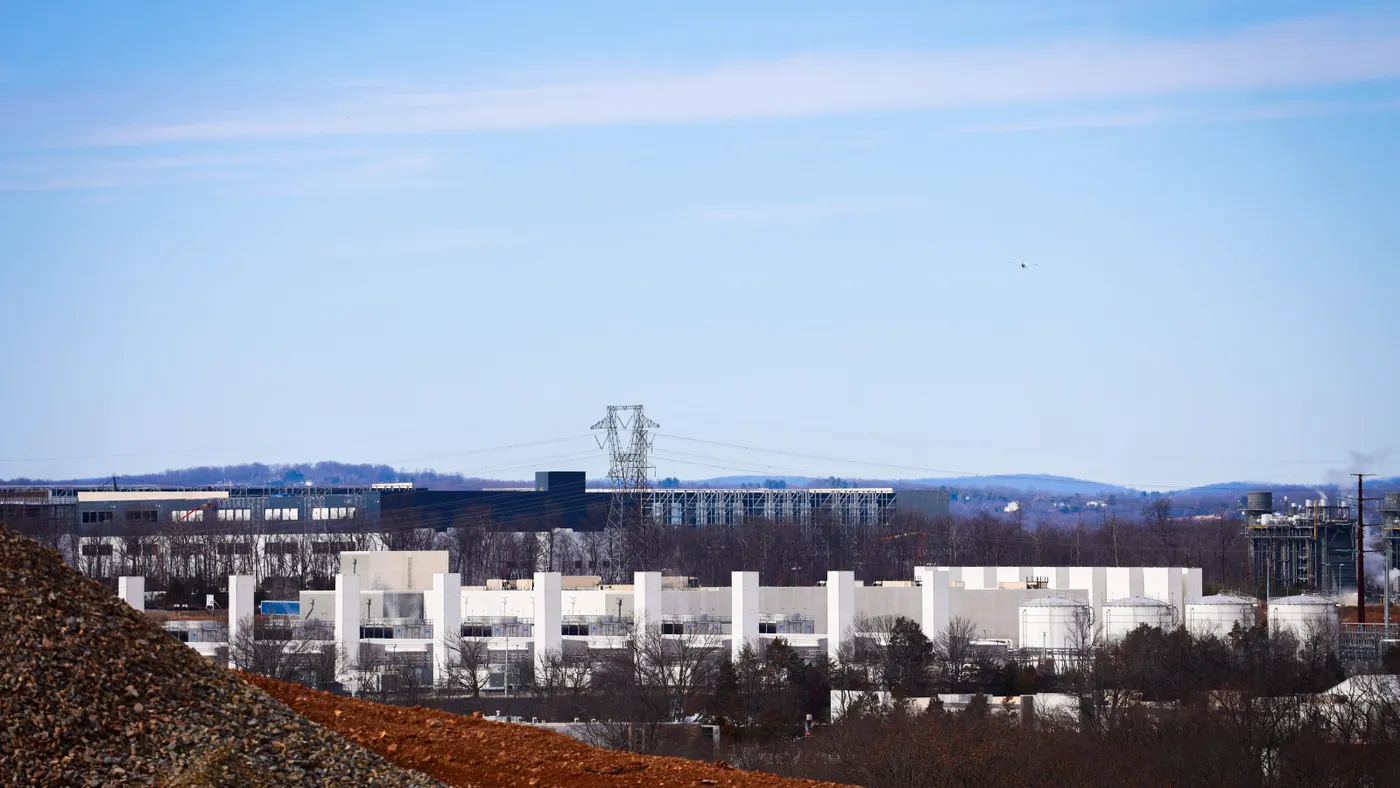
In late 2026, EPRI, NVIDIA, Emerald AI and their partners plan to bring the 96-MW Aurora AI Factory online in Manassas, Virginia. It will validate workload flexibility at scale in a data center “designed for flexibility,” EPRI’s Ratnayake said.
Permission granted by EPRI
The needed agreement
The missing piece in EPRI's DCFlex plans is a standardized binding agreement between utilities and data centers, stakeholders said.
A key parameter of that agreement will be explored in the next EPRI-led pilot. Emerald AI will flex an NVIDIA data center served by Silicon Valley Power, or SVP, which serves 58 data centers in its 20 square mile territory, Chris Karwick, its chief operating officer, said.
For phase one of the pilot, Emerald AI is developing “a bidirectional communication platform with the data center,” Karwick said. SVP “will see the NVIDIA data center load in real time, send a signal to reduce the load in response to simulated events like a forecasted heat wave or a sudden lightening strike, and see the load reduced,” he added.
SVP must also have “the safety net of 100% control of the loadside breaker if the data center wants to have the faster interconnection and additional capacity,” Karwick said. “That is non-negotiable,” and would be part of the interconnection agreement SVP makes with the data center, Karwick said.
The Portland General Electric, or PGE, large load study process already identifies each new data center’s flexibility capabilities, said Isaac Barrow, the utility’s senior manager of data centers and growth. But traditional bill credit incentives are too small to guarantee AI data centers will reduce their lucrative workloads when the utility sends a signal through Emerald AI, he added.
An interconnection agreement offering the right incentive structure will, however, “unlock the next wave of flexibility technologies,” Barrow said. For PGE, an agreement providing accelerated interconnection for a data center must guarantee “visibility” and “dispatchability” of the data center’s load, he added.
New utility regulations could simplify the agreement process by requiring data centers to have flexibility capabilities, said Joe Reele, vice president, solution architects, for energy technology company Schneider Electric. But regulations could require consent to a single digital platform by the power and data center ecosystems, he acknowledged.
With 50 state regulatory jurisdictions and many other local jurisdictions, “it is not an easy solution” with so many proprietary software platforms in use, Reele said.
Optional Caption
Permission granted by EPRI
Will they agree?
The value of a definitive flexibility agreement between data centers and utilities is clear.
“Power availability has become the gating issue for AI,” said Mona Dajani, c-chair of multinational law firm Cooley’s infrastructure, energy and real estate group. In constrained power markets, projects that have “credible, measurable, and contractually defined flexibility may increasingly receive more favorable treatment,” she added.
But the “pain point” remains utilities’ need for control and data centers’ need to choose how to respond to a utility signal for a load reduction, said EPRI’s Ratnayake.
A control mechanism like the one SVP’s Karwick described “is a really hard concept for data centers to embrace because they lose control,” Ratnayake said. Data centers need a more gradual load reduction because their highly sensitive hardware would be at risk and it is probably worth much more than many power system assets, she added.
Utilities need control because their experience with demand response programs shows they cannot always depend on voluntarily load reductions, Ratnayake continued. And “if a GW scale data center goes offline instantaneously it would create a whole host of other system issues,” she said.
Ultimately, the data center and the utility need a program structure defined in a contractual interconnection agreement, Ratnayake said.
The April memorandum of understanding between EPRI and the Open Compute Project Foundation, or OCP, is a major step toward that agreement and those protocols, Ratnayake said. It creates a channel for EPRI utility members and OCP’s tech community to collaborate on standards and protocols that work for both, she added.
Validating technologies, regulatory structures and market certainty will take time, but “it will unlock the power needed to keep pace with needs of AI,” Ratnayake said
Meanwhile, “the reality today is if you want grid power at scale, you cannot have 100% of the hours,” said James Kacergis, senior vice president of corporate and business development for Terawulf, which is building the 750-MW Mariner Lake AI data center for anchor tenants Core42 and Google-backed Fluidstack.
“A hyperscaler’s primary incentive is getting the interconnection to scale the business, and if it is not willing to work with the utility or system operator, a competitor will,” Kacergis said. But “it is not yet clear what the amount of load reduction and duration is that will attract data center customers because it's an emerging market,” he added.
Data centers are capable of slowing, capping or shifting workloads, “but it's questionable whether they want to do it,” added Steven Carlini, chief advocate of AI and data centers for Schneider Electric. If, though, the choice is “having 80% of the data center working or none of it, they would take 80%,” he added.
“Data centers want power as soon as possible and they want that power to be reliable, and utilities want to bring them online as quickly as possible and protect reliability,” said NARUC’s Rendahl. “Flexibility is a way to do what both want.”
Article top image credit: Mario Tama / Staff via Getty Images
‘Clear warning signs’ as PJM wholesale power costs jump 54% in one year
Also, PJM’s last two base capacity auctions show a growing shortfall compared to its reserve margin targets, according to the grid operator’s market monitor.
By: Ethan Howland• Published March 13, 2026
There are “clear warning signs” for the PJM Interconnection’s capacity market and for grid reliability in its footprint largely driven by data center development, the grid operator’s independent market monitor said Thursday.
On the reliability front, PJM’s last two base capacity auctions show a growing shortfall compared to its reserve margin targets. The gap was about 210 MW in the 2026/2027 auction, rising to about 6,520MW in the 2027/2028 auction, Monitoring Analytics noted in its annual report on PJM’s markets.
At the same time, the price impacts have been large and will continue to grow “until the issues associated with the additions of large data center loads are addressed,” it said.
Last year, wholesale power in PJM cost $67 billion, up 54% from $43.5 billion in 2024, according to the report.
Energy costs, which accounted for 60% of total costs in 2025, were up 51% year over year. Capacity costs increased the most over that period — 262% — and accounted for about 16% of total costs last year, compared to 6.5% in 2024. Transmission costs were up 4.5% and accounted for 22% of total costs in 2025.
Capacity costs surged in 2025
Key components of PJM wholesale power cost, with percent increase from 2024.
In PJM’s lastthree capacity auctions, inclusion of existing and forecast data center load growth resulted in a combined total increase in system costs (revenue to suppliers) of $23.1 billion, Monitoring Analytics estimated.
“Large data center load additions have already had a significant and irreversible impact that will be paid through May of 2028 and will have additional significant impacts on other customers as a result of higher transmission costs, higher energy market prices and higher capacity market prices,” the market monitor said.
PJM doesn’t have enough capacity to serve data centers, according to Monitoring Analytics.
As a result, to avoid “wealth transfer issues,” data centers should be required to provide their own new power supplies — with a fast-track load and generation interconnection process — or face curtailment when the grid is stressed, the market monitor said.
“It is essential to have a pragmatic market solution that is consistent with and sustains efficient and competitive PJM markets rather than to create the conditions for a return to cost of service regulation or a variant of cost of service regulation,” Monitoring Analytics said.
“PJM is grateful for the sheer volume of analysis that the [independent market monitor] has devoted to this critical subject area,” Jeffrey Shields, PJM spokesman, said in an email.
The issues raised in the market monitor’s report are under discussion through PJM’s stakeholder process — which includes the market monitor — and are expected to result in “one or more” proposals for approval by the Federal Energy Regulatory Commission in the coming months, he said.
Monitoring Analytics called for holding a separate capacity auction just for data centers and excluding those loads from its regular base capacity auction. Under the proposal, only new generation could offer in the special data center auction. Once the auction is completed, data centers would enter into long-term contracts with the power plant owners.
Monitoring Analytics sought to distinguish its proposal from others that have been floated in PJM’s stakeholder process.
“Contrary to all the other proposals for addressing the issues, including the other backstop auction proposals, the [market monitor] proposal is designed to ensure that data centers do not shift costs and risks to other customers,” Monitoring Analytics said.
For example, allowing utilities to build generation for data centers under cost of service regulation shifts costs and risks to other utility customers, the market monitor said.
Despite the monitor’s concerns, it said PJM’s markets simply need finetuning.
“The assertion that yet another ‘holistic review’ of PJM markets is required or is a panacea is, for many, merely a euphemism for raising prices,” Monitoring Analytics said. “The core elements of the PJM market design remain robust.”
Article top image credit: Diana DiGangi/Utility Dive
Renewables remain cheapest, but their LCOE is rising: Lazard
Utility-scale solar’s levelized cost of electricity ranges between $40/MWh and $98/MWh, while combined cycle gas ranges between $51/MWh and $129/MWh, said a report from Lazard.
The forces driving a rise in LCOE for all types of generation include “higher capital costs, sustained interest rates, tariff pass-through and supply chain repricing,” Lazard said.
The report’s analysis shows a widening in LCOE range for onshore wind and utility-scale solar, “with high-end costs rising faster than low-end costs — likely reflecting that some project developers have been better able to mitigate broader cost pressures across supply chain and project-level economics than others,” it said.
However, wind and solar LCOEs remain below conventional new-build alternatives, Lazard said. This is in spite of the One Big Beautiful Bill Act creating an earlier phaseout deadline for wind and solar projects to qualify for the 48E investment tax credit and 45Y production tax credit.
LCOE is an estimate of the cost of energy from a generating resource over the life of the facility based on factors such as capital costs, fuel costs, and debt and equity costs.
On a per-MWh basis, the report found that utility-scale solar’s LCOE ranges between $40 and $98, while onshore wind ranges between $37 and $99, and offshore wind is between $105 and $167, according to the report. Lazard estimated that the production tax credit could bring the low end of the LCOE range for utility-scale solar to as low as $16/MWh, and offshore wind’s low end to $77/MWh.
Peaking gas-fired generation has an LCOE between $144/MWh and $276/MWh, while combined cycle gas is between $51/MWh and $129/MWh, and nuclear ranges between $175/MWh and $255/MWh.
However, “continuous upward revisions to demand projections have driven a sharp increase in announced new-build gas generation despite a 15-year high LCOE and historically long development lead times,” the report said.
Lazard noted that the cost structure is different across generation types, with renewable energy being predominantly capital cost-driven “while conventional technologies carry higher fuel and variable cost components — a dynamic that drives technology-specific economics across use cases and reinforces the need for a diverse generation fleet.”
On top of other factors, the LCOE for natural gas generation is rising due to the technology’s sensitivity to fuel prices, which have increased year-over-year, as well as high demand driving down supply and driving up prices for gas turbines, the cost of which is projected to rise to $600/kW by the end of 2027, a 195% increase since 2019, according to Wood Mackenzie.
Generally, new build generation has a higher LCOE than existing generation, Lazard said. “The marginal cost of existing renewable generation is near-zero; this gap between marginal cost and new-build LCOE underscores the near-term economic case for optimizing existing generation while new-build costs across all technologies face sustained pressure,” the report said.
Lazard found the levelized cost of storage, or LCOS, showed an increase in cost for utility-scale standalone storage, “reversing last year’s declines,” and noted that “the materialization of tariffs on lithium-ion battery imports has curtailed access to the low-cost Chinese cell supply that previously helped drive costs lower.”
“While the One Big Beautiful Bill Act preserved the storage ITC through 2033, new Foreign Entity of Concern restrictions have accelerated supply chain diversification toward Southeast Asian manufacturing capacity and domestic suppliers,” the report said.
Article top image credit: Mario Tama via Getty Images
Not-for-profit utilities turn to energy storage as data centers drive cost, reliability concerns
Reliability, power price hedging and avoided infrastructure investment are among the top reasons for the battery push, NRECA said.
By: Brian Martucci• Published June 9, 2026
Meeker Energy, a member-owned electric cooperative serving about 10,000 homes and businesses in central Minnesota, is typical of many non-profit utilities across the country. While investor-owned giants tout the profit potential of large-load pipelines in the gigawatts, distribution coops like Meeker are watching the wholesale cost of electricity rise, with little they can do to mitigate it except controlling for their own consumption. That expense accounts for the largest part of members’ bills.
That’s where storage comes in. The utility is in the early stages of testing behind-the-meter residential batteries at members’ homes for resilience and demand response.
Steve Kosbab, Meeker’s energy services manager, said 60% of its members participate in at least one of its load management programs, which already helps Meeker reduce wholesale power demand charges.
“We’re at a level of demand response where we can only shed so much … so we’re looking at how we can enhance demand response programs that are very mature and very successful,” Kosbab told Utility Dive.
Kosbab said Meeker considered incentives for its rural and exurban customer base to add standby generators that run on propane or natural gas, but “a person could get upside down on the fuel costs versus the electric savings” with such equipment. Partial- and whole-home batteries seemed to make more economic sense, he said.
Storage is on the rise across the power sector and on both sides of the meter. As the technology evolves, prices have fallen and capacity has gone up. At the same time, generator retirements and rising demand have caused the grid’s reliability watchdog to warn of potential electricity shortfalls, leading everyone – from residents to hyperscalers to utilities – to invest in storage as a backup in case of a blackout or curtailment, as well as a hedge against price spikes.
Last summer, rural electric cooperatives had 439 MW/1,047 MWh of operating battery energy storage projects, according to the National Rural Electric Cooperative Association.
Those numbers do not necessarily include every behind-the-meter battery in cooperatives’ service territories. They also represent a tiny fraction of the 28 GW/57 GWh of energy storage that Benchmark Mineral Intelligence says connected to the U.S. grid in 2025.
But a lot more could come online soon: NRECA is tracking dozens of smaller-scale projects in development that it says could more than triple rural cooperatives’ energy storage capacity by 2028.
Many of the projects pursued by non-profit utilities will connect to the distribution networks they manage. And a significant amount of the planned capacity will be behind individual members’ electric meters.
In the Electric Reliability Council of Texas territory, the distributed approach is more cost-effective than deploying grid-scale storage, general manager Darren Schauer told Utility Dive.
NRECA says initiatives like these will help shave costly demand peaks, firm intermittent generation, boost resilience and defer infrastructure upgrades. Some energy storage projects will hook up to transmission grids managed by regional cooperatives.
Beth Soholt, executive director of the Clean Grid Alliance, which focuses on the Midcontinent Independent System Operator region where Meeker is located, said cooperatives are eager to adopt new technologies when it’s in their members’ interest, and may not need the “carrots and sticks” state policymakers and regulators use to push investor-owned utilities to innovate.
“Cooperatives really can be innovative,” Soholt told Utility Dive in an interview. “I’ve been impressed over the years how they’re able to pick up on new things and just do them.”
Peak shaving and profit models
In addition to deploying batteries with colocated renewables and encouraging members to use their own energy storage, some cooperatives are also leaning into storage on the distribution system for reliability and economic reasons.
Earlier this year, Blue Ridge Power Agency, a Virginia power wholesaler for municipal and cooperative electric utilities, announced plans to deploy about 25 MW of distribution-connected energy storage at five sites owned by three member utilities. The batteries will charge during periods of low demand and discharge during periods of high demand, providing a source of peak power capacity amid sharply rising load growth in Virginia and the broader PJM Interconnection, BRPA said.
The Electric Power Board of Chattanooga, Tennessee, has 45 MW/95 MWh of front-of-the-meter energy storage in service now and plans to double that capacity over the next 12 months, Ryan Keel, its president of energy and communications, told Utility Dive earlier this year.
One of the new deployments will be a four-hour system anchoring a microgrid in a mountainous area outside central Chattanooga that has a tenuous connection to the main grid and is prone to outages.
But the utility uses most of its existing and planned battery capacity to shave demand peaks. It buys wholesale power from the Tennessee Valley Authority, whose monthly demand charges can account for one-third of EPB’s total power purchase costs, Keel said.
TVA bases each month’s charge on the hour of highest demand, “so whenever that hour occurs, we have a financial incentive to reduce that peak with energy storage and other measures,” Keel said.
That incentive is especially pressing for not-for-profit utilities that — unlike investor-owned utilities — do not earn a regulated rate of return on capital investments, many cooperative and municipal utility leaders say.
The debate over how that profit model influences storage programs was on full display in Minnesota, where regulators recently approved investor-owned Xcel Energy’s Capacity*Connect pilot, a novel type of virtual power plant that will see up to 200 MW of utility-owned distribution-connected storage deployed by 2028.
Representatives from a coalition of nonprofits opposed the utility-owned framework, as opposed to one allowing third parties to aggregate customer-owned resources. They claimed Capacity*Connect would shift financial risk to captive ratepayers and deliver significantly less value than a superficially similar virtual power plant Xcel plans to deploy in Colorado with participation from customer-owned assets.
Xcel spokesperson Kevin Coss told Utility Dive that cost-benefit analysis “is one tool out of many” that the company uses to evaluate potential programs — one that is “inherently limited because it does not consider qualitative benefits or as-yet-unknown potential value,” he added.
Coss said Xcel “expects to measure and evaluate the ongoing costs and benefits of the program” and report them in both quarterly filings and “interim program assessment” to be released by August 2028.
Xcel has said Capacity*Connect will complement its growing renewable generation portfolio and preserve dispatchable capacity as it retires thermal assets in Minnesota. Even if its approach to distributed energy storage differs from some cooperatives’, Soholt said the program and hundreds of megawatts of more traditional utility-scale projects in MISO’s northern zones will produce valuable lessons for the region’s not-for-profit utilities.
Energy storage is particularly appealing for non-profit utilities serving communities in remote or isolated communities with limited transmission.
In rural Alaska, Homer Electric Association installed a 46.5 MW/93 MWh BESS in 2022 to boost reliability in a remote coastal area served by a single 115-kV transmission line. An outage on that line can cost the association upwards of $20,000 per day in added fuel costs, HEA executives said at the time. In 2024, HEA got a $100 million U.S. Department of Agriculture loan to add another 45 MW/180 MWh BESS nearby.
Several hundred miles north, near Fairbanks, the Golden Valley Electric Association will use its own $100 million USDA loan for two cold-hardened 46 MW/92 MWh BESS units that it says will boost reliability, reduce fuel costs and provide spinning reserve service.
In March, the Hawai’i Public Utilities Commission approved a 43 MW/172 MWh solar-plus-storage project that will cover nearly 20% of Kaua‘i Island Utility Cooperative’s load. KIUC says the project will significantly reduce its fuel costs, saving the cooperative and its members an estimated $365 million over 25 years — up to $21 per month for the average residential customer.
In North Carolina, Tideland EMC operates a nearly 10-year-old microgrid that pairs a 3-MW diesel generator with a 1-MWh battery and a small solar array to back up storm-prone Ocracoke Island’s mainland grid connection.
And Nevada’s Valley Electric Association plans to add two BESS arrays to its sparsely populated territory northwest of Las Vegas: a 35-MW bulk installation that will help mitigate power costs and integrate renewable energy, and a 2-MW solar-plus-storage facility in a remote valley community whose sole grid connection is vulnerable to wildfire-related public safety power shutoffs.
Energy storage also offers clear value for not-for-profit utilities in more populous areas with robust transmission connections, including for the entities that own the transmission assets themselves.
Larger distribution cooperatives also see the value in bigger energy storage installations that provide critical capacity and help avoid potentially costly system upgrades.
Connexus Energy, which has about 150,000 members across east-central Minnesota, built the state’s first megawatt-scale grid batteries in 2018. Those early systems, totaling 15 MW/30 MWh of storage capacity, initially charged off colocated solar but now draw from the grid as well, Tessa Haagenson, Connexus vice president of power supply, told Utility Dive.
So does a 2.5 MW/10 MWh standalone battery installed in 2025 at a substation in a congested part of Connexus’s grid. The system boosts reliability in the area without requiring a larger transformer, saving members money and avoiding a disruptive upgrade process, Connexus says.
And because it’s registered with MISO as a capacity asset, the battery system “can capture additional wholesale market value streams through accredited capacity and strategic dispatch during high price periods,” Haagenson said.