Rising demand, new technologies, natural disasters and a shifting generation mix are converging to pose the greatest challenge to grid reliability in decades.
A 2025 report from the U.S. Department of Energy said load growth and plant retirements could make blackouts 100 times more likely by 2030. Some grid operators are already warning of dangerously thin reserve margins as they struggle to speed the interconnection of new generation. Tensions have emerged between those who want to delay the retirement of fossil fuel plants and those who see the path to reliability through more renewables, storage and grid modernization.
Others say the risks to reliability are a result of outdated planning models designed to meet a few peak events each year while the grid is largely underutilized most of the time. Investment in transmission and distribution, and the aggregation of distributed energy resources, have the potential to flatten peaks, improve reliability and delay certain system upgrades, they say.
The stories below explore advances in policy and technology to address reliability, as well as the reliability risks the U.S. power system is facing.
Extended heat wave could cripple New York’s grid this summer: NYISO
Electric reliability margins will be “the lowest ... in recent history” at just 417 MW available under baseline summer conditions, the New York Independent System Operator said Friday.
By: Robert Walton• Published April 28, 2026
Electric reliability margins this summer in New York will be “the lowest ... in recent history,” with extreme weather and an aging generation mix contributing to a risk of blackouts, the New York Independent System Operator said Friday.
“Coordination with generation owners, utility companies, neighboring grid operators, and government officials will be essential as we work to maintain grid reliability this summer,” Aaron Markham, ISO vice president of operations, said in a statement.
The ISO’s annual summer reliability assessment estimates 34,615 MW of power resources will be available this year to meet forecasted peak demand of 31,578 MW. The ISO said it is required to maintain 2,620 MW from the available resources in reserve, leaving a reliability margin of 417 MW under baseline summer conditions.
New York’s reliability margin has declined almost 80% since 2022, when it was 1,918 MW.
“This assessment reflects the challenges of the grid in transition — declining reliability margins, performance issues with aging generators, and an absence of new dispatchable resources,” Markham said.
In the event of a three-day or longer heat wave with average daily temperatures of 95 degrees, and absent emergency operating actions, NYISO said its capacity margin is forecasted to be -1,679 MW. If the average daily temperature reaches 98 degrees, the margin declines further to -3,370 MW.
The ISO can take emergency actions, including purchasing energy, calling for voluntary industrial curtailment and allowing a reduction in operating reserves, to produce 3,166 MW of additional headroom on the system, it said.
The ISO’s all-time peak demand record of 33,956 MW was set in July 2013.
The thin reliability margins build on previous warnings from the New York ISO. In November, the grid operator published its 2025 to 2034 Comprehensive Reliability Plan, which concluded that the state’s power system is at an “inflection point” as it deals with an aging generation fleet and increasing difficulty in deploying dispatchable resources amid rapid load growth.
New York may need several thousand megawatts of new dispatchable generation over the next 10 years, according to the assessment.
“The margin for error is extremely narrow, and most plausible futures point to significant reliability shortfalls within the next ten years,” it said.
A 20-year system outlook published in 2024 concluded total system demand could increase by 50% to 90% over the next two decades, driven by the electrification of heating and transportation and the development of energy-intensive projects and industry.
Article top image credit: Getty Images
Sudden data center load losses prompt NERC alert, recommendations
The reliability watchdog is concerned about a series of “widespread and unexpected” customer-initiated load reductions in 2024 and 2025 during which 1,000 MW or more dropped off the bulk power system.
By: Robert Walton• Published April 21, 2026
The North American Electric Reliability Corp. is in the “final stages of preparing to issue a Level 3 essential actions alert” related to large computational loads unexpectedly disconnecting from the grid, a NERC official confirmed to Utility Dive in an email Monday.
The alert will include a set of essential actions for transmission owners and operators, reliability coordinators and balancing authorities to take, including changes to the modeling, study, monitoring and commissioning of large loads, including data centers for artificial intelligence.
As the grid becomes more complicated to manage, NERC has issued a series of warnings over how the proliferation of new technologies may impact the bulk power system in unexpected ways.
The alert is intended to be implemented “while NERC develops updates to its registry criteria and reliability standards to account for the needs associated with computational loads,” according to the board meeting agenda.
The May alert will follow a Level 2 warning on large loads that NERC issued in September. Responses to the previous warnings illustrated to NERC that “entities generally did not have sufficient processes, procedures, or methods to address emerging computational loads,” NERC said.
NERC has three tiers of email-based alerts it uses to communicate vital information to the power sector, ranging from an advisory to recommendations and essential actions.
According to the September alert, NERC was concerned about a series of “widespread and unexpected customer-initiated load reduction of large loads” that involved multiple events — most in 2024 and 2025 — during which 1,000 MW or more of unexpected large loads output reduction occurred.
“The increase of Large Loads-related events coincides with an increase in Large Load penetration across the BPS,” NERC said in September. Those loads include data centers, cryptocurrency mining facilities, hydrogen electrolyzers, manufacturing facilities and other industrial loads.
Summer peak demand across the bulk power system is forecast to grow by 224 GW over the next 10 years, a more than 69% jump over the prior year’s forecast and a 24% increase from 2025 peak demand, NERC said in its annual Long Term Reliability Assessment, published in January. New data centers account for most of the projected increase.
“Rapid, major swings in load, experienced both in typical operations as well as in response to grid disturbances, can impact the [bulk power system’s] ability to maintain frequency, regulate transmission voltage, and otherwise maintain stability,” NERC warned in September.
The large size and “unique end-use operational characteristics” of the loads “necessitate enhancements” to grid operations, the reliability watchdog said.
Essential actions to be included in the alert include:
Transmission planners and planning coordinators should “develop a detailed list of modeling data, settings, and parameters” needed from computational loads, and distribute this to transmission owners in their footprint.”
Planners and coordinators should study the stability margins in their area “at least annually for areas with computational loads.”
Transmission owners should establish a commissioning process for computational loads and should install and utilize dynamic fault recording devices to analyze computational load facility electrical performance during disturbances.
The proliferation of large loads is not the only new challenge leading NERC to make industry recommendations.
Grid operators are under no illusions about the grid reliability challenge on their hands. Power lines and substations are only getting older, while data centers and consumer devices are contributing to rising (and increasingly complex) electrical demand. Fortunately, a solution that avoids the need for expensive grid upgrades is at hand.
Next-generation software solutions are putting upgraded tools in the belts of utilities, enabling a new generation of flexible programs that can increase headroom on the network and ensure grid reliability.
The grid reliability challenge
Today’s networks face a triple threat. For starters, infrastructure is aging. Seventy percent of the US grid is over 25 years old. The average substation and transformer are reaching the end of their design life and reliability is decreasing accordingly. This threatens increased infrastructure failures and power cuts, as well as rising prices for consumers.
At the same time, grid demand is growing. After decades of relative stability, data centres drove half of last year’s growth in electrical demand and are set to make up around 10% of grid demand in four years’ time. Continued electrification is also driving a rise in consumer demand, with electrified transport (EVs) and other distributed energy resources (DERs) expected to drive demand increases of 18% by 2030 and 38% by 2035. Managing grid demand is simultaneously becoming more complex as EVs are joined by a range of consumer-facing distributed energy resources (DERs) including solar panels, smart thermostats and batteries – accompanied by complicated demand patterns and bidirectional flows.
To top it all off, the rise of distributed renewable resources is simultaneously bringing cheaper, cleaner, yet more intermittent power onto the grid, posing another well-known challenge when it comes to reliably matching power supply with demand.
Consumer flexibility at scale: A non-wires solution
Utilities find themselves under unprecedented pressure to add reliablecapacity to meet these challenges while maintaining affordability for customers.The default is to build, upgrading aging networks and financing new infrastructure to support data centres and growing consumer demand. But this tends to be expensive and unpopular, with ratepayers feeling the costs.
Fortunately, there are other ‘non-wires’ solutions at hand. Today, one of the most powerful levers utilities have at their disposal are next-generation demand flexibility programs. Technological leaps are now enabling extremely effective programs that can unlock capacity and flexibility year-round and at a much lower cost than physical assets.
Incentivizing and encouraging customers to shift demand can take massive pressure off the grid and enhance reliability. A broadening consumer device landscape – moving from thermostats to EVs and home batteries – gives utilities much more to work with, especially as these devices offer continuous (rather than seasonal) support. Where EVs and other consumer DERs might have the potential to drive up consumer electricity demand, if managed correctly, they can form part of the solution rather than the challenge.
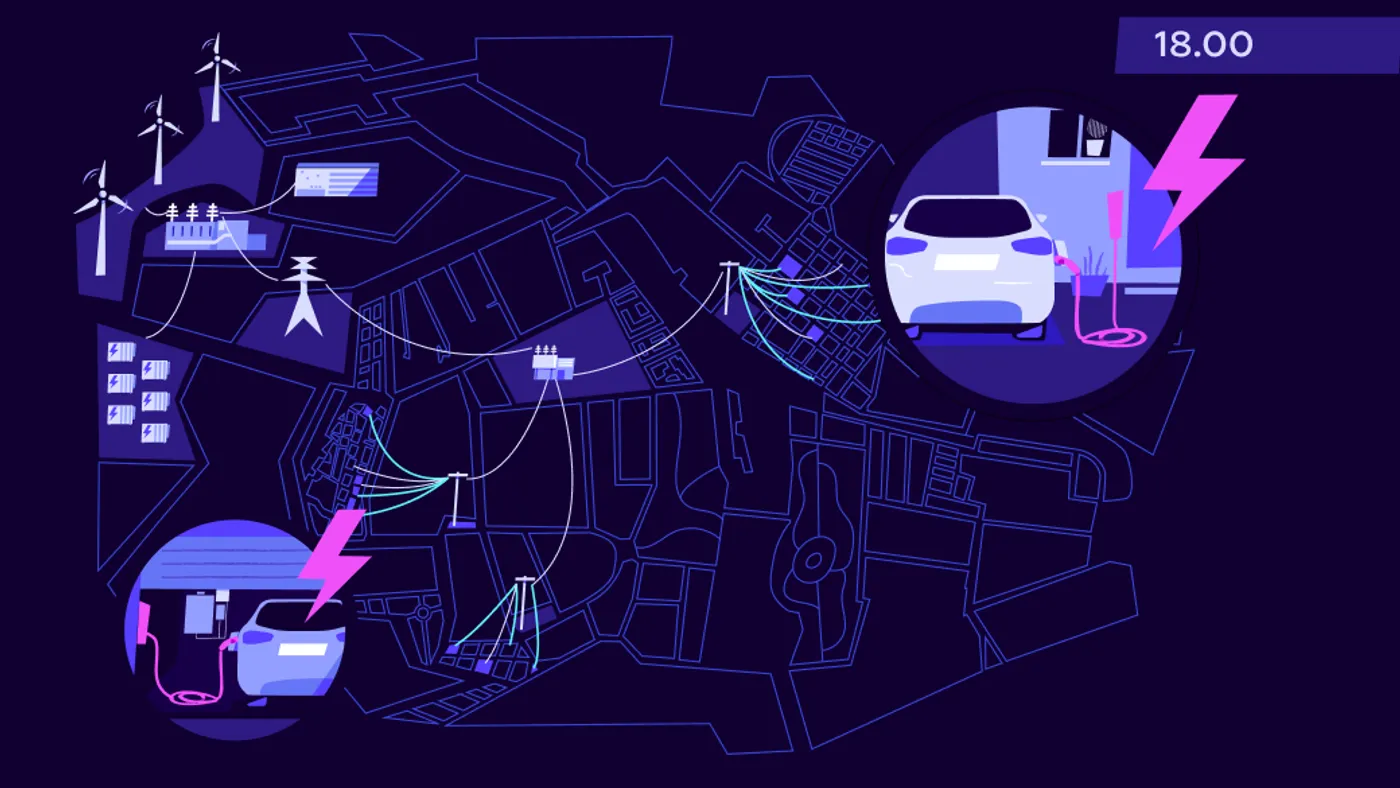
Sticking with EVs for a moment: pioneering utilities are now automating and optimizing electric vehicle charging, offering bespoke rates that automatically charge vehicles at cheaper times overnight, shifting massive loads to times when the grid is less stressed. Moreover, next-gen energy operating systems also enable multi-asset optimization, balancing solar panels, batteries, EVs and heat pumps for example, which might automate the charging an EV with home solar when it is more advantageous than discharging to the grid, for example. These solutions take massive pressure off the grid, reducing daily peaks in demand and therefore the need for expensive upgrades to ensure reliability through increased capacity.
Building next-generation flexibility programs
So how can utilities roll out these kinds of mature flexible programs and unlock scalable capacity that can be reliably dispatched all year round (just like today’s peaker plants)?
Larger portfolios mean more flexibility and additional reliability, but they also require software that can handle that scale and complexity, creating room to grow further. Today, next generation tech is available that makes rolling out these programs easier than ever. Upgraded energy operating systems give utilities all the tools they need to manage and scale effective flexible programs.
Kraken’s unified operating system is a case in point. Streamlined software is already empowering utilities to create new flexible rates and products in weeks not months and to manage devices at a massive scale. Instead of having separate programs, incentives, teams and technologies to manage different device types, holistic systems such as Kraken’s allow utilities to make use of extensive integration catalogues to centralize consumer flexibility resources and dispatch as one large, unified asset.
Moreover, these unified operating systems allow seamless integration of holistic residential flexibility platforms with customer management capabilities, facilitating the improvement of consumer experience and building the trust that must accompany consumer programs for continued engagement. In the UK, for example, Kraken’s work to enable Octopus Energy to flex EV charging is shifting peak load by 42%, saving £2bn in infrastructure and energy costs. This unlocks value for consumers and grids alike, passing savings to EV drivers and reducing charging costs by an average of $463, while supporting a more reliable energy system nationwide. Globally, Kraken helps utilities flex up to 4.2GWh daily of EV charging. These solutions are ready and waiting for all utilities that are bold enough to reach out and take them.
As the benefits of influencing demand (rather than focusing solely on supply) become clear, long-held industry assumptions are being turned on their heads. In an increasingly volatile world, next-generation flex programs and the software that enable them are a vital, powerful tool for improving grid reliability, insulating utilities and those they serve from price shocks, expensive infrastructure upgrades and ultimately enabling a smarter, more secure energy future.
Article top image credit: Permission granted by Kraken
‘Emergencies’ requiring coal plants to stay open need not be imminent, DOE tells court
States, environmental groups and others have sued the U.S. Department of Energy over its repeated emergency orders to run the J.H. Campbell plant in West Olive, Michigan.
By: Ethan Howland• Published March 23, 2026
The U.S. Department of Energy’s secretary has broad authority under the Federal Power Act to declare emergencies to keep power plants from retiring, and those emergencies don’t have to be imminent, DOE told a federal appeals court last weekin response to challenges over its orders keeping a Michigan coal plant online.
“The statute’s text grants the Secretary discretion to determine that an emergency exists,” DOE said in a March 17 brief with the U.S. Court of Appeals for the District of Columbia Circuit. “This expressly includes a sudden increase in demand, a shortage of generation facilities, or other causes.”
The brief is the DOE’s first defense in court of the 90-day emergency orders it began issuing last year to prevent fossil-fueled power plants from retiring. So far, the orders have targeted six power plants — all but one coal-fired — totaling about 4,300 MW.
Generally, in those orders, DOE said the power plants need to keep running to prevent blackouts in the face of rising electric demand. The DOE has not allowed any of those orders to lapse, using its authority under the Federal Power Act’s section 202(c) to issue new 90-day orders when the old ones expire.
The brief was in response to challenges brought against the DOE over its May 23 order directing Consumers Energy to continue running the 1,407-MW, coal-fired J.H. Campbell power plant in West Olive, Michigan, past its May 31 retirement date. The department has renewed that order three times since.
Michigan, Minnesota and Illinois as well as the Sierra Club and other groups have challenged the emergency order. In part, they contend that DOE failed to show the Midcontinent region around the Campbell power plant faces an energy emergency.
In its brief, DOE said the Federal Power Act defines emergency broadly.
“It does not require imminence or an unexpected development,” DOE said. “The Secretary is also granted broad discretion to use his ‘judgment’ on what ‘will best meet the emergency and serve the public interest.’”
Moreover, the statute lacks strict procedural requirements, according to DOE.
“Contrary to Petitioners’ contentions, the Secretary was not required to prepare any particular analysis, weigh alternatives, or to select the best theoretically possible emergency response,” the department said.
When DOE considered issuing an emergency order for the Campbell power plant, the department found that electricity demand was rising, major power plants were retiring and new power sources weren’t coming online fast enough, it said. The Midcontinent Independent System Operator was at “elevated risk” for reliability problems and higher than normal temperatures were expected, DOE told the court.
“The Secretary interpreted the totality of this evidence and applied his expertise to find that an emergency exists,” DOE said.
DOE noted that Secretary Chris Wright ordered the Campbell plant to operate under “economic dispatch” to reduce ratepayer costs.
If the court finds a legal flaw in the 202(c) order, it should send the issue back to DOE instead of vacating the order and limiting its ability to issue similar orders,government lawyers argued.
“The Secretary must be able to use section 202(c) to protect public health and safety, particularly in anticipation of extreme weather events like the recent Winter Storm Fern and the ensuing, prolonged cold snap,” the DOE said.
In the seven months after DOE ordered the Campbell plant to stay online, it produced 3.6 million MWh, down 39% from 5.9 million MWh generated over the same period in 2024, according to the latest U.S. Energy Information Administration data.
Campbell's generation falls 39% after DOE emergency order
The monthly output from the Campbell power plant in MWh.
Consumers Energy spent about $254 million keeping the Campbell plant operating per the DOE orders through December, according to a Feb. 10 filing at the U.S. Securities and Exchange Commission. It received $119 million in revenue from running the plant in the second half of last year and has asked the Federal Energy Regulatory Commission for permission to recoup $135 million in costs from MISO ratepayers, said CMS Energy Corp., which owns Consumers.
The utility asked the court to “avoid unintended consequences for those separate proceedings, including making clear that any decision here does not assume the availability of refunds or otherwise affect FERC’s decision-making in those separate proceedings.”
DOE continues to issue emergency orders to keep other fossil-fueled power plants running. On March 16 it issued its second emergency order for TransAlta’s 730-MW, coal-fired Centralia power plant in Washington. The company mustmake the plant available to run until mid-June under the order. The company had planned to shut it down at the end of 2025.
TransAlta’s president and CEO, John Kousinioris, said during an earnings call in February that the company was complying with the orders, but he did not expect the plant to run given “how flush” the state was with hydropower.
“Our primary focus is more on getting clarity on the existing order,” including how TransAlta will recoup its expenses from keeping the unit online, Kousinioris said.
Other generators under 202(c) orders are in Colorado, Indiana and Pennsylvania.
Article top image credit: Alex Wong via Getty Images
NERC forecasts peak demand to rise 24% on new data center loads
“The system is changing faster than the infrastructure needed to support it,” said John Moura, NERC’s director of reliability assessments and performance analysis.
By: Robert Walton• Published Jan. 30, 2026
Reliability risks are spreading across the bulk electric system, driven by soaring peak demand forecasts and lagging resource additions, the North American Electric Reliability Corp. said Thursday in its annual Long Term Reliability Assessment.
Summer peak demand across the bulk system is forecast to grow by 224 GW over the next 10 years, a more than 69% increase over the 2024 LTRA forecast and a 24% increase from 2025 peak demand, NERC said. New data centers account for most of the projected increase. Winter demand growth is even higher, with 246 GW of growth forecast over the next decade.
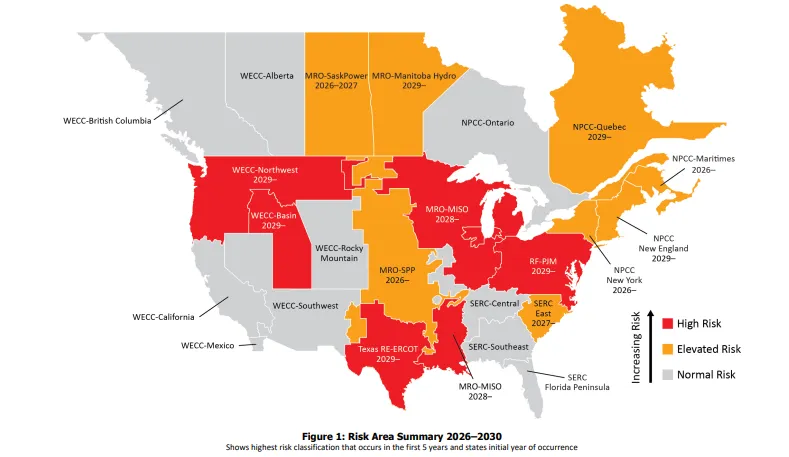
The Midcontinent Independent System Operator, PJM Interconnection, Electric Reliability Council of Texas and parts of the Pacific Northwest all face a high risk of insufficient reserve margins or exceeding unserved energy criteria at some point within the next five years, according to the report.
“The system is changing faster than the infrastructure needed to support it,” John Moura, NERC's director of reliability assessments and performance analysis, said in a call with reporters. We are “in a period here where future electricity supply has never been more uncertain.”
From 2024 to 2025, existing capacity from fossil-fueled generators fell by 21 GW, while bulk power system capacity for peak demand hours from battery, wind, and solar resources increased by 23 GW, according to the report.
Bulk power system capacity “fell short of projections this year,” said Mark Olson, NERC’s manager of reliability assessments. “And that was the case last year as well,” he added. Delays in connecting new resources and unanticipated generator retirements are the cause of the miss.
In a change from last year’s LTRA, NERC said solar PV is no longer the sole, predominant generation type planned over the next 10 years.
“New battery resource projects have grown to match solar projections, and, together, solar and battery capacity additions represent two-thirds of the Tier 1 and Tier 2 resources in this year’s 10-year LTRA study period,” the report said.
“Those provide good capability for meeting summer peak demand, but the capability of resources in the winter is very different,” Olson noted.
Natural-gas-fired generator additions represent 15% of the projected capacity additions followed by wind and hybrid resources at 8% each.
Projected generation retirements have shrunk from the 2024 reliability assessment. Confirmed and announced potential retirements over the next 10 years “remain high and total over 105 GW in peak seasonal capacity,” NERC said, but that is “roughly 10 GW lower than the 10-year retirement projections last year.”
All areas are adding resources and working to ensure grid stability, NERC said. But some face high risks over the next five years.
In MISO, projected resource additions “do not keep pace with escalating demand forecasts and announced generator retirements,” NERC said. In PJM, the grid operator’s anticipated resource margin will fall below a reference level starting in 2029.
In ERCOT, NERC said probabilistic unserved energy metrics for 2026–2027 have improved since the 2024 LTRA, “but continued rapid load growth outpaces projected resource additions in later years.” In parts of the Northwest, near-term resource additions “are predominantly solar PV, leading to a more variable resource mix,” and there is a growing unserved energy risk in summer and winter.
Industry groups responded, calling for policies to speed resource development and maintain existing plants.
“Poor grid operator interconnection processes, as well as overly cumbersome state-level siting and permitting rules, need urgent attention,” Caitlin Marquis, a managing director at Advanced Energy United, said in a statement. State leaders and grid operators “need to remove the red tape blocking deployment of the most cost-effective and fastest-to-build resources, including solar, energy storage, and demand-side resources.”
The Electric Power Supply Association, which represents competitive generators, said the industry is focused on adding new resources but also needs policies to keep existing plants online.
“Reliability is best served by competitive electricity markets that send clear, durable development signals — not by policy interventions that create misalignment between supply and demand,” EPSA President and CEO Todd Snitchler said in a statement. “In order to address the warnings NERC’s LTRA sets out, it will require getting market signals right while addressing permitting and siting delays, supply chain bottlenecks, and other barriers to development.”
America’s Power, which represents coal generators, called NERC’s assesment “another sobering wakeup call.”
“Utilities have announced plans to retire more than a fourth of the nation’s coal power plants over the next five years. Most of these retiring coal plants are located in high-risk regions,” America’s Power President and CEO Michelle Bloodworth said in a statement. “Unless these retirement plans are reversed, the grid will lose an energy-secure, affordable, and reliable source of baseload power.”
Article top image credit: Getty Images
FERC members raise alarms about PJM failure to meet reliability target
PJM says several factors could close the capacity shortfall, including a new load forecast next month that could be significantly lower than the last due to stricter vetting of potential large loads.
By: Ethan Howland• Published Dec. 19, 2025
The PJM Interconnection’s failure to buy enough capacity to meet its reliability target in its most recent auction raised alarms among Federal Energy Regulatory Commission members at the agency’s open meeting Thursday.
“It's very concerning,” FERC Chairman Laura Swett said. “These market results suggest that we have to act to ensure that new supply is available to interconnect to PJM quickly enough to meet historically surging demand.”
PJM on Wednesday said it procured about 145,780 MW in its latest capacity auction, about 6,625 MW below the grid operator’s 20% installed reserve margin target — an estimate of how much capacity is needed to prevent more than one unexpected power outage every 10 years. It failed to meet its reserve margin while also setting record-high prices for the third auction in a row.
Several factors could close that shortfall by the time the auction’s capacity year starts on June 1, 2027, according to PJM. Its demand forecast for the auction was based on a load forecast issued in January. PJM is set to release a new load forecast next month that could be significantly lower, partly based on stricter vetting of potential large loads and a reduced economic outlook, said Stu Bresler, executive vice president for market services and strategy at PJM.
Even so, the failure to acquire enough capacity to meet its reserve margin is “unacceptable,” according to FERC Commissioner David Rosner.
“We need PJM to file, without further delay, meaningful changes to its rules to overcome the interconnection and financing barriers to building new generation to close the resource adequacy gap before the end of this decade,” Rosner said.
PJM’s shortfall could be filled by building more power plants, Rosner noted.
“We should be able to build five or six new large power plants in the next few years in PJM, and it's really troubling that we can't,” he said.PJM’s capacity auction drew 774 MW of new generation and power plant uprates.
In a decision on PJM’s colocation rules FERC issued Thursday, the agency gave the grid operator until Jan. 19 to file a report on the status of proposals that were considered in the grid operator’s Critical Issue Fast Path stakeholder process on integrating large loads, including the status of the grid operator’s expedited interconnection process for shovel-ready generation projects.
“The informational report also must identify specifically which of these initiatives would support the addition, on an expedited basis, of new generation that is sufficient to serve large loads, like data centers, while meeting PJM’s near-term system resource adequacy needs,” FERC said.
PJM is the largest U.S. grid operator, running the power system and electric wholesale markets in the Mid-Atlantic and Midwest regions where about 67 million people live.
PJM’s 2027/28 capacity auction resulted in a 14.8% reserve margin, below PJM’s 20% target, FERC Commissioner Lindsay See noted.
“It's an understatement to say that those are concerning outcomes,” See said. “The work coming out of PJM’s stakeholder process is more critical and time sensitive than ever.”
FERC Commissioner Judy Chang echoed her colleagues' concerns.
“We're hitting the grid reliability crisis that has been brewing for years, and PJM’s report from yesterday confirms exactly that,” Chang said. “And really, PJM is not alone. We just see it more visibly with PJM.”
The North American Electric Reliability Corp. in a mid-November report said much of the the continent is at an elevated risk of lacking enough power supplies to meet demand in extreme operating conditions this winter.
The tight market conditions in PJM and elsewhere are partly driven by policies implementedby the Biden administration and some states, according to FERC Commissioner David LaCerte.
“Baseload and dispatchable power were suppressed and vilified,” LaCerte said. The issue was made worse by the forced retirement of coal-fired power plants and a lack of gas pipeline capacity, he added.
“Greenhouse gas emissions and carbon footprints ruled the day,” LaCerte said. “[They] became the primary driver, really the only metric, during the Obama and Biden administrations, separating FERC from its economic regulation roots and framing it as an environmental regulator.”
Generation and resource adequacy generally fall under state jurisdiction, LaCerte noted.
“Up until very recently, this has largely been a very successful balance,” he said.
PJM’s capacity auction reached all-time high prices, which will affect tens of millions of consumers, but fell “dangerously short” of the grid operator’s reliability requirement, former FERC Chairman Mark Christie said in a LinkedIn post.
However, he cautioned against federal regulators acting hastily in ways that could infringe on local authority or exacerbate affordability concerns.
“The fundamental problem is that load growth driven by data centers is far exceeding any realistic possibility of new generation,” Christie said. “Now is not the time for FERC to make the crisis worse by incenting the cannibalization of existing generation to serve only co-located data centers, or to pre-empt the states in a rush to interconnect data centers when states are trying to protect reliability and their consumers from cost shifting.”
Americans lost more power last year than any year in previous decade: EIA
The annual average of 11 hours of electricity interruptions was nearly double the annual average of the last ten years, with hurricanes a leading cause.
By: Diana DiGangi• Published Dec. 2, 2025
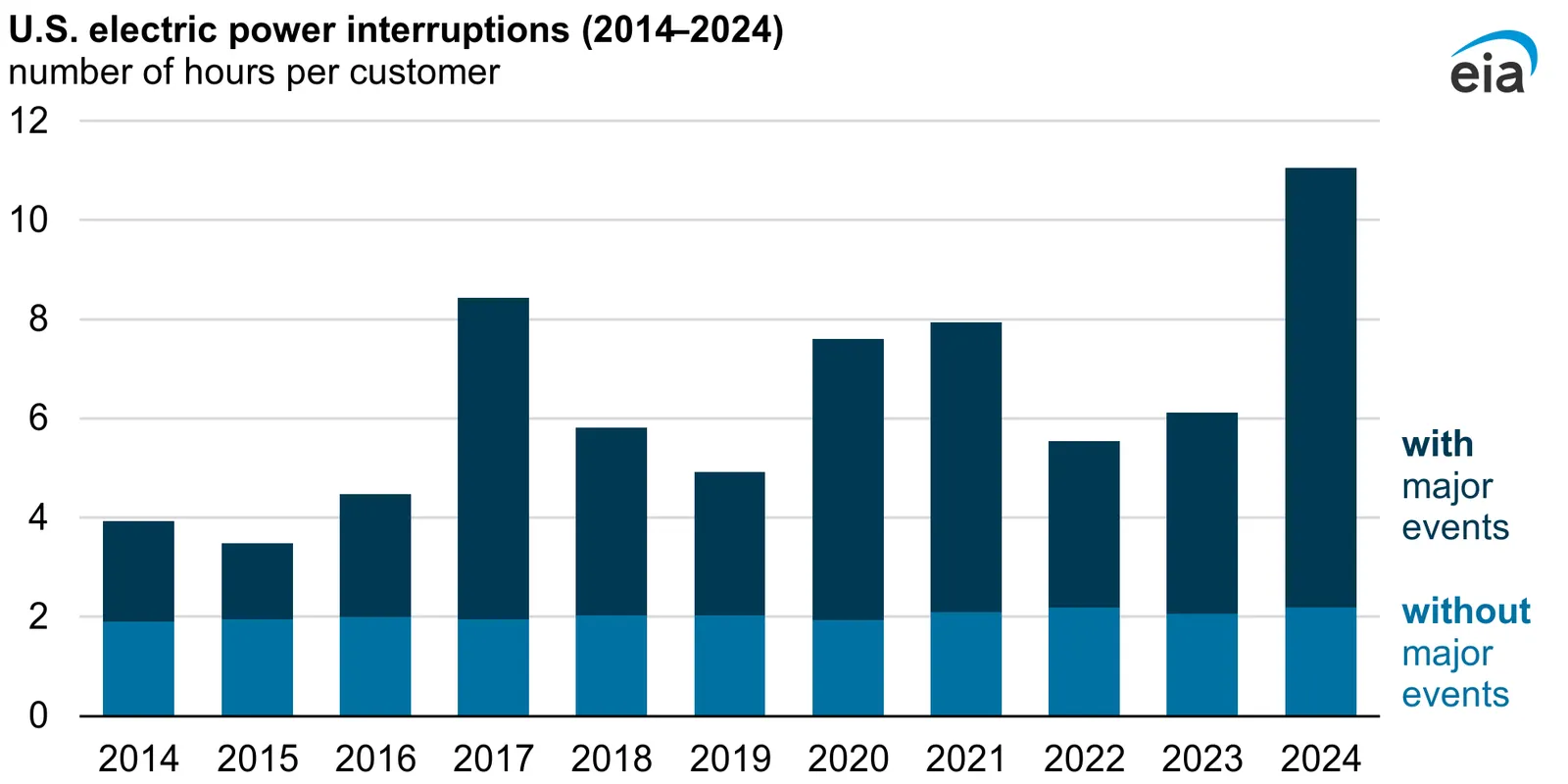
U.S. electricity customers experienced an average of 11 hours of power outages in 2024, nearly twice as many as the annual average across the previous decade, according to a new report from the Energy Information Administration.
Hurricanes accounted for 80% of those lost hours, with most of last year’s outages resulting frommajor weather events like hurricanes Beryl, Helene and Milton, EIA said in the report released Monday.
“Interruptions attributed to major events averaged nearly nine hours in 2024, compared with an average of nearly four hours per year in 2014 through 2023,” EIA said. “Service interruptions that aren’t triggered by major events routinely average about two hours per year.”
Optional Caption
Courtesy of Energy Information Administration
Customers in South Carolina were significant outliers in terms of outage duration, the report said, experiencing an average of 53 hours of outages in 2024. Much of this was due to last September’s Hurricane Helene, which left 1.2 million customers in South Carolina without electricity.
The report appears to build on a growing body of evidence that extreme weather is taking a heavier toll on the electric power system in parts of the country. In October, JD Power released a report that found the average length of the longest outages are getting longer and concluded that disasters have become a “fact of life” for many utility customers.
Helene, in particular, caused severe damage to utility systems in the U.S. Southeast and Mid-Atlantic.
Duke Energy said after the hurricane that transmission infrastructure in upstate South Carolina “was severely damaged and, in many cases, destroyed” and would need to be entirely rebuilt.
Three days after the hurricane struck, 900,000 Duke customers remained without power across North Carolina and South Carolina, the utility said. Following hurricanes Helene and Milton, Duke reported needing to replace around 16,000 transformers — more transformers than utilities generally require in an entire year, WoodMac Senior Analyst Ben Boucher said in February.
South Carolina, along with North Carolina and Florida, “dealt with strong winds and flooding from Hurricane Helene that affected transmission and distribution power lines as well as substations leading to prolonged power outages,” EIA said. The following month, Hurricane Milton “left 3.4 million customers in Florida without power,” it added.
“In contrast, customers in states such as Arizona, South Dakota, North Dakota, and Massachusetts experienced, on average, less than two hours of service interruptions in 2024,” EIA said
While Hawaii averaged less than 10 hours of total outages throughout the year, the state saw more frequent interruptions — an average of 4.4 interruptions per customer, compared to the U.S. average of 1.5, “mainly due to adverse weather, volcanic activity, unexpected outages at oil-fired plants, and issues connecting new generating capacity,” EIA said.
Article top image credit: Joe Raedle via Getty Images
Winter peak demand is rising faster than resource additions: NERC
Batteries and demand response make up the bulk of new resources heading into this winter, the North American Electric Reliability Corp. said Tuesday.
By: Robert Walton• Published Nov. 19, 2025
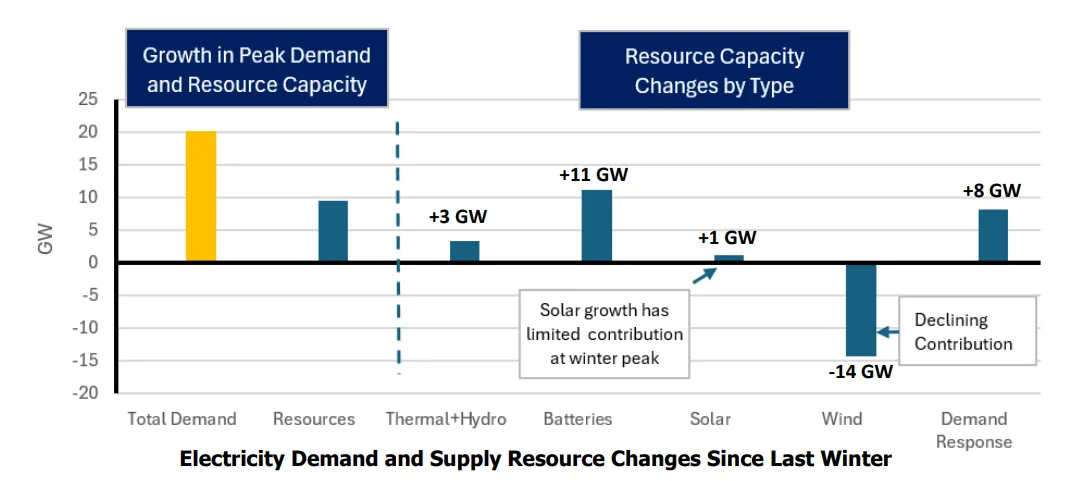
Peak demand on the bulk power system will be 20 GW higher this winter than last, but total resources to meet the peak have only increased 9.4 GW, according to a report released Tuesday by the North American Electric Reliability Corp.
Despite the mismatch, all regions of the bulk power system should have sufficient resources for expected peak demand this winter, NERC said in its 2025-2026 Winter Reliability Assessment. However, several regions could face challenges in the event of extreme weather.
There have been 11 GW of batteries and 8 GW of demand response resources added to the bulk power system since last winter, NERC said. Solar, thermal and hydro have also seen small additions, but contributions from wind resources are 14 GW lower following capacity accounting changes in some markets.
NERC officials described a mixed bagheading into the winter season.
"The bulk power system is entering another winter with pockets of elevated risk, and the drivers are becoming more structural than seasonal,” said John Moura, NERC’s director of reliability assessments and performance analysis. "We're seeing steady demand growth, faster than previous years, landing on a system that's still racing to build new resources, navigating supply chain constraints and integrating large amounts of variable, inverter-based generation.”
Aggregate peak demand across NERC’s footprint will be 20 GW, or 2.5%, higher than last winter. “Essentially, you have a doubling between the last several successive [winter reliability assessments],” said Mark Olson, NERC’s manager of reliability assessment.
Nearly all of NERC’s assessment areas “are reporting year-on-year demand growth with some forecasting increases near 10%,” the reliability watchdog said.
The U.S. West, Southeast and Mid-Atlantic — areas with significant data center development — have highest growth rates, NERC said. “Demand growth is contributing to lower reserve margins and signaling need for more resources,” according to a presentation on the report.
But some types of new resource additions are slow to come online. Just 3 GW of thermal or hydro generation was added since last winter. Solar nameplate capacity rose 11 GW since last winter, but is expected to contribute only about 1 GW towards meeting peak demand.
Bringing resources online more quickly will require changes to policy and markets, according to the Electric Power Supply Association.
“We need permitting reform, predictable market rules, and policies that support private investment,” EPSA President and CEO Todd Snitchler said in a statement. The group represents competitive generators.
An increasingly complex resource mix “brings additional challenges for operators,” NERC said, particularly in extreme or extended cold weather.
In the Maritimes region, imports may be needed to meet peak demand, NERC said. New England could see gas shortages in extended extreme conditions. In areas of the Southeast, reserves may not be sufficient for high demand scenarios, or resource shortages may occur during early morning hours with high demand.
In the Electric Reliability Council of Texas footprint, “strong load growth is contributing to continued risk of supply shortfalls in extreme cold,” NERC said. In parts of the Northwest, resources may not be sufficient during wide-area cold weather that causes thermal plant outages and wind performance issues.
“Winter reliability is improving in some aspects, but the system is still being tested by conditions outside historical norms,” Moura said.
NERC’s assessment includes several recommendations: grid operators should review seasonal operating plans; generation owners should complete winter readiness and weatherization efforts; and balancing authorities should implement generator fuel surveys to monitor the adequacy of fuel supplies.
“Gas production and supplies going to generators strongly impacts how well the bulk power system can perform during winter conditions,” Olson said. “These two systems are inextricably linked.”
Article top image credit: Julie Denesha via Getty Images
NERC president warns of ‘five-alarm fire’ for grid reliability
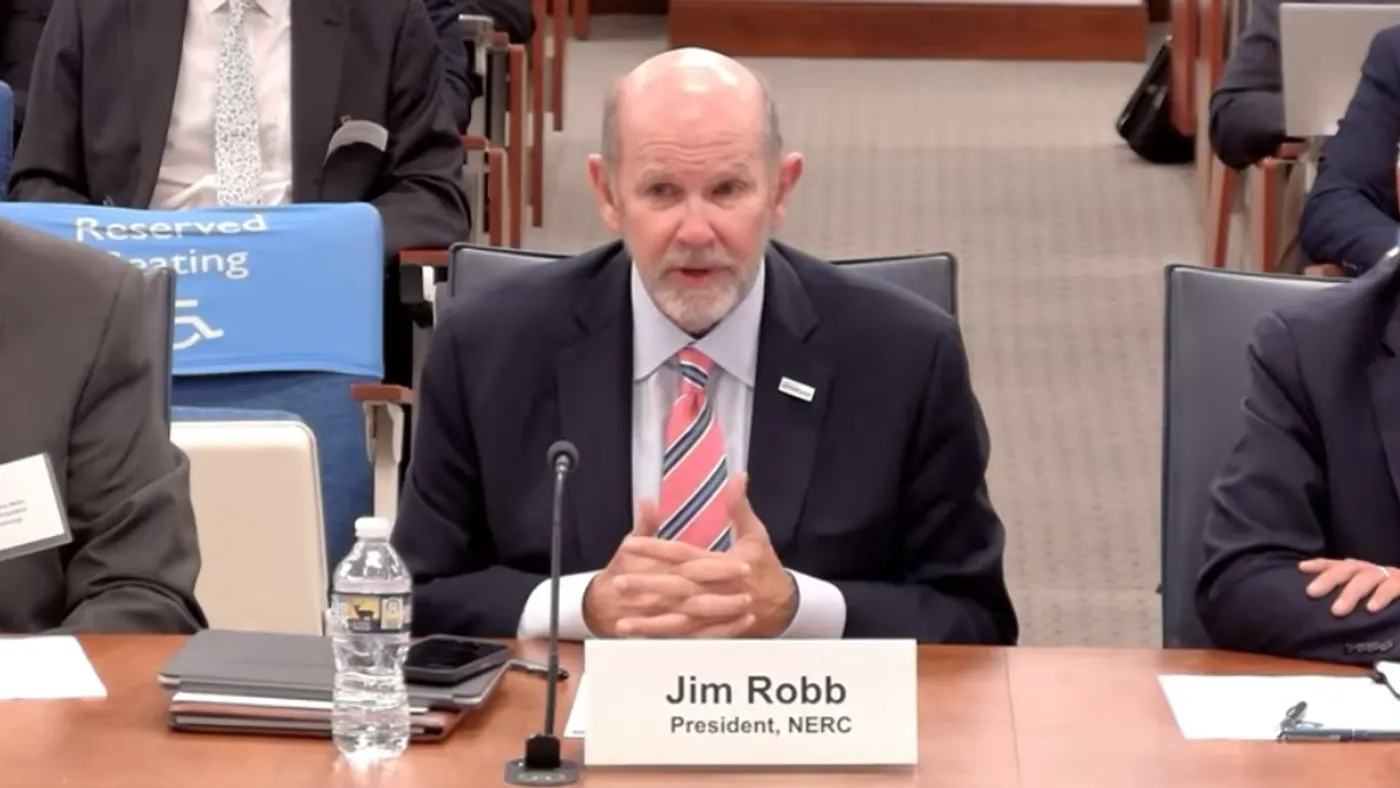
“The reliability of the power grid remains extremely high, but ... the risks to reliability continue to mount,” the North American Electric Reliability Corp.’s Jim Robb told federal regulators.
By: Ethan Howland• Published Oct. 22, 2025
The issue of data centers — and how to ensure they can be safely added to the grid — was a key focus of a grid reliability conference held by the Federal Energy Regulatory Commission on Tuesday.
Generally, grid reliability is strong in the United States, but challenges are growing, Jim Robb, president and CEO of the North American Electric Reliability Corp., said at the meeting.
“The reliability of the power grid remains extremely high, but, paradoxically, the risks to reliability continue to mount,” Robb said. “We're seeing … an increasing number of small scale events and near misses that continue to reinforce what we can't call anything but a five-alarm fire when it comes to reliability.”
According to Robb, grid reliability challenges include dwindling resource adequacy with weakening reliability services, extreme weather, interdependency with natural gas and other sectors, especially telecommunications, policies affecting resource and fuel development, load development, the ability to site and permit needed infrastructure and an “escalating toxic soup” of physical and cybersecurity risks.
The U.S. faces potential imbalances between electricity supply and demand amid uncertainty about how much load may be coming online and how much generation and transmission must be built to handle it, saidFERC Commissioner Judy Chang, warning that the risks and uncertainties around those issues are “coming to a head.”
Estimates in data center growth range widely. The U.S. Department of Energy in December said U.S. data centers could use 6.7% to 12% of all U.S. electricity by 2028, up from 4.4% in 2023.
The U.S. needs to build energy infrastructure more quickly, according to FERC Chairman David Rosner.
“I see our grid as needing every single megawatt, every single electron and every single molecule we can get to meet demand on those peak days and peak hours,” Rosner said. “That means we need to make sure that we're studying faster, we're giving permits faster and unlocking all different types of energy infrastructure that are needed.”
The power sector needs to move quickly to address reliability challenges, according to Jennifer Curran, senior vice president of planning and operations for the Midcontinent Independent System Operator.
“Where we are today, I would say, is not safe because we are in a tight reserve margin situation,” Curran said. “We are in a situation where we do have new types of resources coming on, and we are going to have to make our best steps to continue to increase reliability.”
Given the uncertainty, Curran called for ensuring the grid system has adequate “shock absorbers,” such as improved data analysis tools.
“How do we make sure that we have both in our physical grid and in our market products … the right incentives to make sure that we are able to bear these uncertainties that are really going to be coming before us?” Curran asked.
“The best thing we can do is get better at quickly dealing with the uncertainty and having as much built-in infrastructure as we can to really provide that balance of reliability and economic efficiency,” she continued. “Getting the transmission built to help provide those connections and provide that optionality within the system is something that's really important, and it takes a long time.”
Electricity affordability and the grid buildout
Dealing with some of those challenges will be costly, according to FERC Commissioner Lindsay See.
“Some of that is inevitable, but we are reaching a point where bills are becoming incredibly difficult for people across the country,” See said.
Some states are taking measures to try and shield ratepayers from costs associated with data centers and other large loads.
Tricia Pridemore, a commissioner at the Georgia Public Service Commission, said with appropriate guardrails, large data centers can help reduce electric rates.
In Georgia, large loads enter into 15-year contracts to pay for all the new generation, transmission and distribution needed to manage their load, Pridemore said. The PSC recently approved a plan for Georgia Power to add 7.1 GW of capacity to meet growing demand, which the commission estimates will reduce residential rates by $2.64 a month, she said.
Matthew Holtz, vice president of transmission operations at Invenergy, said merchant transmission, which is paid for by entities buying capacity of transmission lines, can take cost burdens off ratepayers.
Invenergy is also calling for “cloud-based” system monitoring, which Holtz said could lead to more economic energy and capacity sharing between regions and help respond to extreme weather events.
Long-term and more integrated system planning that co-optimizes transmission, generation and load solutions could put downward pressure on electric rates, according to Carlos Casablanca, managing director ofdistribution planning and analysis at American Electric Power.
“We are seeing … a lot more costs coming: the build out that needs to occur to accommodate large loads, and also the resources that are required to both address retiring generation but also meet the need from the large loads,” Casablanca said. “So anything we can do in the planning space to prepare for what's coming and optimize as early as we can, it'll help. It'll pay dividends down the road.”
Load growth, plant retirements could drive 100x increase in blackouts by 2030: DOE
The U.S. Department of Energy on Monday published a methodology for assessing grid reliability, but clean energy advocates say it likely exaggerates the risks of blackouts.
By: Robert Walton• Published July 8, 2025
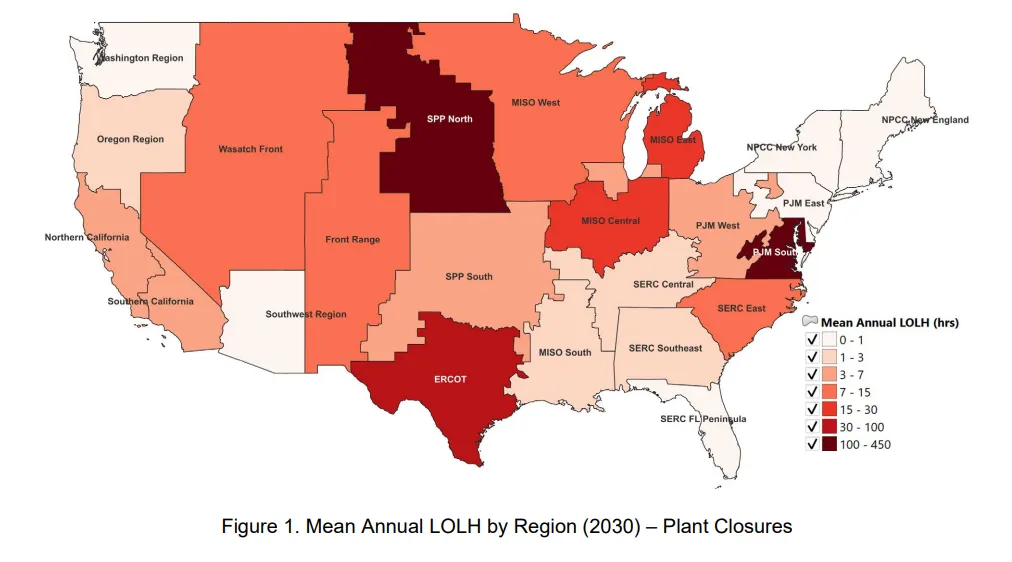
Blackouts could increase by 100 times in 2030, relative to today’s averages, if the United States continues to shutter power plants and fails to add additional firm capacity amid rising demand, the U.S. Department of Energy said in a July report.
The report includes a uniform methodology to identify regions at risk of power outages and guide federal reliability “interventions,” DOE said. The report was required by President Donald Trump’s April executive order which directed the agency to respond to an “energy emergency” he declared in January.
But clean energy advocates say the report appears to exaggerate the risks, and undercount the contributions of wind, solar and battery storage resources. “If the analysis is overly pessimistic about advanced energy technologies and the future of the grid, consumers will end up paying too much for resources we no longer need,” Caitlin Marquis, managing director at Advanced Energy United, said in an email.
DOE’s report assumes 104 GW of plant retirements by 2030, alongside the addition of 210 GW of new generation — but only 22 GW of the additions will be “firm, reliable, dispatchable generation.”
“Modeling shows annual outage hours could increase from single digits today to more than 800 hours per year. Such a surge would leave millions of households and businesses vulnerable,” the report said. “We must renew a focus on firm generation and continue to reverse radical green ideology in order to address this risk.”
Average Loss of Load Hours could jump from 8.1 annually to 817.7 under some scenarios, the report said. It estimated an additional 100 GW of new peak capacity is needed by 2030 — of which, 50 GW is attributable to data centers.
“Data centers can be built in 18 months, but it takes more than three times as long to add new generation required to service those data centers,” DOE said in a fact sheet accompanying the report.
Even assuming no retirements, DOE said its model found outage risks in several regions rise more than 30-fold, “proving the queue alone cannot close the dependable-capacity deficit.”
“This report affirms what we already know: The United States cannot afford to continue down the unstable and dangerous path of energy subtraction previous leaders pursued, forcing the closure of baseload power sources like coal and natural gas,” Energy Secretary Chris Wright said in a statement.
America’s Power, which represents the coal sector, praised the report.
The analysis “is further proof that the premature retirement of coal plants is putting the reliability of the U.S. electricity grid at risk,” America’s Power President and CEO Michelle Bloodworth said in a statement. “Baseload power sources like coal are being replaced by less reliable sources like wind and solar. These renewables are not capable of meeting the constant 24/7 electricity demands required for AI, data centers, and other advanced technologies.”
The report includes a methodology that DOE says it will use to identify which generation resources within a region are critical to system reliability. The methodology uses hourly datasets for load, generation and interregional transfer capabilities for the 23 U.S. electric subregions.
DOE said it developed its outage risk estimates by running simulations using 12 different years of historical weather, with every hour based on actual data for wind, solar, load and thermal availability.
Clean energy advocates say they have doubts about the agency’s methodology.
DOE’s study “appears to exaggerate the risk of blackouts and undervalue the contributions of entire resource classes, like wind, solar, and battery storage,” AEU’s Marquis said.
“We are working quickly to dig into the numbers to unpack how DOE reached its conclusions,” Marquis said. “But it’s troubling that the report was not subject to public input and scrutiny, especially since the Executive Order that mandated it calls for it to be used to identify power plants that should be retained for reliability.”
The methodology “is another attempt to push the false narrative that our country’s energy future depends upon decades-old coal- and gas-plants, rather than clean renewables,” Sierra Club Senior Attorney Greg Wannier said in an email.
The Federal Energy Regulatory Commission and the states “are already well equipped to meet any projected resource needs through the existing regulatory process, which ensures that electricity demand is reliably met at the least public cost,” Wannier said. “Any effort by DOE to override this process to forcibly keep coal plants online past their planned retirements would be an extraordinary and unlawful overreach of its regulatory authority.”
In May, DOE issued an emergency order under section 202(c) of the Federal Power Act, directing Consumers Energy to delay, by about three months, shutting down a 1,560-MW, coal-fired power plant in Michigan. Earthjustice and other groups have asked the agency for rehearing, and said they may go to the courts to challenge the order.
“Determining the reserve margin and ‘critical’ resources are complex decisions with severe health and economic consequences that Congress rightly entrusted FERC to oversee using a robust public adjudication process,” said Christine Powell, deputy managing attorney for Earthjustice’s clean energy program. DOE’s methodology “attempts to usurp that process, and would impose billions of dollars and harmful pollutants on consumers without any corresponding benefits for anyone except for the coal industry.”
DOE’s analysis “doesn’t support President Trump’s strategy of using emergency declarations to stop power plants from carrying through with their plans to retire,” said Jennifer Danis, federal energy policy director at the Institute for Policy Integrity.
“The Trump administration’s own study has found that no present emergency exists in the two regions where it already issued 202(c) orders,” Danis said. “Reforms may be needed to ensure better planning for future resource adequacy to power AI, but they should focus on improving existing markets and planning standards, as well as speeding up new resource interconnection, rather than forcing customers to pay to keep old, inefficient plants online.”
Article top image credit: Getty Images
Increasing grid reliability in the U.S.
Rising peak demand, generator retirements, extreme weather and other factors are driving significant reliability concerns for the U.S. power sector. Initiatives from the industry, policymakers and other stakeholders are being introduced to reduce those risks and ensure grid reliability across the country.
included in this trendline
Extended heat wave could cripple New York’s grid this summer: NYISO
Sudden data center load losses prompt NERC alert, recommendations
‘Emergencies’ requiring coal plants to stay open need not be imminent, DOE tells court
Our Trendlines go deep on the biggest trends. These special reports, produced by our team of award-winning journalists, help business leaders understand how their industries are changing.