Dive Brief:
- The U.S. government needs a comprehensive and robust used nuclear fuel recycling program to manage growing volumes of the material and support a more efficient, sustainable fuel supply chain as more reactors come online, the Energy Innovation Reform Project said in a report released Monday.
- The Case for Commercial Recycling of Used Nuclear Fuel urges the federal government to develop an integrated nuclear waste strategy that encompasses recycling, expand U.S. Department of Energy and public-private UNF recycling initiatives, and enact legislation to bolster the commercial UNF recycling industry.
- The report follows a DOE request for information from states interested in hosting “nuclear lifecycle innovation campuses” that would have fuel fabrication, enrichment, UNF reprocessing and nuclear waste disposition capabilities. The first of these campuses could come online as soon as next year, DOE said in the solicitation.
Dive Insight:
The United States has accumulated about 94,000 metric tons of UNF since the dawn of the nuclear age and adds about 2,000 metric tons to the stockpile each year, the EIRP report states. The material contains several fission byproducts, some of which remain dangerously radioactive for thousands of years.
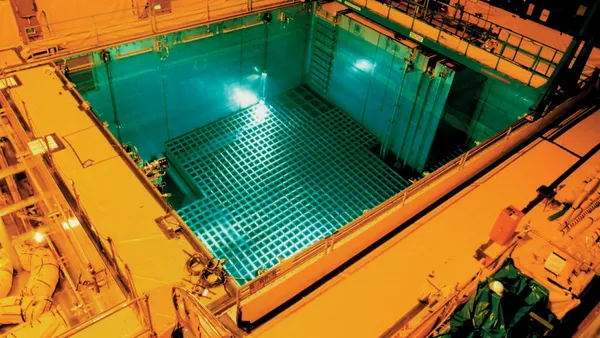
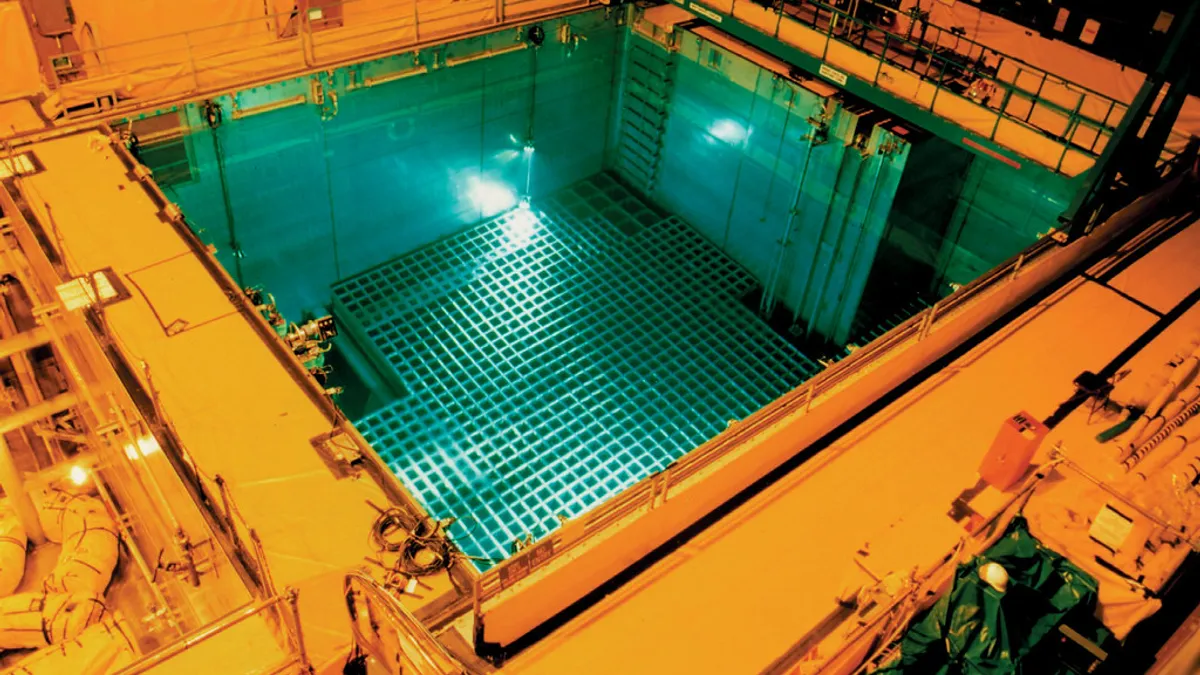
Most UNF from commercial power generation is stored in cooling water pools or stainless steel casks in concrete vaults at both active and decommissioned nuclear power plants. Congress passed a law in 1987 designating Yucca Mountain, Nevada, as a permanent deep geologic repository for about 77,000 metric tons of used nuclear fuel, but legal and political difficulties dogged the project for decades before Congress pulled its funding in 2011.
Though construction is underway on a privately owned interim UNF repository in Texas, and at least one startup company has plans to store material in deep, dispersed boreholes, with a demonstration project under construction, also in Texas, the U.S. — like most countries — remains without a central long-term storage site for civilian nuclear waste. Finland began commissioning what’s expected to be the world’s first government-supervised permanent repository in 2025.
“Building a single [deep geologic repository] has been a decades-long challenge that the United States has so far failed to meet,” the EIRP report states.
A robust UNF recycling program would significantly reduce the amounts of long-lived radioactive waste that eventually need to be stored, according to the report. A 2021 study by the Organisation for Economic Co-operation and Development’s Nuclear Energy Agency found that a multistage recycling program, paired with fast reactors that can run on used nuclear fuel, could greatly reduce the volume and radiotoxicity of waste and reduce the need for additional uranium mining.
The report was co-authored by EIRP’s founder and president, Samuel Thernstrom; Paul Saunders, a board member and senior adviser; and Christina Leggett, director of fuel cycle technology at Oklo, an advanced nuclear startup developing a type of reactor that can run on used nuclear fuel.
Oklo and other fast reactor developers would benefit from what EIRP calls a “closed fuel cycle.” In September, Oklo said it would build an up to $1.7 billion UNF recycling facility in Tennessee to produce fuel for the fast reactor fleet it hopes to deploy in the coming years. That same month it broke ground for its first commercial reactor in Idaho, Aurora-INL, which it expects to begin commercial operation by late 2027 or early 2028.
EIRP’s report flagged several tailwinds for nuclear fuel recycling at scale.
A federal ban on uranium imports from Russia, a major supplier of the material, could create a significant supply gap for U.S.-based reactor operators when it comes into effect in 2028. Moving toward a closed fuel cycle will shore up domestic supplies of critical minerals and help the U.S. compete with Russia and France for UNF recycling and reactor construction contracts, the EIRP report said.
A closed fuel cycle will also help stretch uranium supplies beyond the approximately 90 years of global identified reserves, the report said. EIRP warned the world’s reserves of economically recoverable uranium could be depleted more quickly as the global nuclear power fleet grows.
Meanwhile, advanced nuclear fuel recycling technologies such as pyroprocessing could be more cost-effective at scale than traditional processes, and the recovery of valuable recycling byproducts like medical cesium and strontium isotopes could improve the economics further, EIRP said.