Dive Brief:
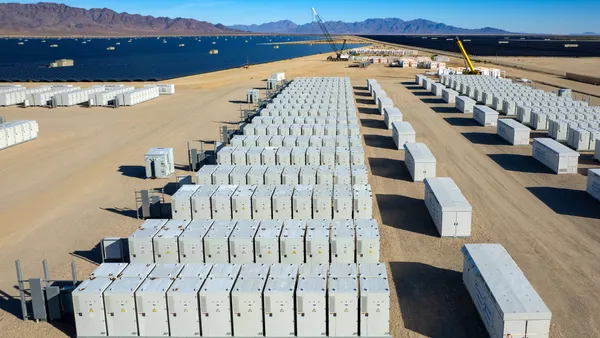
- Pricing for U.S. utility-scale and distribution-scale energy storage systems diverged in the first quarter of 2026, Anza Renewables said in its latest quarterly market report.
- Utility-scale system prices have fallen by as much as 8.6% since November and 20.9% since May. Distribution-scale, or DG, system prices are largely unchanged since November but remain as much as 14% lower than in May, the energy market intelligence firm said.
- The divergence appears driven by suppliers focused on supporting larger projects for data center and independent power producer clients while treating the distribution-scale segment — at least for now — as an “afterthought,” Anza said.
Dive Insight:
The United States installed a record amount of energy storage in 2025: 18.9 GW/51 GWh across all customer segments, according to a Wood Mackenzie report released last month.
Utility-scale installations accounted for 16 GW/47.3 GWh, up 48% and 40% over 2024, WoodMac said. Residential energy storage installations saw a bigger year-over-year jump in percentage terms, according to the London-based energy consultancy, which in an earlier report noted that much of the increase was due to residential customers rushing to install before the Section 25D tax credit expired at the end of the year.
In the months since, pricing for alternating-current and self-integrated, direct-current distribution-scale energy storage systems has flattened out around $203/kWh and $175/kWh, respectively, Anza said in its report this month. Suppliers’ shift toward larger-scale installations “is likely contributing to tighter supply conditions for DG-appropriate configurations, helping to firm up prices in the process,” the group said.
Energy storage system pricing is down across the board since May, however. Distribution-scale system prices have fallen about 14% for AC and 8.9% for DC configurations since then, marking “a meaningful improvement in project economics,” Anza said.
Utility-scale system prices have fallen 20.9% for AC configurations and 18.1% for DC configurations over the same period, according to Anza’s report.
Anza says it checks in with energy component suppliers “monthly or more frequently” to gather up-to-date pricing information for over 95% of solar module supply and 85% of the energy storage market. Its storage pricing data represents “median capex values,” which include costs for materials, shipping, commissioning and any relevant tariffs, it says.
Anza sees energy storage prices stabilizing and potentially trending upward in the coming months due to rising lithium carbonate prices and an April 1 reduction in value-added tax rebates in China, the world’s top energy storage producer.
But two trends could temper “upward pressure” on energy storage prices, Anza said.
One is newfound clarity on the U.S. Treasury Department’s rules around sourcing battery materials from foreign entities of concern, principally those tied to China. Treasury guidance released earlier this year allows systems to qualify for the federal investment tax credit — good for a 30% or greater offset of system costs — if battery cells contain a sufficient amount of FEOC-compliant material, Anza said.
Of 79 energy storage products in Anza’s dataset, 40% are at “low” risk of violating FEOC rules. Nine percent carry a “medium” risk and 51% carry “high” or “highest” risk, the firm said.
The other is an ongoing expansion of domestic production capacity. Anza expects six “complex domestic” battery cell suppliers to begin production in the U.S. by the end of June and seven more to come online in the subsequent 12 months.
Uncertainty around U.S. trade policy continues to cloud the longer-term energy storage pricing outlook, Anza said. Significant policy risks include tariffs of around 100% on active anode material imported from China, potential “national security” tariffs on a broader set of battery materials and systems, and a possible Congressional ban on imports of Chinese inverters, Anza said.