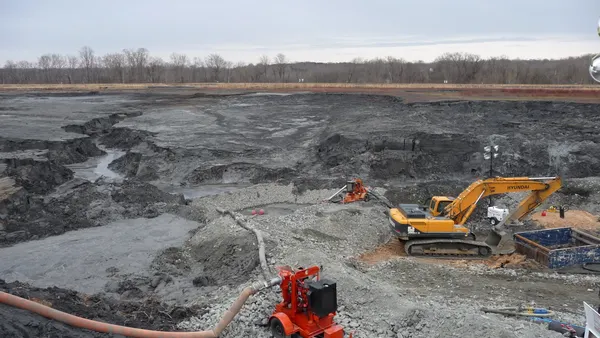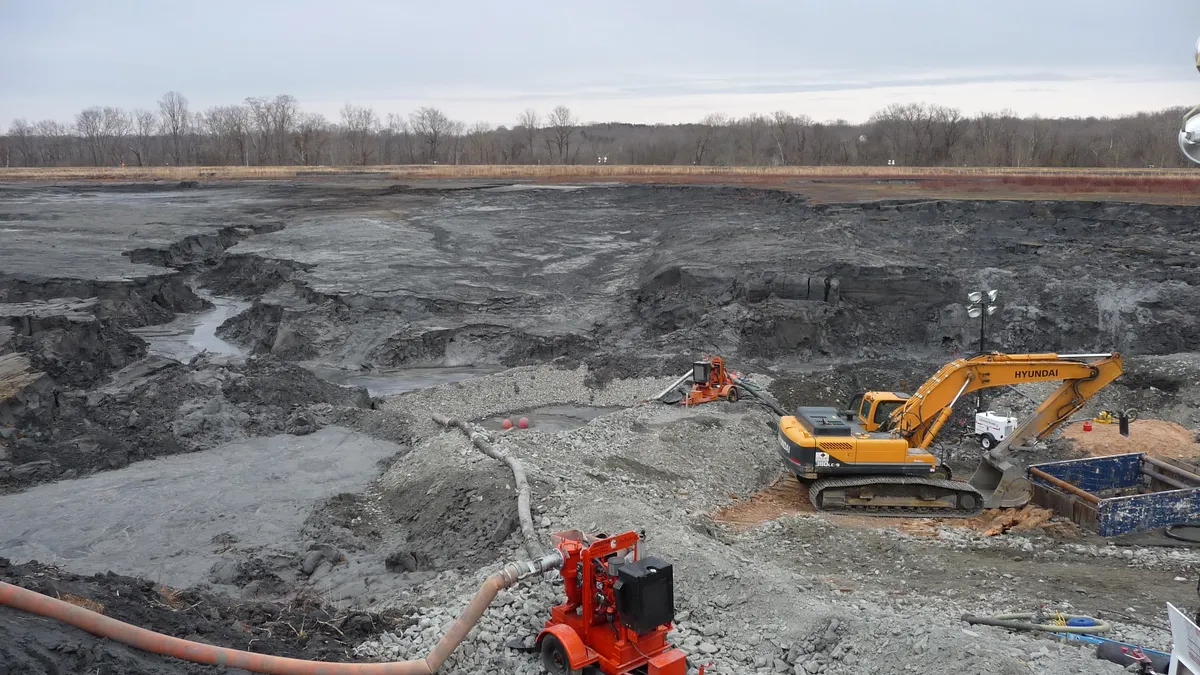
The owners of inactive coal ash ponds, landfills and other fill sites at coal-fired power plants will have until February 2032 — an extra 33 months — to begin cleaning them up under a final rule issued Tuesday by the Environmental Protection Agency.
The rule also pushes out groundwater monitoring requirements to February 2031 from May 2028.
“This new [groundwater monitoring] deadline is based on the Agency’s assessment of the time required to complete the groundwater monitoring requirements and to provide time for unforeseen and facility-specific delay, accounting for delays such as procuring qualified personnel on contractors, seasonal and regional weather, and permitting and approval needs,” the EPA said.
The deadline changes affect the EPA’s Coal Combustion Residuals requirements for “legacy” coal ash ponds and landfills that were issued in 2024. A separate 2015 rule covers active coal ash deposit sites.
The EPA said it plans to make additional changes to coal ash rules for legacy sites found in a Jan. 16, 2025, proposal.
Coal ash contains mercury, cadmium, chromium and arsenic, which are linked to cancer and other health problems, according to the EPA. Those pollutants can seep into groundwater from the coal ash disposal sites.
The EPA estimates that there are 110 coal-fired generating units with 189 coal ash disposal sites that will be affected by the deadline changes.
The owners of the landfills will save a total of $8.1 million to $30 million a year because of the delayed compliance deadlines, depending on the discount rate used to make the calculation, according to the EPA.
Delaying the compliance deadlines may increase health risks for children and other populations, the EPA said in its final rule.
The delay means more pollution will enter groundwater supplies, according to Earthjustice, an advocacy group that led litigation that caused the EPA to issue its rules for active coal ash sites and legacy landfills and ponds.
“The longer industry delays, the more toxic waste enters our water, and the more difficult cleanup becomes,” Lisa Evans, senior counsel at Earthjustice, said in a statement.
In line with the Trump administration’s support for fossil-fueled generation, the EPA has moved to weaken regulations affecting coal-fired power plants.
The agency, for example, has proposed rescinding its “endangerment finding” for greenhouse gas emissions, rolling back air pollution rules under its Good Neighbor Plan, extended wastewater deadlines for power plants and proposed repealing updates to its Mercury and Air Toxics Standards affecting coal- and oil-fired generating units, according to a regulatory tracker from the Environmental & Energy Law Program at Harvard University.
At about 193 GW, coal-fired power plants made up about 14% of installed U.S. generating capacity as of November, down from about 306 GW a decade earlier, according to the Federal Energy Regulatory Commission.