Dive Brief:
- The California Energy Commission on Friday issued its final permit for a first-of-its-kind energy storage system that can discharge at full power for up to eight hours.
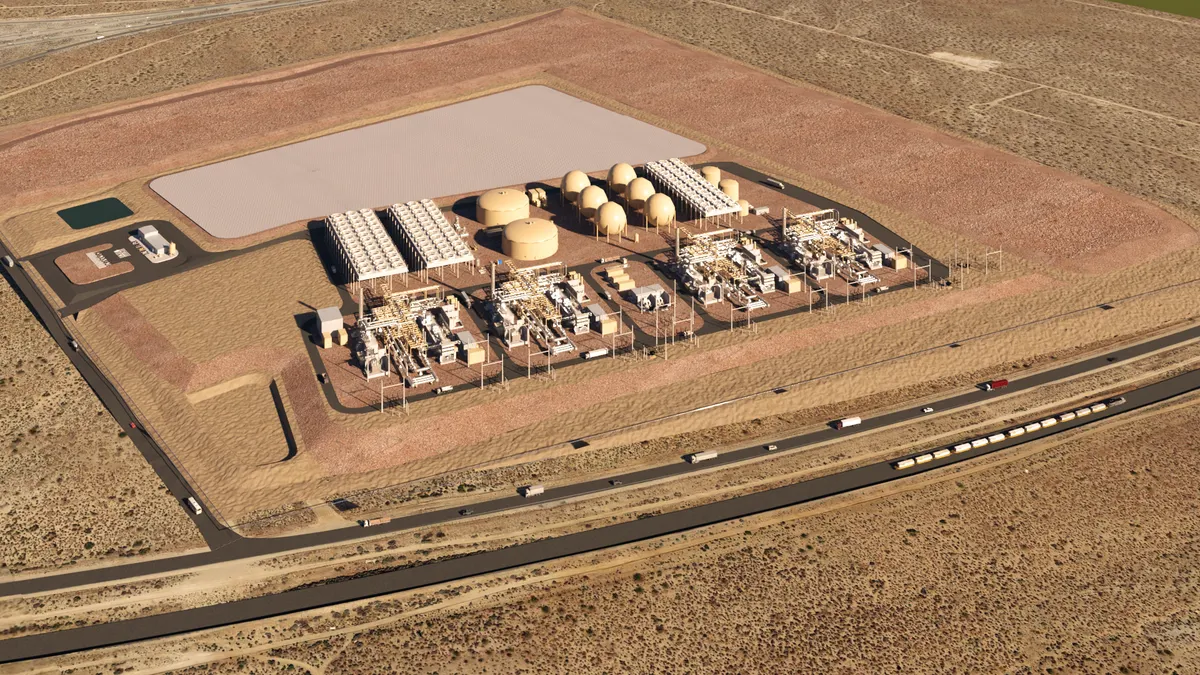
- The 500 MW/4 GWh Willow Rock Energy Storage Center would use proprietary compressed-air technology developed by Hydrostor, a Canadian company. Hydrostor expects the facility to operate for 50 years, it said.
- The company plans to break ground on the project in mid-2026, Jon Norman, Hydrostor’s president, said in an email. “[We have] a few additional federal actions already underway that are typically completed in the months immediately preceding the associated phase of construction [and are] confident in our ability to secure these agreements in advance,” he said.
Dive Insight:
Hydrostor has until December 2030 to begin construction, after which it would need to request an extension from the CEC, Norman said.
The Willow Rock Energy Storage Center would be built on 89 acres of private land in a sparsely populated high-desert section of Kern County, the longtime hub of California’s oil and gas industry. It will interconnect at Southern California Edison’s Whirlwind Substation via a new 230-kV, 19-mile transmission line.
Hydrostor’s “advanced compressed-air energy storage” system, or A-CAES, taps compressed air, water and heat to store and discharge electricity.
The system uses a grid-powered compressor to concentrate and inject air into purpose-built rock caverns. It captures and stores the heat generated during compression in a thermal storage tank, which Hydrostor says increases efficiency and eliminates the need to burn fossil fuels later in the process. An aboveground “water head” keeps the compressed air locked in the caverns at a constant pressure. When the system is ready to discharge, it releases the head and allows the air to flow back to the surface, where it recombines with the stored heat and drives a turbine to generate electricity.
The CEC says Willow Rock will have four power turbine trains with their own electric drivetrains, heat exchangers, generators and air exhaust stacks. The trains will share a common set of thermal storage tanks and air storage cavern.
Hydrostor says its design is more efficient than existing CAES systems, has low construction and operating costs, and can economically scale beyond 100 MW.
In a July 2024 interview with Utility Dive, Hydrostor co-founder and CEO Curtis VanWalleghem said the company’s installed cost is about $3,000/kW for a 10-hour system and about $50/kWh per additional hour, with a “clear path” to a further 20% cost reduction. A September analysis by GridLab and Halcyon found significant recent increases in pricing for combined-cycle gas turbine plants, with quotes for new builds “often exceeding $2,000/kW.”
Since 2019, Hydrostor has operated a “commercial reference facility” in Ontario with 1.75 MW/7 MWh of contracted discharge capacity. But Willow Rock would likely be one of Hydrostor’s first utility-scale projects to reach operation — joining the 200 MW/1.6 GWh Silver City Energy Storage facility in New South Wales, Australia, which received a key permit earlier this year.
Hydrostor says it has more than 6 GW of projects in earlier stages of development, mostly in renewables-rich regions like Australia, the United Kingdom and the southwestern United States. The company says its systems can help reduce renewables curtailment.
According to Hydrostor’s website, the U.S. pipeline includes potential 500-MW projects in Nevada, Arizona and New York; a 500-MW project in San Bernardino County, California; and “an active queue position with [the Los Angeles Department of Power and Water] that is currently contemplated to be used for an additional project in Kern County.”
The CEC said last year that California needs as much as 37 GW of long-duration storage to fully replace its gas fleet by 2045 as required by law.