Dive Brief:
- Peak Energy and General Motors are teaming up to develop and deploy sodium-ion battery systems for grid-scale stationary energy storage, the companies said on June 9.
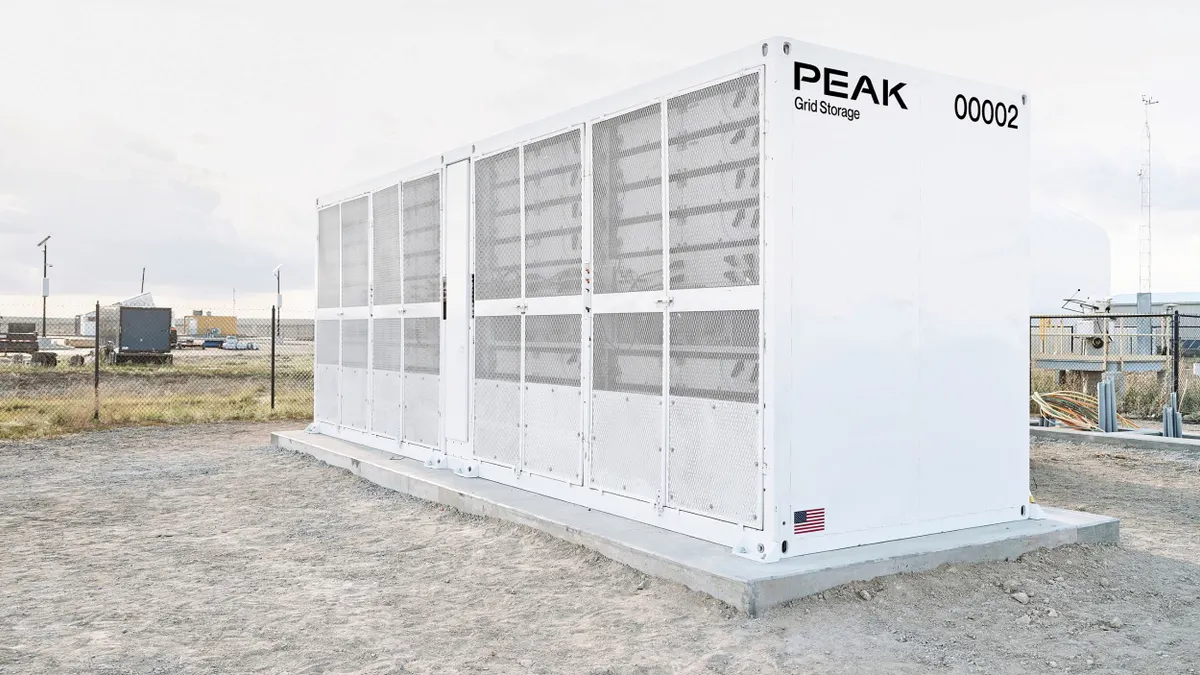
- Peak and GM said the partnership will tap Peak’s passively cooled energy storage technology with GM’s battery cell manufacturing capabilities. GM will develop sodium-ion battery cells in Michigan and enjoy exclusive manufacturing rights, creating a reliable domestic supply of components for Peak’s finished energy storage systems.
- The companies said Peak’s sodium-ion battery systems cut energy storage costs by 20% over conventional systems and could reduce energy waste from U.S. grid battery systems by up to 2 TWh per year following a wholesale switchover from lithium-iron-phosphate, the current standard for grid-scale stationary energy storage.
Dive Insight:
This marks Colorado-based Peak Energy’s second major customer or partnership announcement in less than a year.
Peak said in November that it would supply up to 4.75 GWh of sodium-ion battery systems to Jupiter Power, an independent power producer, by 2030. That agreement sees Peak delivering 720 MWh to Jupiter for deployment in 2027 and a capacity reservation for up to 4 GWh of additional capacity from 2028 to 2030.
The company has 6.5 GWh of orders booked, Landon Mossburg, Peak’s cofounder and CEO, told Utility Dive last week.
Most of the world’s operating sodium-ion stationary energy storage systems are in China. So is most of the technology’s manufacturing capacity, which the International Energy Agency expects to increase sixfold by 2030. Peak and now GM are leading the push to stand up a domestic U.S. supply chain after Peak energized the country’s first grid-tied deployment last fall — a 3.5-MWh system near Denver.
“Pairing GM’s supply chain access with Peak’s work at our cell engineering center [in Colorado], we are well positioned to build a mine-to-grid domestic supply chain,” Mossburg said in an email.
The systems the company plans to develop with GM will use Peak’s current system design but will nonetheless “leapfrog existing tech on the market,” Mossburg said, with improved energy density that further reduces operating costs.
Mossburg said the systems will target four- to 12-hour discharge durations and support the country’s two biggest markets for energy storage: data centers and the power grid. The cells’ high cycle lives and low degradation rates make them a better fit for data centers’ volatile power needs than lithium-ion batteries, which struggle with multiple daily charge and discharge cycles, he said.
Sodium-ion batteries also have a wider range of optimal operating temperatures than lithium-ion batteries. According to the IEA, they retain 90% of operational capacity at minus 104 degrees Fahrenheit and can operate at temperatures up to 158 F, hotter than any temperature ever recorded on Earth’s surface.
And because Peak’s systems are passively cooled, rather than actively cooled like lithium-ion battery systems, they use less energy for their own operations and require less maintenance over time, Mossburg said.
More news may soon be on the way for Peak Energy. The company will announce the location of a planned 4 GWh/year domestic manufacturing facility this summer, Mossburg said.