Dive Brief:
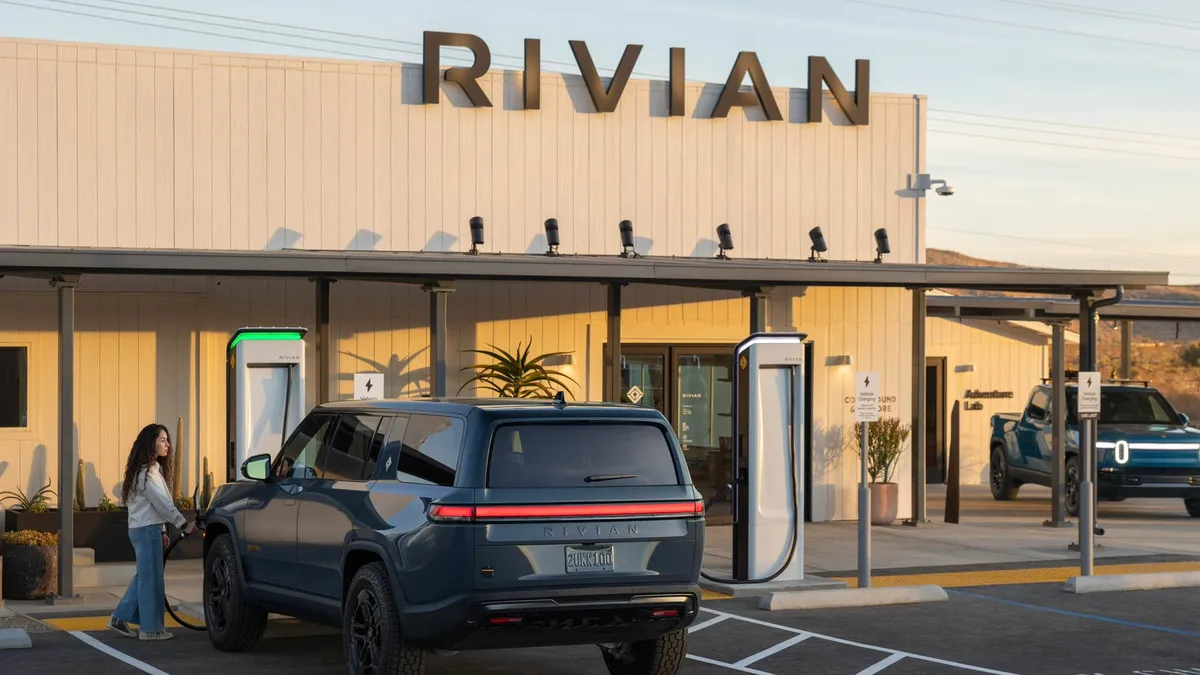
- Rivian electric vehicle drivers will have access to utility EV charging programs managed by EnergyHub under a partnership the companies announced Tuesday.
- In statements accompanying the announcement, Rivian and EnergyHub officials said participating EVs would help utilities shore up their grids amid rising electricity demand while simplifying drivers’ daily routines and lowering their fuel costs.
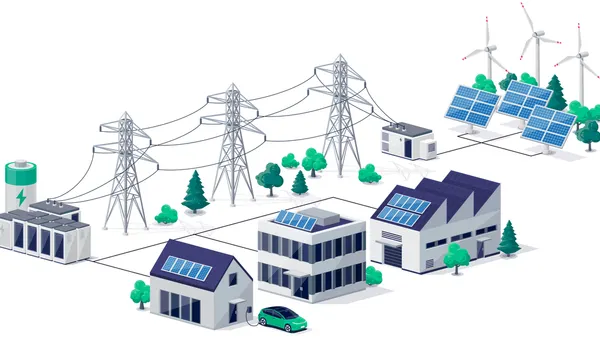
- Rivian EVs will be eligible to participate in the active and passive EV charging solutions EnergyHub offers to utilities as part of a broader virtual power plant platform that knits together connected thermostats, residential batteries and other distributed energy resources, the companies said.
Dive Insight:
In an interview ahead of the announcement, leaders with Rivian and EnergyHub said EV adoption had advanced to the point where managed charging provides tangible benefits from individual distribution nodes all the way up to regional bulk power grids.
The combined capacity of EVs on U.S. roads today is nearly 200 GWh, said Andrew Peterman, Rivian’s director of advanced energy solutions.
“People talk about the need to scale EVs [further] to be a resource for the grid, but we’ve already reached a level of EV adoption that is incredibly meaningful for the grid today,” Peterman said.
A January report prepared by Brattle Group on behalf of EnergyHub found that active and passive managed charging strategies delivered far less energy to plugged-in EVs during peak demand windows than EVs in an “unmanaged” control group consumed. Individual EVs in the active managed charging group consumed less energy than those in the passive group, underscoring the load-shaping potential of EnergyHub’s technology.
Effective managed charging programs boost distribution grids’ EV hosting capacity by a factor of two to three before infrastructure upgrades are required, Brattle said in the report, which also found that utilities could lower per-vehicle costs more than 25% by switching from unmanaged to managed charging.
Jeff Huron, EnergyHub senior manager for EV strategy and business development, said his industry is pushing to make managed charging more cost-effective by reducing overall program cost and adding more “layers” of value — something that works better when aggregators like EnergyHub partner directly with automakers, he added.
EnergyHub inked a similar managed charging partnership with GM Energy in April of last year that cleared Chevrolet, GMC and Cadillac EV owners to enroll in utility charging programs administered by EnergyHub.
Huron said his company is particularly excited about its partnership with Rivian, which he and Plowman separately called “a software-first” manufacturer that allows drivers to set up and modify managed charging for their vehicles.
Drivers in participating utility territories can use EnergyHub’s managed charging solution to plug their vehicles in, specify a desired state of charge and leave time, and let the software do the rest. EnergyHub ramps power flows to the vehicles up and down while ensuring they reach the target state of charge by the time they’re needed again.
Plowman said simplicity is a key selling point of software-enabled managed charging for time-pressed drivers and utilities eager to shape load. Because utility time-of-use tariffs are more complicated than the gas station billboards that tell internal-combustion vehicle drivers when and where to fill up, many EV drivers don’t follow them consistently on their own, he added.
“It’s unrealistic to expect customers to have to manage all that on a daily basis,” he said.
Rivian EVs will join a virtual power plant that EnergyHub says includes 2.5 million DERs and more than 3.5 GW of flexible capacity, across more than 170 utilities. Huron said having multiple resource types on the network — not just EVs but thermostats, home batteries and other devices — broadens its appeal to utilities facing a wide range of energy management challenges. So does its “dynamic load shaping” capabilities for EVs specifically, which makes battery-powered vehicles an asset rather than a liability on congested distribution grids.
“Some [utilities] are more interested than others based on characteristics of the market,” Huron said, explaining the appeal of EnergyHub’s VPP. “But the goal is to unlock enough layers of value that you can apply it to your utility or your [grid] network.”