




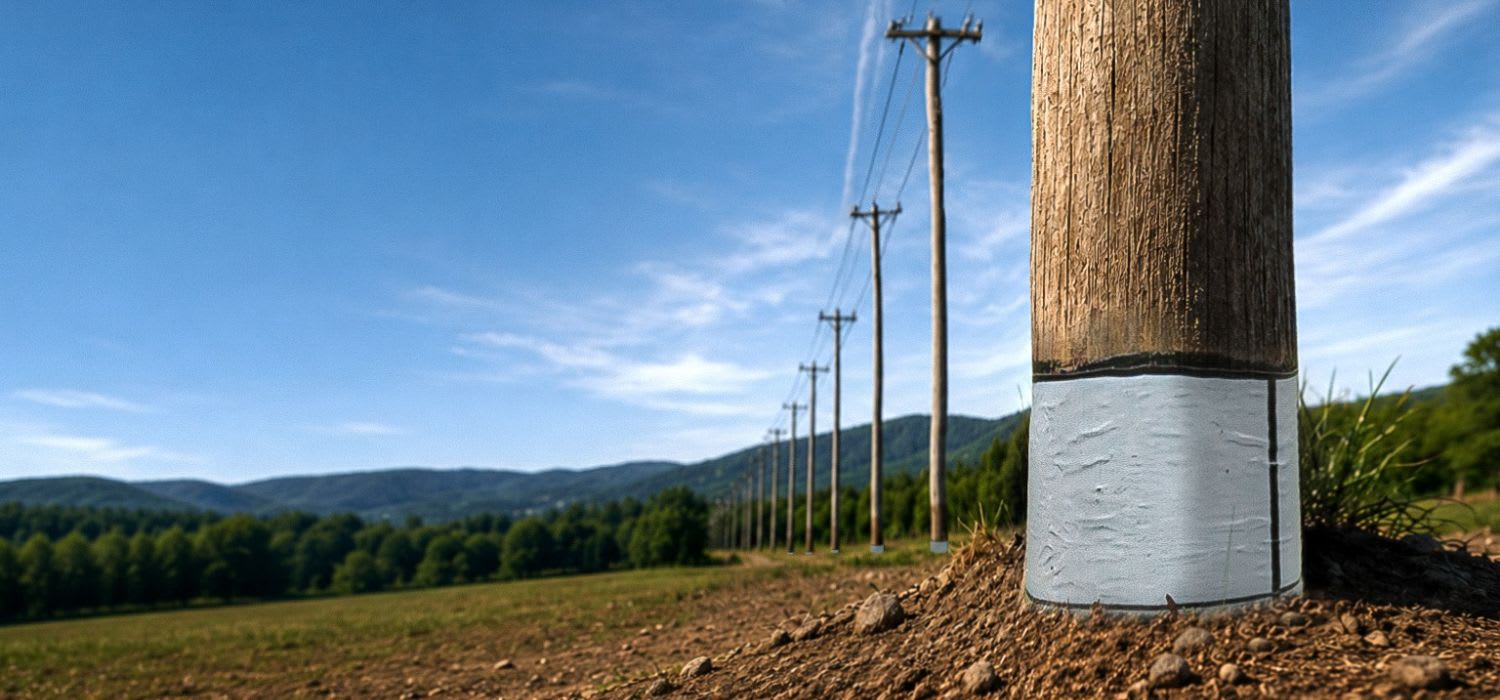
A review of decades of field and laboratory evidence concludes that an additional 20 years of service life is a realistic and achievable outcome for wooden utility poles protected with Polesaver Rot-Guards.
Polesaver, manufacturer of Rot-Guard ground-line protection barriers for wooden utility poles, commissioned the independent review of its product test data by American wood preservation expert Craig R. McIntyre of McIntyre Associates, Inc.
The review brings together field trials, laboratory testing and utility experience accumulated by Polesaver over more than 30 years. It assesses evidence relating to moisture ingress, resistance to biological decay and the retention of wood strength; key factors influencing the long-term performance of wooden utility poles.
The evidence reviewed spans multiple testing environments, exposure periods and assessment methods, including:
- Eight years of volume field exposure in Uganda, providing evidence from a challenging outdoor environment.
- Ten years of independent field testing on poles in England, assessing performance over an extended period.
- 25 years of independent field testing on wooden stakes, providing a longer-term perspective on barrier system performance.
- Four years of utility commissioned independent soil-bed testing, investigating the effectiveness of Rot-Guard in preserving wood strength.
- Moisture-ingress testing examining the performance of complete and partial barriers.
Together, these studies provide a substantial body of evidence for evaluating the performance of Rot-Guard technology and its potential contribution to longer-lasting wooden utility poles.
Simon McArt, Global Sales Manager at Polesaver, commented:
“This independent review is an important milestone for Polesaver. It brings together decades of testing and practical experience and provides valuable external support for our claim that Rot-Guards can add a further 20 years to the service life of wooden utility poles.
“For utilities, maximising pole life can help reduce premature replacement, improve asset management and make better use of infrastructure investment. Research and development have always been central to our approach, and this review reinforces the importance of building product claims on a robust body of evidence and our long term experience of millions of Rot-Guard protected poles protected worldwide.”
The review examines findings from field exposure trials and laboratory testing to evaluate how Rot-Guard technology helps manage moisture at the vulnerable ground-line section of wooden poles, where conditions can promote fungal decay and subsequent loss of structural strength.
For electricity utilities worldwide, pole longevity is an important consideration in network reliability, maintenance planning and whole-life asset costs. Technologies that prevent ground-line decay offer a practical means of improving the service life of new wooden poles and reducing the frequency of premature replacement.
A copy of the test can be downloaded here: https://polesaver.com/products/rot-guard-sleeve/craig-mcintyre-report/
About the independent reviewer
Craig R. McIntyre is an American wood preservation expert and author of the review, undertaken through McIntyre Associates, Inc. His professional affiliations include organisations and standards bodies associated with wood preservation, forestry, materials testing and industry standards, including ASTM, AWPA, ANSI, AFPA, ICC and SWST.
About Polesaver
Polesaver develops technologies that protect wooden utility poles and maximises their service life. Its Rot-Guard sleeves are fitted to new wooden poles before installation, creating a protective dual-layer barrier around the critical ground-line region. By helping protect this vulnerable area against decay, Rot-Guard technology is designed to support longer-lasting pole infrastructure and reduce premature pole replacement. Find out more at: https://polesaver.com/


