
Every buried utility pro has lived some version of this scene:
A crew gets a dig ticket, shows up on site, and everything looks right, until it doesn’t. The locate marks are there, the maps are… somewhere, and the asset you’re trying to locate is either (a) not where the map says it is, (b) not metallic enough to trace cleanly, or (c) installed by someone who cannot be reached.
That’s the reality of underground work: the dirt keeps secrets, documentation gets stale, and even good locates can’t tell you everything about what’s below. This is exactly where RFID-enabled buried markers change the game because they don’t just mark a point. They carry the story of that point.
A marker isn’t just a target. It’s a data handoff.
Traditional buried markers solve an important problem: they make non-metallic assets and critical points findable. Assets such as valves, splices, tees, drops, end-of-lines, transitions. But a “findable point” still leaves key questions unanswered:
- Which line is this: water, reclaimed water, gas, fiber, power, irrigation control?
- What size/material?
- How deep? Installed when? By whom?
- Is there a known issue? Repair history?
When that information lives in someone’s binder, or on a laptop back at the office, it’s not helping the person holding the shovel.
With read/write RFID markers, the marker becomes a bridge between field reality and digital records right where decisions are being made.
The “five years later” problem (and how RFID fixes it)
Imagine you install a service today. You place an RFID-capable buried marker, like the Tempo OmniMarker-ID or Spike Marker-ID, at a critical point. Then you write useful, specific data to that marker:
- Asset type and owner
- Line ID / circuit ID / service ID
- Depth at install and offset notes
- Install date, crew, materials
- GPS coordinates (or a link/reference to them)
- Work order number tied to your mapping/GIS system
Fast-forward five years. Different crew. Different supervisor. Maybe a different contractor. The site has been repaved twice and landscaped once.
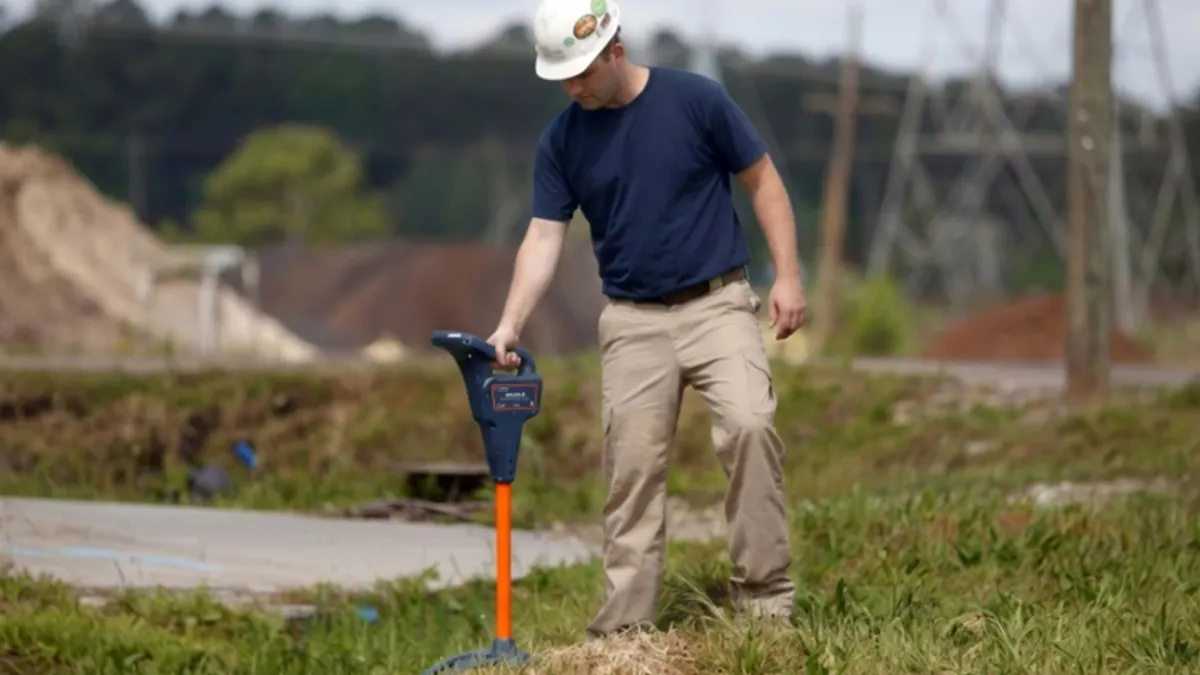
Now, when the technician uses a marker locator such as the Tempo EML250-ID Locator to find that marker, they’re not stopping at “there’s something here.” They can read what the marker says the moment they locate it and confirm they’ve got the right point before anyone breaks ground.
And if there have been repairs, reroutes, or there are depth differences they can write updates back to the marker after the work is done. That’s the part that matters most: read/write turns a static marker into a living record.
For utilities managing large plant inventories across sprawling service territories, the aggregated value of this data is significant. Each RFID read becomes a verification event — proof that an asset was present, at a given location, on a given date, with confirmed attributes. Over time, record-keeping supports smarter capital planning, faster emergency response, and more defensible compliance documentation.
Marking is good. Marking + mapping is better.
RFID strengthens good locating practices through:
1) Better identification at the point of work
When multiple utilities run through the same corridor, “close enough” can still be risky. RFID lets crews confirm what they found, not just where something might be.
2) Cleaner handoffs between crews and contractors
Field teams don’t have to guess what the last team meant by “valve near fence line.” The marker holds the same message for everyone.
3) Faster troubleshooting and repairs
If a tech can pull up the asset ID, previous work order notes, and even photos while standing over the marker, the fix gets quicker and more accurate.
4) Mapping that stays current
The real win is when RFID data connects to your mapping software. The marker gives you a consistent ID and a reliable “ground truth” point. Updates made in the field can be synced back into GIS/asset management platforms, keeping maps of the maze underground.
RFID-enabled markers like OmniMarker-ID and Spike Marker-ID, paired with the EML250-ID Marker Locator, turn a buried point into a usable data node. You’re not just placing a marker for the next locate - you’re building a system where the next locate (and the next one after that) is safer, faster and less dependent on tribal knowledge.
Learn more about Tempo’s RFID-enabled OmniMarker-ID, Spike Marker-ID and EML250-ID Electronic RFID Marker Locator at https://www.tempocom.com/tempes_cat/location-and-irrigation/.