Federal Energy Regulatory Commission members on Thursday said they saw progress in recently proposed frameworks for ensuring the PJM Interconnection has adequate power supplies and protects consumers from rising utility costs.
Last week, the Trump administration and governors of states in PJM’s footprint called on the grid operator to hold an “emergency” auction for data center developers to contract for new power supplies. Separately, the grid operator’s board issued its own plan for a backstop auction that would assign costs to utilities and other load-serving entities.
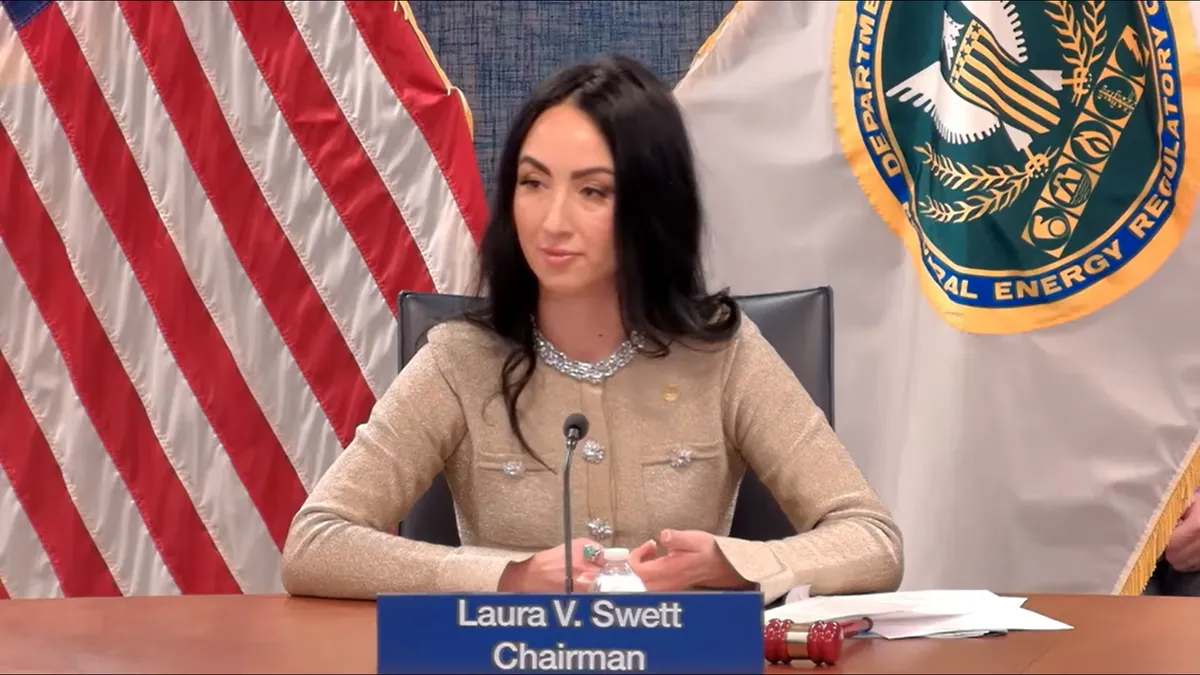
FERC Chairman Laura Swett said she is “encouraged that PJM and its stakeholders are working cooperatively now, much more so than they have in the recent past.”
She emphasized the importance of market rules to drive decisions around building, financing and operating critical resources “to support our country's reindustrialization and to win the AI race against our adversaries.”
“We are at a crossroads of deciding critical issues to maintain national and economic security, but we need to ensure that hard working Americans don't shoulder increasing energy bills,” she added.
Swett said she saw many shared principles between the two plans, including a reliability backstop auction, load forecasting improvements, expedited interconnection, a broad review of PJM’s market design and consideration of an extended price collar on the auction results.
“FERC is ready to quickly evaluate any proposals that come before us,” Swett said.
Commissioner David Rosner also said he was encouraged by the “consistent direction” among stakeholders toward “fixing” PJM’s markets.
However, Rosner warned that the PJM market was only one part of the puzzle in developing power supplies in the grid operator’s footprint, which covers all or parts of 13 Mid-Atlantic and Midwest states and the District of Columbia.
“We also are entirely dependent on the PJM states, the load serving entities and the developers who build this new generation to take that financing, procurement and permitting and construction steps that are needed to turn a price signal into steel on the ground,” Rosner said. “We can get the price signal right, but we also need our partners in the states and the industry to expeditiously pursue their part of the job.”
PJM staff is working hard to address the supply crunch in a “very complicated and really difficult environment” with few easy or obvious solutions, according to Commissioner Judy Chang.
“My hope is that by the end of 2026, we will make real progress towards bringing new competitive supply online while stabilizing the markets on which customers rely,” she said.
The grid operator said in a Tuesday letter that it expects to make an “imminent” filing at FERC proposing a voluntary bring-your-own-generation construct for large loads that will include an expedited interconnection track for new generation. PJM aims to have the new process in place by August.
The PJM board also directed PJM staff and stakeholders to immediately begin developing rules for a reliability backstop procurement mechanism. The process will be “informed” by the “statement of principles” endorsed by the White House National Energy Dominance Council and PJM governors, PJM said. The grid operator said it intends to give FERC informational details on the effort by Feb. 27.
FERC approves capacity auction parameters
Meanwhile, FERC on Wednesday approved a set of parameters that help set capacity prices in PJM. In its decision, FERC dismissed arguments by PJM’s market monitor that elements of the proposal “will result in unjust and unreasonable capacity prices during a time of already significant market stress.”
Monitoring Analytics contends the PJM proposal will result in a maximum capacity price of $526/MW-day. Using parameters the market monitor deems more appropriate, the price cap would be $390/MW-day, resulting in billions of savings to consumers, it said.
But commissioners seemed swayed by the broad stakeholder support for PJM’s proposal.
Swett said it was designed to reduce price volatility, reduce customer exposure to higher prices and enhance the capacity market's ability to attract and retain the capacity resources over the status quo rules.
Rosner said the level of consensus behind the proposal was noteworthy.
“It requires a solid economic underpinning, because economic theory does matter, but it also needs to have buy-in from the people who finance, build, permit and pay for the generation and transmission needed,” Rosner said. “That's the way that we're going to find durable solutions to similar problems facing PJM and other regions.”
Independent power producers supported PJM’s proposal. However, they may balk at an extension of a price collar that would lower the capacity auction’s maximum price as suggested in the White House-governors statement of principles. The PJM board said the grid operator should consider stakeholder comments on the issue.