
Dive Brief:
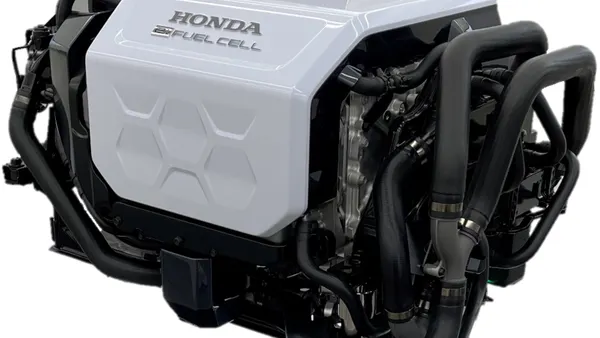
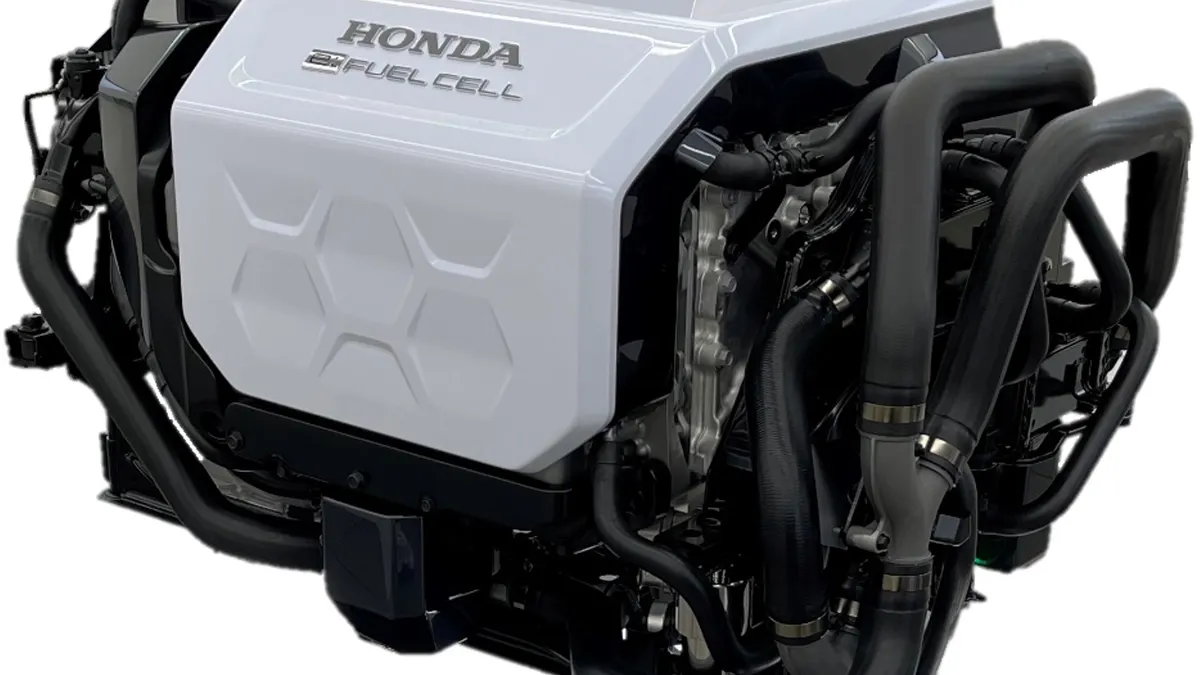
- Honda Motor Co. is ending production of fuel cell systems under its “Fuel Cell System Manufacturing” joint venture with General Motors by the end of 2026, the automaker announced in a Jan. 20 press release.
- The Michigan-based joint venture was established in January 2017 as the first-ever auto industry collaboration to produce lower-cost fuel cell systems using commonized parts suppliers and used by both automakers. At the time, Honda announced it was making an equal investment in the 50/50 joint venture with GM totaling $85 million.
- Honda, which has been working on fuel cell technology for over 30 years, will develop its next-generation hydrogen-powered system internally, without a partner. The automaker says it will continue to pursue opportunities to grow its hydrogen business and make it a core segment within Honda in the future, per the release.
Dive Insight:
The fuel cell system collaboration agreement between Honda and GM was first announced in July 2013. Although Honda said its fuel cell system collaboration with GM yielded “some positive results,” the two companies held discussions regarding the continuation of the business and an agreement was reached to end production.
The joint venture started volume production of fuel cell systems in January 2024 at a 70,000-square-foot facility inside GM's Brownstown battery plant in Michigan, which currently assembles battery packs for the electric Cadillac Celestiq.
In October, GM also announced it was ending fuel cell development through its Hydrotec brand, as well as ending production of hydrogen fuel cells for data centers and power generation through the FCSM joint venture with Honda. The automaker said it was refocusing its R&D efforts and capital resources to develop EVs, batteries and new charging technology.
In July 2025, Stellantis also announced it was scrapping its entire hydrogen fuel-cell development program in Europe for light-commercial vehicle applications and canceling the launch of hydrogen-powered vans. Production of the first fuel cell vans was slated to begin last summer. The automaker cited the limited availability of hydrogen refueling infrastructure and higher capital requirements for its decision.
In addition to its long-term commitment to develop fuel cell technology, Honda is refocusing its electrification efforts. Last May, Global Honda CEO Toshihiro Mibe announced that the company was reducing its investments in electric vehicles by $20.7 billion through 2030 in order to focus on launching new hybrid models.
In October, Honda unveiled its next-generation hybrid-electric (HEV) technologies at the company’s “Honda Automotive Technology Workshop.” Among the announcements was a new midsize platform for hybrid vehicles and a new V-6 engine for fullsize hybrid models.
Honda was the world’s first automaker to offer a fuel cell vehicle when it launched the second-generation hydrogen-powered Clarity sedan in December 2016 in California. The fuel cell Clarity also received a Wards 10 Best Engines award for 2018. But production of all Clarity models ended in August 2021.
Along with Honda, Hyundai Motor is also developing fuel cell technology as part of its long-term electrification strategy. Last April at the Seoul Mobility Show 2025, the automaker unveiled an all-new version of its NEXO fuel cell crossover. A global launch is planned for early 2026, but Hyundai did not say if its new hydrogen-powered SUV would be offered in the U.S.