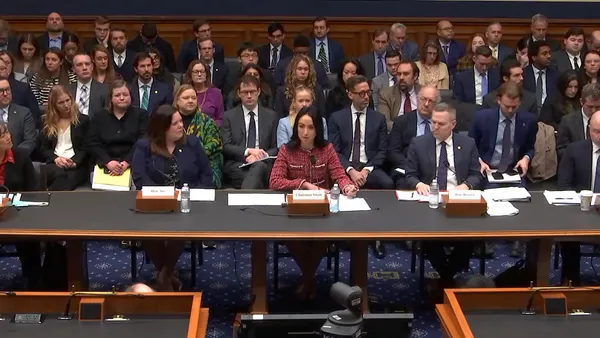
The U.S. House of Representatives on Thursday passed permitting reform legislation, the SPEED Act, with an amendment that prevents the bill from applying to offshore wind projects.
The SPEED Act would amend the National Environmental Policy Act to ease and speed the permitting of energy projects. It introduces new deadlines for opposition to projects – opponents would have to make a claim against a project no later than 150 days after final agency action is made public, for instance.
It also mandates that “not later than 30 days after completing an environmental impact statement or an environmental assessment for the proposed agency action, the lead agency, and any cooperating agency, shall issue a final agency action.”
The offshore wind carveout applies to “the issuance, modification, approval, or administration of any lease, easement, right-of-way, site assessment plan, construction and operations plan, or any other authorization for an offshore wind energy project,” the amendment says.
The amendment was proposed by two New Jersey representatives, Reps. Chris Smith, R-N.J., and Jeff Van Drew, R-N.J., along with Maryland’s lone Republican representative, Rep. Andy Harris, R-Md.
Smith said in a Thursday release that the amendment was “absolutely critical for preserving the Trump administration’s ability to continue its much-need reviews of ocean wind projects off of the Atlantic Coast due to overwhelming safety and national defense concerns.”
He said that the amendment was designed to avoid nullifying the Trump administration’s actions against offshore wind, including a halt on offshore wind permitting which a federal judge struck down as illegal in a Dec. 8 ruling.
In his own release, Harris said he “was engaged in deliberations with the House Natural Resources Committee for months to ensure the inclusion of this language, guided by a single principle: my constituents in Ocean City and communities across the Atlantic Coastline are not for sale.”
The Oceantic Network said in a Thursday release that the group is “disappointed in the late inclusion of an amendment which is discriminatory toward renewable energy” and urged the Senate to “restore the heart of bipartisan permitting reform” when it takes up the bill.
The Union of Concerned Scientists said Thursday that it opposed to the bill in its entirety out of concern that it “would erode public and environmental safeguards” and that “NEPA outlines a robust process for environmental reviews based on scientific rigor, transparency and deliberation, all of which require appropriate time and effort.”