Dive Brief:
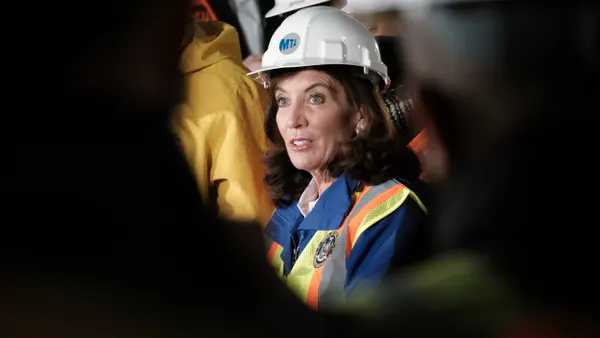
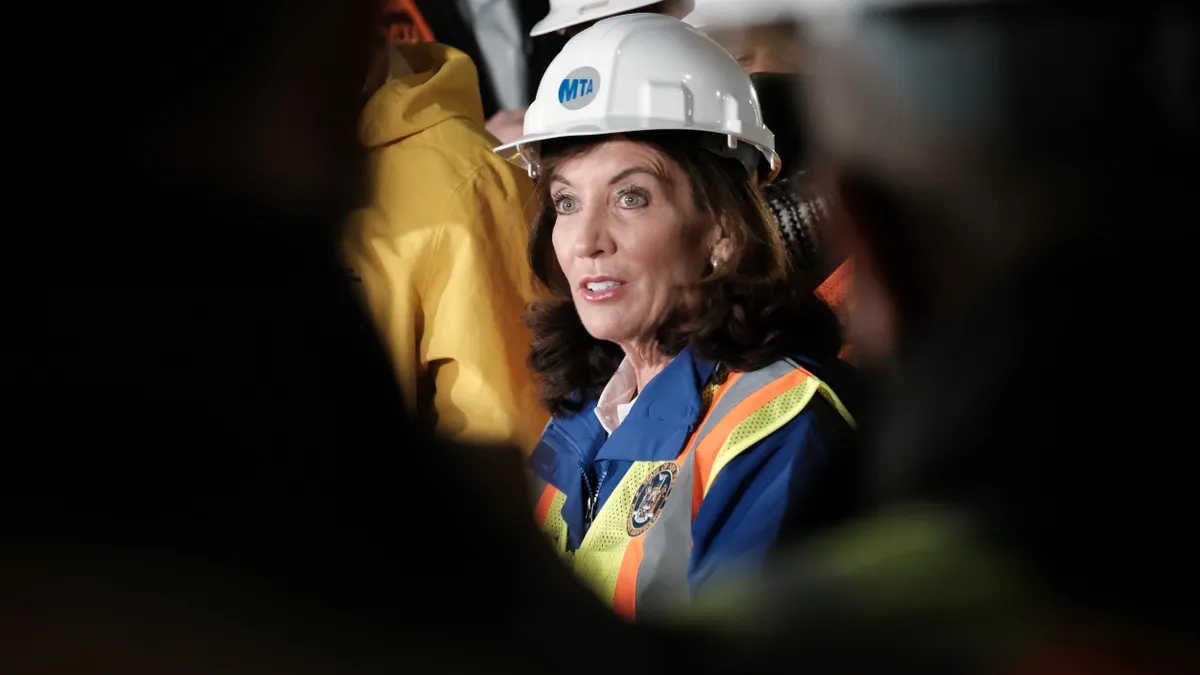
- New York needs “breathing room” in meeting a state law that requires 70% renewable energy and a 40% cut in state-wide greenhouse gas emissions by 2030, Gov. Kathy Hochul said during a Wednesday summit hosted by Politico.
- Hochul said the state’s ambitious emissions reduction goals have been hindered by factors including the COVID pandemic, the financial struggles the offshore wind industry encountered after 2020, President Donald Trump’s opposition to renewable energy and the ongoing energy affordability crisis.
- “No matter what we do, we're always going to fail because we jacked up the standards so high on ourselves,” Hochul said during a fireside chat with Politico’s Albany bureau chief, Nick Reisman. “My job is dealing in reality. This is the reality I have.”
Dive Insight:
The governor said the state’s ongoing budget talks are likely the “best vehicle” for altering the 2019 New York Climate Leadership and Community Protection Act. The law set a state goal of 100% zero-emission electricity by 2040 and 9 GW of offshore wind by 2035.
Cutting greenhouse gas emissions by 40% by 2030 as required by the CLCPA could cost the households that would be most impacted — “upstate, two car households that rely on heating oil” — an additional $4,100 a year in energy and fuel costs, the New York State Energy Research and Development Authority said in an analysis released Feb. 26.
“The targets as adopted in 2019 could not have foreseen the substantial reversal in the federal policy landscape, the disruptive and lingering impacts of COVID-19 and the subsequent supply chain crisis, the return of an inflationary economy, and the influence of geopolitical events on energy costs generally,” NYSERDA said.
Some Republicans in the New York Assembly rallied around the memo as a confirmation that the CLCPA’s mandates are unaffordable for the state, while climate activists and some Democrats in the legislature criticized the memo’s accuracy and aims.
“The NYSERDA memo misleads by conflating the CLCPA with cap-and-invest — a program that does not yet exist — and by speculating on the most expensive way to do it,” said Assemblymember Jo Anne Simon, D, in a March 6 release. “We should be driven by reality and not Big Oil’s talking points.The reality is that utility costs are driven by maintaining costly, old fossil fuel infrastructure, not by the CLCPA.”
When Reisman asked about opposition from Democratic lawmakers to changing the law, Hochul said, “I'm on their side. I have been on their side... I cannot deal in hypotheticals and aspirations when I have to govern a state where my people are suffering and I have to alleviate that pain.”
Hochul criticized New York’s representation in Congress, saying, “I don't hear much from them in fighting for us. Let's get them to say, ‘You know what, can we just get offshore wind turned back on without any hassle? Can we get more support for solar arrays?’”
The governor said she also sometimes faces a lack of local support in a state with “very strong home rule.”
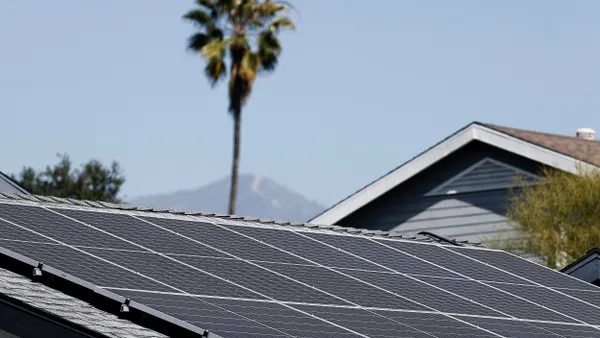
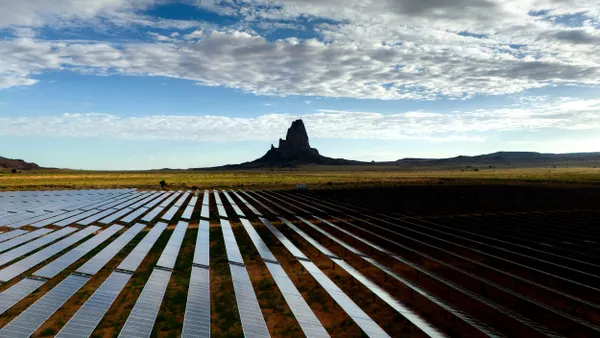
“Solar arrays and battery storage, we've got a problem with localities who are saying no, so let me just point that out as well,” Hochul said. “If the locals don't want it, I can't jam it down their throats.”
“We have plans,” she said about renewable energy installations. “I wish we had this local support, and we don't.”