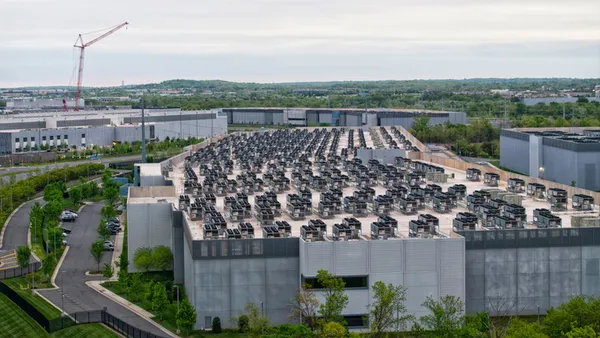
Dive Brief:
- New Jersey Assemblyman David Bailey Jr., D, whose bill requiring utilities to develop large load tariffs that would apply to data centers passed both legislative chambers this week, said Democratic Gov. Phil Murphy is seeking last-minute changes to the proposal that in Bailey’s view would weaken its ratepayer protections.
- Gov. Murphy’s office did not immediately reply to a request for comment. Gov.-elect Mikie Sherrill is due to be sworn in on Jan. 20, but according to Bailey, the incoming governor cannot sign legislation that was passed under the previous administration, placing the fate of the bill in Murphy’s hands.
- “We are not willing to bend to any changes to this bill,” Bailey told Utility Dive in an interview. “If he does nothing, in essence, he pocket vetoes it ... That’s on him.”
Dive Insight:
Bill A5462 was originally specific to data centers, but was amended to address “large loads” with a monthly demand of more than 100 MW. It is intended to protect other ratepayers from any increased costs that result from connecting and serving those large loads.
It directs regulated electric utilities to file an application for a new large load tariff with the New Jersey Board of Public Utilities within 180 days. The tariff must include ratepayer protections against cross-subsidization and stranded costs, and incentivize large load customers to adopt energy efficiency measures, including utilization of waste heat.
Additionally, it requires each utility to ensure that any new large load customer provides adequate financial guarantees that they will pay for at least 85% of the service they request for a period of not less than 10 years. Qualifying customers must also demonstrate that their project is “unique and not duplicative” to weed out speculative requests, and they must provide financial security in case the project ceases operations or takes less service than requested within 10 years.
The board may relax the requirements if a customer “commits to providing sufficient operational flexibility or commits to bringing additional sources of energy and capacity online to meet its load, such that these requirements are not necessary to protect ratepayers,” the bill says.
Bailey said Gov. Murphy had asked for changes that would make the bill less prescriptive and more flexible by removing some of the hard numbers around power purchases and timelines.
“Frankly, they’re seeking changes that would benefit the data centers,” Bailey said. “They came back to us with changes that we believe would really water down and weaken the bill.”
Dan Diorio, vice president of state policy for the Data Center Coalition, said his organization has been in talks with Gov. Murphy about their concerns with the bill, including the 85%, 10-year minimum demand provision and the “duplicative” disclosure requirement, which he said was vague and raised proprietary information concerns.
“The industry feels strongly that these [utility] commissions, the regulatory bodies, are best positioned in order to craft the details of the tariffs, of the rates, to ensure flexibility,” Diorio said. “Legislative ratemaking is, I think, never the preferred outcome.”
He said the industry was broadly aligned with many of the principles in the bill around customer protections and committed to paying its full cost of service for the energy it uses.
If Gov. Murphy doesn’t sign the bill before Gov.-elect Sherrill assumes her post, it would have to go back to the legislature to be voted on again, Bailey said. But he was confident that it would pass given its broad bipartisan support and the fact that the difficult negotiations have already taken place.
The bill passed both houses Monday by a margin of 24 to 15 in the Senate and 51 to 23 in the Assembly.
In an analysis, Capstone called the bill’s passage “unsurprising” given the rising concerns about affordability in states in the PJM Interconnection, which has seen sharp increases in power bills from capacity auction results.
It said its analysts “do not expect any forthcoming large load tariff to have material implications for the Public Service Enterprise Group Inc. (PEG) or data centers, given that New Jersey is not considered a prime location for development, considering land and energy constraints.”
“However, we do believe this would serve as a political win for state Democrats,” it added. “We expect energy affordability to drive the need for further legislative action this year in New Jersey and across the rest of PJM.”