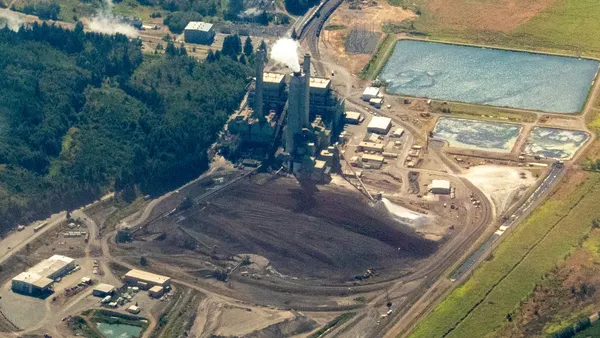
The Nuclear Regulatory Commission issued its first commercial nuclear reactor construction permit in nearly 10 years Wednesday to a subsidiary of Bill Gates’ TerraPower for a 345-MW plant planned near the site of a retiring coal plant in Kemmerer, Wyoming.
Kemmerer Power Station Unit 1 will be the first utility-scale advanced nuclear power plant in the U.S., TerraPower said in a release, and will supply power to PacifiCorp’s grid, with completion anticipated in 2030.
The NRC said that after a streamlined mandatory hearing process, it authorized its Office of Nuclear Reactor Regulation to issue the permit, “having found the staff’s review of the Kemmerer application adequate to make the necessary regulatory safety and environmental findings. The staff expects to issue the permit soon.”
Kemmerer Power Station Unit 1 is being developed through the Department of Energy's Advanced Reactor Demonstration Program, TerraPower said. It uses a design called Natrium, a “sodium-cooled fast reactor with a patented molten salt-based energy storage system,” which TerraPower co-developed with GE Hitachi Nuclear Energy.
The storage element can boost the system's output to 500 MW of power when needed “to keep base output steady, ensuring constant reliability, and can quickly ramp up when demand peaks,” said TerraPower.
TerraPower and Meta announced a deal last month that Meta would help fund the development of and receive power from two new Natrium units with 690 MW of capacity, with delivery as early as 2032. Meta also secured rights to energy from up to six other Natrium units totaling 2.1 GW in capacity with delivery targeted for 2035.
The NRC issued its safety evaluation for TerraPower’s permit in December, finding that the preliminary design and analysis of Kemmerer Power Station Unit 1 was “consistent with guidance and is sufficient and meets the applicable regulatory requirements” for the issuance of a permit, though staff noted “some remaining areas of uncertainty in the KU1 design and analysis.”
That uncertainty is acceptable under the NRC’s regulations, the report said, “which state that the expected design and analysis is preliminary and that outstanding safety questions may be resolved through [research and development] efforts.”
“The staff also notes that … [a permit] does not constitute Commission approval of any design feature unless specifically requested and incorporated into the permit; no such approval was requested in the application,” the NRC wrote, adding that this information can be left for later consideration in the Final Safety Analysis Report.