Dive Brief:
- The PJM Interconnection’s board should reject a proposal from NextEra Energy and Exelon to build a $1.7-billion transmission line across central Pennsylvania, partly due to the uncertainty around data center demand forecasts, according to the Pennsylvania ratepayer advocate.
- The project is part of PJM’s proposed $11.6-billion regional transmission expansion plan that is under review by the grid operator’s board. The RTEP aims to ensure a reliable grid in 2030 and is based on substantial demand growth from data centers contained in a forecast issued a year ago. A more recent forecast issued this month trimmed those expectations while still projecting growth.
- “We believe that likely in-state generation buildouts or faster-to-deploy alternatives utilizing existing [right-of-ways] could solve the problems this line intends to address while imposing lower costs and providing higher benefits to Pennsylvania ratepayers,” the Office of Consumer Advocate, or OCA, said in a letter to PJM’s board on Wednesday.
Dive Insight:
PJM’s annual RTEP comes amid concerns about how data centers could make electricity more expensive for ratepayers.
In PJM, a region that covers all or part of 13 Mid-Atlantic and Midwest states and the District of Columbia, much of the focus has been on how rising capacity prices affect electric bills. The grid operator holds capacity auctions several years in advance to secure supply based on existing and projected loads, leading to price spikes that were heavily influenced by aggressive estimates of future demand.
In PJM’s last three capacity auctions, data centers accounted for $23.1 billion in costs — $21.5 billion of which were for projected data centers that were not online yet at the time of the auctions, the grid operator’s market monitor said in a Thursday presentation to the grid operator’s Members Committee.
As a result, the average cost of wholesale power in PJM jumped 49% in 2025 to $82.67/MWh, according to the presentation from Marketing Analytics. Energy accounted for 60% of that price, followed by transmission at 22% and capacity at 16%.
By comparison, in 2024, the average cost of wholesale power in PJM was $55.52/MWh, with energy accounting for 59%, transmission for 32% and capacity just 7%.
Capacity costs accounted for $13.09/MWh of the overall price of wholesale power last year, up about 260% from $3.61/MWh in 2024. Net transmission costs increased more modestly, from $17.73/MWh in 2024 to $18.53/MWh in 2025.
The Pennsylvania consumer advocate concluded that electric utility customers in that state are paying higher energy prices largely because of increased costs for bulk power grid services “driven by data center and artificial intelligence demand that is outstripping existing and forecasted supply, resulting in higher wholesale supply costs and expensive transmission grid expansion.”
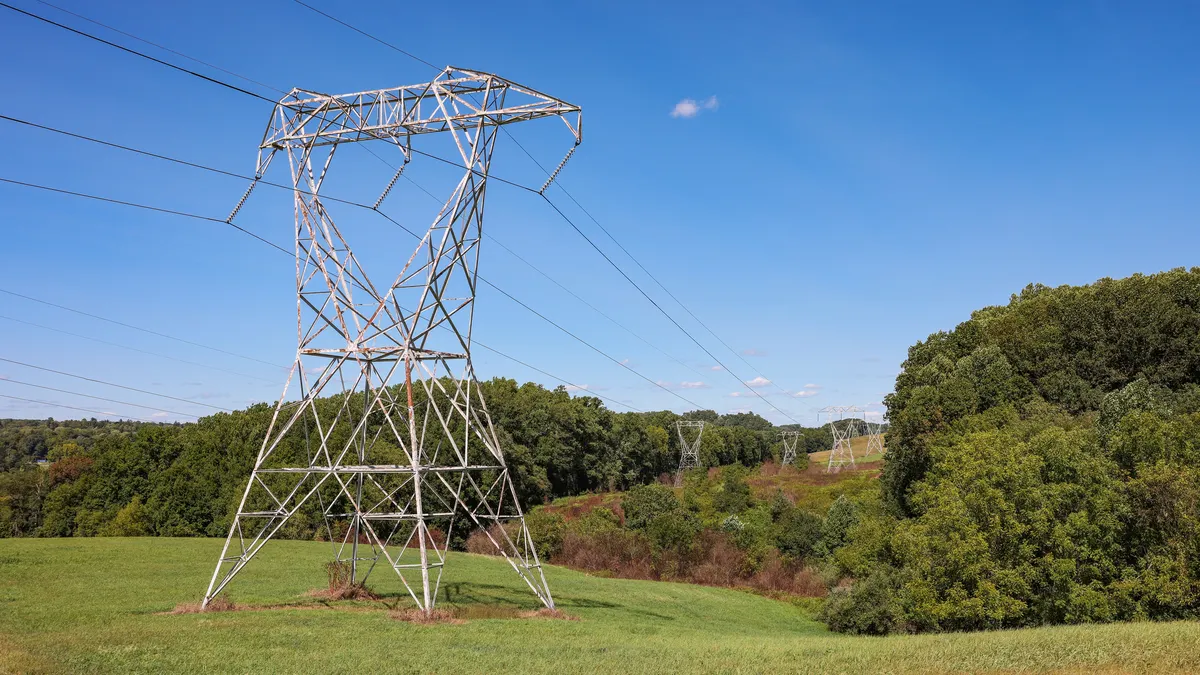
The OCA’s concern centers on a 765-kV project proposed by NextEra and Exelon that would run about 221 miles from Marshall County, West Virginia, to Perry County, in central Pennsylvania. 765-kV is the highest voltage transmission line available and are not widely deployed in the U.S., but several major grid operators are building more.
Residential ratepayers across PJM would pay about $9 billion if the entire $11.6-billion regional transmission plan is approved as proposed, according to the office, which is led by Darryl Lawrence. The lead advocate is nominated by the state attorney general and confirmed by the state Senate.
PJM has said the line — called Project 237 — would help it reliably handle load growth in PPL Energy’s territory and the Mid-Atlantic region in general, according to its analysis. It would also help the grid cope with delays in offshore wind development and future generation retirements by expanding an existing 765-kV backbone into PJM’s eastern region, allowing for more flexibility in serving load, PJM staff said in the report.
But the ratepayer advocate said the approval of the NextEra-Exelon project is premature given “rapidly evolving circumstances around data center AI load, incomplete assumptions, and process concerns.”
Last week, PJM revised down its near-term load growth projections, and the Trump administration and PJM governors and PJM’s board have both called for a backstop or emergency auction to procure more power supplies — though the details of those proposals are unclear and would require regulatory approval.
The advocate said the impact of any changes on transmission needs and planning is uncertain, raising the risk of expensive new projects.
“Project 237 has the potential to become the ‘poster child’ for overbuilding new transmission infrastructure and failure to solve reliability needs with potentially less expensive generation options, storage, demand response and other innovative proposals,” the OCA said.
Previous transmission expansion plans by PJM have sparked conflict. The Maryland Office of People’s Counsel, for example, in 2024 challenged the cost allocation for PJM’s $5.1-billion 2022 Regional Transmission Expansion Plan Window 3.
In part, that plan was driven by data center development in northern Virginia. Under a cost allocation proposal approved by the Federal Energy Regulatory Commission, ratepayers in Virginia will pay about $2.5 billion, leaving utility customers in Maryland to pay $551 million and other PJM transmission owners paying about $2.1 billion, according to the Maryland OPC.
The Maryland ratepayer advocate had argued unsuccessfully that Virginia should pay a larger share of the cost for data centers built in that state.