Dive Brief:
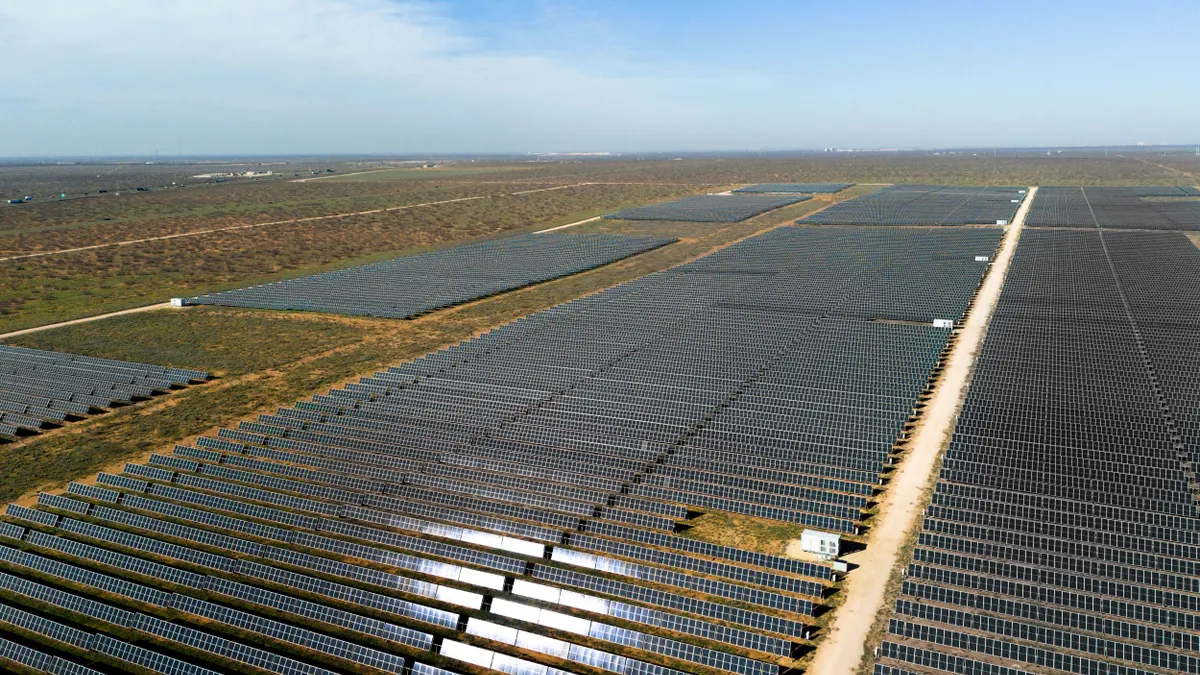
- The United States added 2 GW of utility-scale solar to the grid in September, bringing total solar installed this year to 21 GW — slightly above the 20 GW installed over the same period last year, according to the Federal Energy Regulatory Commission’s latest monthly infrastructure update.
- Solar accounted for 75% of the 28 GW of new generation installed in 2025 so far, followed by wind at 13% and gas at 11%.
- Natural gas is still the largest single generation resource in the U.S. electric power system, comprising 42% of total installed generating capacity. Wind, solar and hydro together make up 31% of the capacity mix.
Dive Insight:
The results of FERC’s latest infrastructure report show that solar continues to dominate new generation coming online as the country experiences rising demand for the first time in about two decades. The report does not include energy storage or rooftop solar.
Enverus Intelligence Research recently released its long-term U.S. power capacity expansion outlook, which projected a 57% increase in installed capacity by 2050 driven largely by solar and nuclear.
EIR analysts said they expect solar additions to peak in 2028, “but remain competitive, supported by ongoing demand for power purchase agreements (PPAs) and low costs.”
“Our analysis shows the U.S. grid is entering a transformative period, with solar installations surging in the near term and nuclear power taking a leading role in the decades ahead,” Juan Arteaga, principal analyst at EIR, said in a statement.
EIR’s relatively positive outlook for solar comes despite attacks on renewable energy by the Trump administration, whose officials have derided solar and wind as unreliable and expensive. In July, President Donald Trump signed the One Big Beautiful Bill Act sunsetting renewable energy tax credits early, and his administration has also sought to revoke permits for some renewable energy projects and subject others to additional scrutiny that has slowed deployment.
But the administration’s preferred alternatives — nuclear, gas and coal — face myriad obstacles to replacing solar as the dominant new generation source.
The EIR report said nuclear will not achieve steady expansion until around 2040, while gas will continue to displace coal, which it expects to be fully phased out around the same time.
Of the 136 GW of “high probability” additions FERC expects to see energized by September 2028, solar accounts for 91 GW — about 67%. Wind makes up 23 GW, or 17% of high probability additions; gas accounts for 20 GW, or about 15%; and nuclear is expected to provide just 335 MW — 0.2%.
"FERC’s latest data show that no amount of rhetorical manipulation can change the fact that solar, wind, and other renewables continue on the path to eventual domination of the energy market,” said Ken Bossong, the executive director of the pro-solar Sun Day Campaign, in a statement.