Dive Brief:
- The U.S. solicitor general on Monday urged the U.S. Supreme Court to deny Duke Energy’s appeal challenging a lower court’s ruling in an antitrust lawsuit brought by independent power producer NTE Energy.
- In August 2024, the U.S. Court of Appeals for the Fourth Circuit properly ruled that NTE Carolina’s antitrust suit against Duke could move ahead after it was dismissed by a lower court, according to U.S. Solicitor General John Sauer.
- “This appeal arises out of a campaign by an established monopolist to stop a more efficient rival from disturbing its long-dominant hold over a regional energy market,” Sauer said. “Without ever competing with [NTE] on the merits (i.e., offering a better service), [Duke] was able to prevent [NTE] from operating its superior [generating] facility.”
Dive Insight:
In the last decade or so, the Department of Justice and private plaintiffs have been reluctant to use antitrust laws to challenge utilities, but that could change based on Sauer’s brief, according to Joshua Macey, a Yale Law School associate professor.
“At the very least, this suggests that the Trump Solicitor General's Office thinks that antitrust should be a viable tool in electricity markets, and it may indicate that the administration is concerned with anticompetitive conduct,” Macey said in an interview Thursday.
The solicitor general’s stance in the brief makes it less likely the Supreme Court will take up Duke’s appeal, according to Macey.
The action at the Supreme Court centers on a long-running dispute between Duke’s vertically-integrated North Carolina subsidiary and NTE that led to anticompetitive claims by the power producer against the utility company.
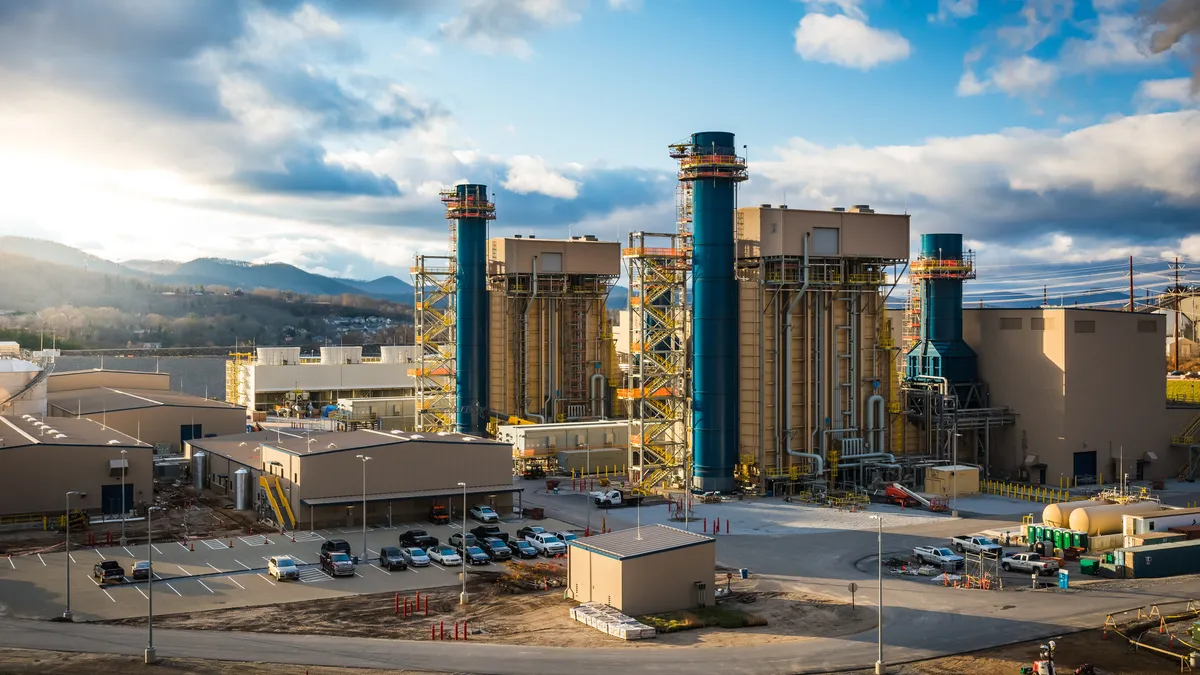
Duke Energy Carolinas in November 2017 entered into a large generator interconnection agreement with NTE Carolinas II, which planned to build a combined-cycle gas-fired power plant in Reidsville, N.C.
Two years later, Duke Energy Carolinas sued NTE for breach of contract, alleging that the independent power producer failed to make payments required under the interconnection agreement. In June 2022, a district court dismissed NTE's claims that Duke Energy Carolinas engaged in illegal, anticompetitive behavior.
However, the Fourth Circuit appeals court reversed the district court's decision, finding that Duke took various steps that in combination could be considered anticompetitive, according to Sauer.
“When a monopolist engages in a coordinated campaign to squelch competition, no circuit holds that each discrete aspect of the defendant’s conduct must be analyzed in isolation,” Sauer said. “Instead, courts uniformly agree, consistent with this Court’s precedent, that a holistic analysis is appropriate in circumstances like these.”
In its petition asking the Supreme Court to review the appeals court’s decision, Duke said each action it took in relation to the planned NTE power plant was legal.
The appeals court embraced a “monopoly broth” theory that a set of legal actions can be deemed anticompetitive, according to Duke.
“If an antitrust plaintiff pleads a series of independently lawful acts, each of which does not violate this Court’s precedents, those acts cannot together add up to some nebulous antitrust violation,” Duke said in its petition.
NTE’s plans to build its power plant hinged on landing an offtake agreement with the city of Fayetteville, N.C., according to court documents. Duke undercut that option by restructuring Fayetteville’s supply contract with the utility — which had produced $100 million in annual revenue for Duke — to give it a short-term discount and lump-sum payment, Sauer said.
Duke also agreed to quadruple the price it paid for excess power from a Fayetteville power plant — a price increase worth $283 million, according to Sauer.
In total, Duke gave Fayetteville a $325 million incentive, which it intended to recoup through future price increases on Fayetteville and other customers, he said.
At the same time, Duke sought to “hobble and discredit” NTE, in part by sending two notices of default on NTE’s interconnection agreement and falsely claiming that NTE failed to pay its invoices, Sauer said.
Duke had previously lost nine wholesale customers to NTE after the company built a combined-cycle power plant in North Carolina that was cleaner and cheaper than Duke’s power supply, Sauer said.