Dive Brief:
-
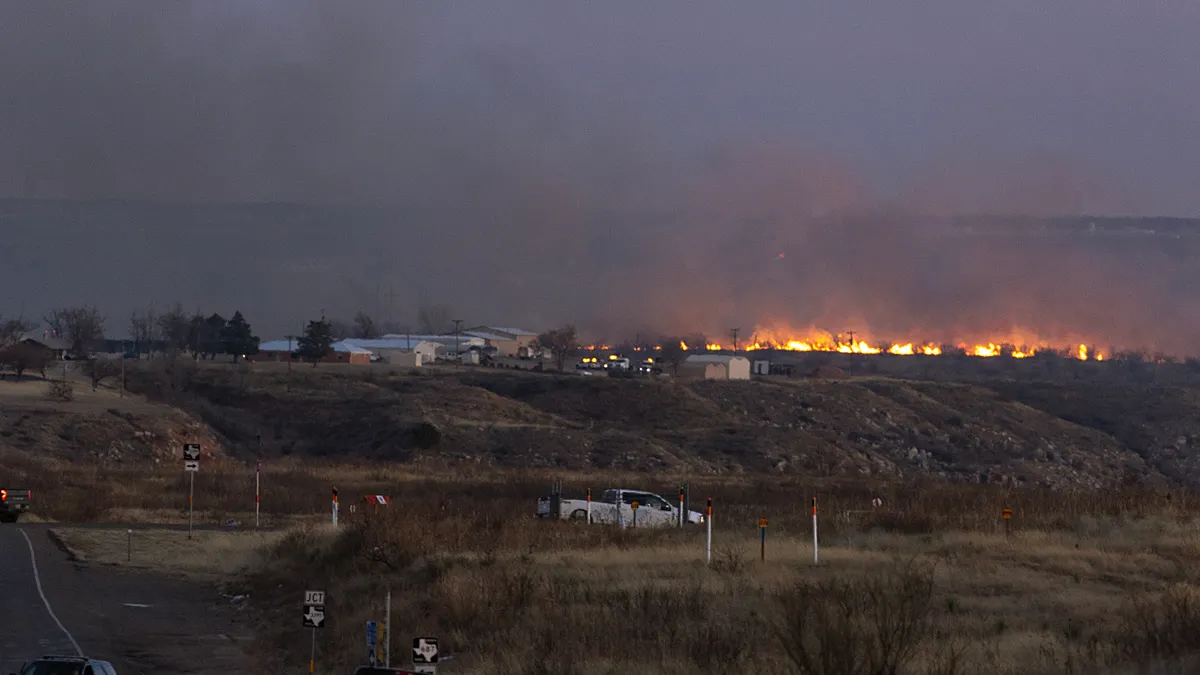
Texas has sued Southwestern Public Service Co., an Xcel Energy subsidiary that goes by the parent company’s name, for damages caused by the 2024 Smokehouse Creek Fire, believed to be the largest wildfire in Texas history.
-
The blaze killed three people, burned more than 1 million acres, destroyed a state-run wildlife preserve and damaged state roads and infrastructure, according to the suit. Together with other fires that merged with it, the Smokehouse Creek fire caused at least $1 billion in economic damages, it says.
-
In addition to seeking monetary compensation of $1 million or more, the state is asking the court to prevent Xcel from recovering fire costs from customers and from marketing its equipment as safe.
Dive Insight:
The largest wildfire in Texas history was “entirely preventable,” according to the lawsuit announced on Dec. 16 by Texas Attorney General Ken Paxton.
“Xcel’s blatant negligence killed three Texans and caused unfathomable destruction in the Texas Panhandle,” Paxton said in a statement. “The company made false representations about its safety commitments and ignored warnings that its aging infrastructure needed immediate repair and to be updated. This created a substantial wildfire risk, which Xcel did nothing about. There must be accountability for the death and devastation the company caused.”
According to the lawsuit, a contractor hired to inspect Xcel’s lines flagged the pole responsible for the Smokehouse Creek Fire as decayed and in need of “priority one replacement” roughly three weeks before the blaze.
On Feb. 26, 2024, the decayed utility pole broke off at ground level and the distribution line atop it fell, igniting the Smokehouse Creek Fire, the suit said.
The next day, a second utility pole owned by Xcel also fell to the ground and ignited the neighboring Reamer Fire, which later merged with the Smokehouse Creek Fire, it said.
The state of Texas accrued tens of millions of dollars in costs while responding to the fires, according to the suit. It also had to cancel outstanding grazing leases and hunting licenses following the blaze, and claims the impact of habitat loss on local wildlife could linger for years. The state also paid for veterinary care for wild animals that were injured by the fire, according to the suit.
In addition to reimbursement for these costs, the state has asked the courts to order Xcel to immediately cease any advertisements that claim Xcel's equipment is “safe, reliable, resilient, well-maintained, pose minimal or no fire risk, or otherwise protect consumers or the public from harm.” The suit also asks the court to prohibit Xcel from shifting any costs or penalties from the Smokehouse Creek Fire to Texas ratepayers.
An Xcel spokesperson said the company was “deeply disappointed” by the state's decision to pursue litigation and that they would defend the company “vigorously.”
“When the Attorney General’s office approached us earlier this year requesting information, we worked with them in good faith to try and find a consensus solution. They chose to file litigation instead,” the company said in a statement emailed to Utility Dive.
“Though Xcel Energy disputes claims that it acted negligently in maintaining and operating its infrastructure, we accepted responsibility from the beginning and set up an expedited claims process,” it said. “Even now, the work to fairly compensate those affected continues. To date, Xcel Energy has agreements for settlements totaling $361 million for 212 of 254 total claims made against the company.”
In September, Xcel settled civil suits related to the 2021 Marshall Fire, the most destructive fire in Colorado history, for $640 million. The company continues to hold that its equipment did not ignite the Marshall Fire.
Correction: This story has been updated with the correct amount of estimated damages from the Smokehouse Creek Fire and the compensation the state is seeking.