Dive Brief:
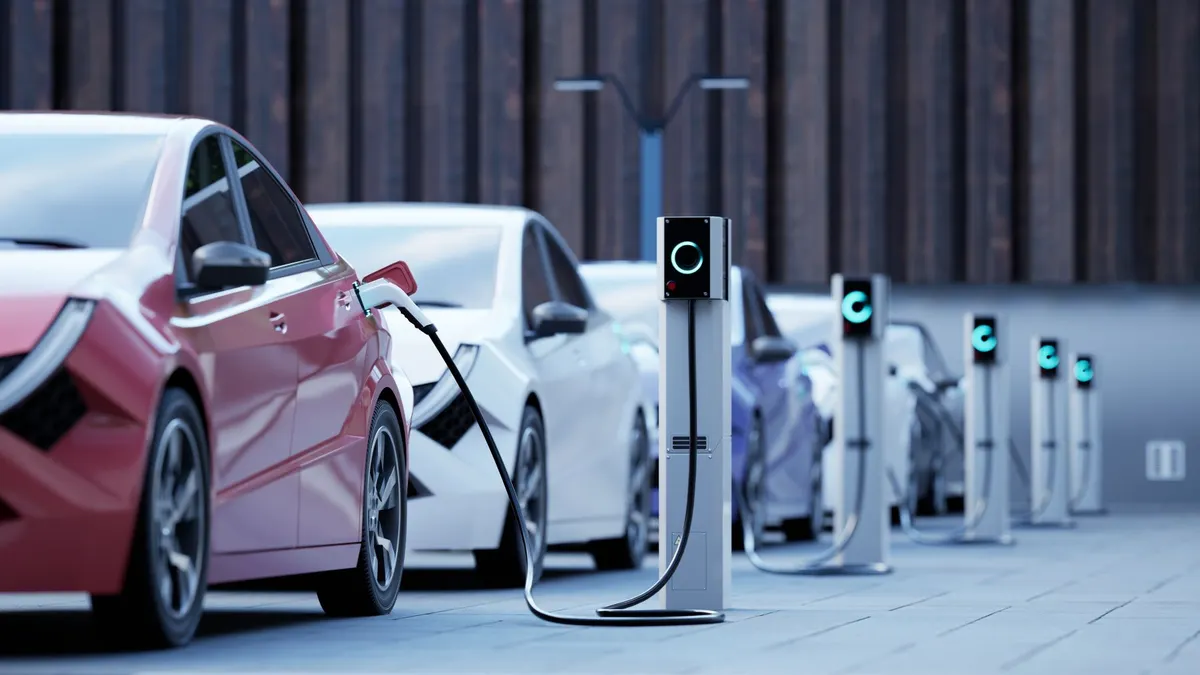
- Utilities that implement “active” managed charging solutions can reduce peak demand for electric vehicle charging by 50% or more while increasing distribution networks’ capacity to support EVs, Brattle Group said in a report prepared for EnergyHub this month.
- Active managed charging can also significantly reduce EVs’ system costs, Brattle found. On a system where annual unmanaged charging cost utilities about $800 per vehicle, active management saved utilities about $245 per EV. The savings could rise to $400 per vehicle where system costs are higher, according to the report.
- Brattle’s analysis found “significant electric system cost savings [that] will be a really important affordability lever not just for EV drivers but also for utility ratepayers,” report co-author Akhilesh Ramakrishnan, Brattle Group managing energy associate, said in an interview.
Dive Insight:
Active managed charging solutions use control algorithms to optimize power flows to plugged-in EVs. The aim is to reduce load on distribution networks, thereby lowering customer costs, system costs or both.
Passive managed charging, in contrast, uses price signals — typically time-of-use rates with distinct on- and off-peak periods — to encourage customers to charge vehicles when the cost of delivering electricity is likely to be lower. “Unmanaged” charging is the absence of either passive or active managed programs, where customers charge whenever they wish.
The Brattle study used EnergyHub’s charge management platform to test two different active managed charging strategies on a cohort of 58 drivers in Washington state. One actively controlled charging loads in customer groups served by the same distribution assets, reducing local peaks caused by coincident charging and minimizing energy, generation capacity and transmission system costs. The other combined the same load-limiting framework and time-of-use rates that rose at peak periods and fell during periods of lower demand.
Ramakrishnan said the results were compelling.
“We found that active managed charging can more than double the EV hosting capacity of the distribution grid compared with unmanaged charging or time-of-use rates, which remain more common,” he said.
Participating vehicles consumed about 5% of charging energy during the 9 a.m. to 9 p.m. weekday peak when load-limiting was combined with time-of-use rates and about 12% of charging energy during the peak without paired time-of-use rates.
Both represented significant improvements over unmanaged charging, which saw 31% of charging energy delivered during peak windows. Passive managed charging delivered just 3% of charging energy during the peak period, but with a much higher aggregate peak per vehicle: 3.3 kW, compared with less than 2 kW for both active strategies.
By reducing peak loads on local feeders and transformers, active managed charging can more than triple the distribution grid’s EV hosting capacity and defer infrastructure upgrades for as long as 10 years, Brattle found.
Drivers participating in the study were able to override active managed charging, but Brattle recorded an average of just 2.3 monthly session opt-outs per month, per driver, suggesting most drivers were comfortable with the idea of a third party controlling power flows into their vehicle.
EnergyHub’s platform allowed drivers to set desired state-of-charge targets and “need-by” times to ensure their vehicles were adequately fueled when needed next. The platform also used predictive modeling to “infer” need-by times for the large majority of drivers who don’t regularly specify them. With those capabilities, every vehicle that remained plugged-in with sufficient time to charge during the optimization window reached the desired state of charge, Brattle said.
Freddie Hall, an EnergyHub data scientist, said in an interview that customers need to feel confident that a managed charging solution won’t interfere with their freedom of movement.
“Fundamental to this is making sure drivers get to the state of charge they want … delivering that trust is foundational,” he said.