
For decades, utilities evaluated large industrial customers using a familiar framework. Manufacturing facilities, refineries and even early-generation data centers typically appeared as large but predictable blocks of demand. Their load profiles were relatively stable, making conventional interconnection studies sufficient to assess reliability and grid impacts.
The rapid emergence of AI is changing that equation.
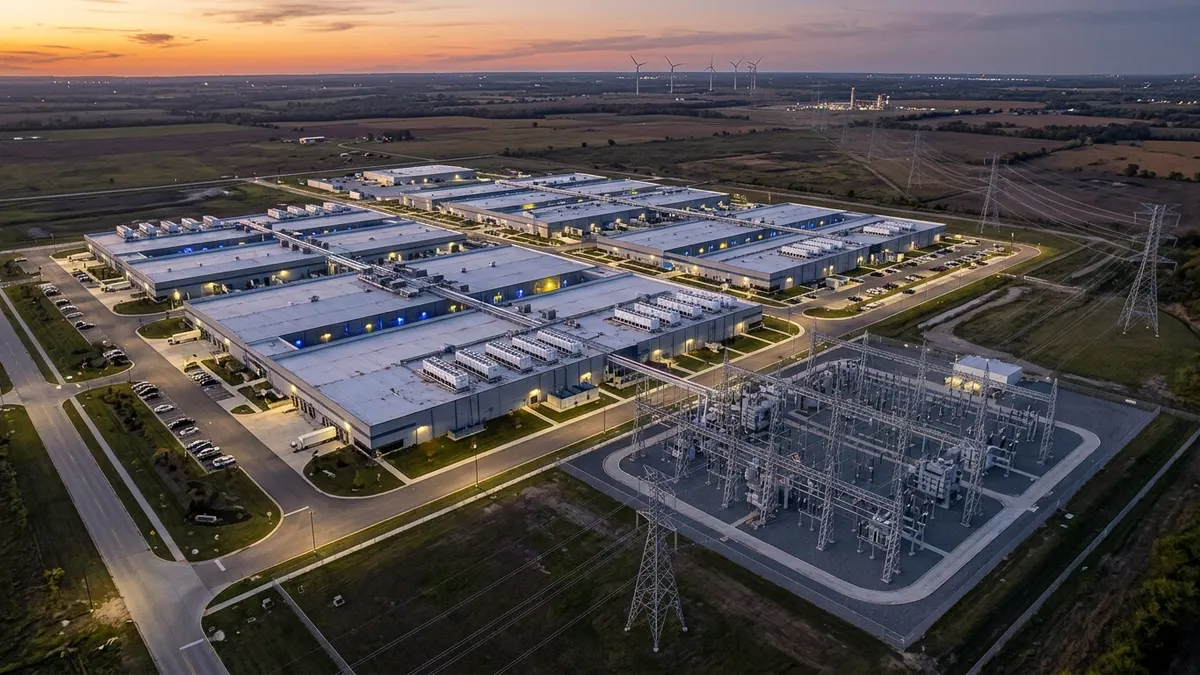
Today's AI training campuses are not simply larger versions of traditional data centers. With proposed loads reaching 1,000 MW or more, they represent a new category of grid-connected customer whose size and electrical behavior challenge many longstanding planning assumptions. As utilities across North America confront unprecedented load growth requests, they are discovering that conventional interconnection studies alone may not provide the answers they need.
Traditional data centers typically consumed power at a steady rate. Thousands of small IT loads smoothed out variations, allowing planners to model facilities using static load representations. AI campuses behave very differently. Compute-intensive workloads can cause power consumption to change by hundreds of megawatts within seconds as training jobs start, pause, checkpoint and conclude.
At the same time, these facilities rely heavily on power-electronic equipment that responds to grid conditions far faster than traditional industrial systems. Voltage disturbances that might have little effect on conventional loads can trigger rapid reactions from electronically coupled equipment, sometimes resulting in transfers to backup generation or other control actions. Many projects also include battery energy storage systems, on-site generation and sophisticated plant controllers that actively influence behavior at the point of interconnection.
These characteristics create challenges that traditional power-flow and positive-sequence dynamic studies were not designed to capture. While those analyses remain essential, they no longer address every stability concern associated with large AI facilities. Increasingly, utilities are turning into electromagnetic transient (EMT) studies to gain a more detailed understanding of how these loads interact with the grid.
Several key questions are driving this shift.
First, utilities need confidence that a facility can ride through nearby faults without creating larger system disturbances. When a multi-hundred-megawatt load suddenly changes behavior during a fault event, the consequences extend well beyond a single customer site. EMT analysis helps planners understand how facilities respond during and after disturbances, providing insights that conventional studies may miss.
Second, ramp-rate performance has become a growing concern. Rapid swings in AI-related demand can affect system stability, particularly in areas with limited grid strength. Utilities must determine how quickly load can change and whether plant controls or energy storage systems are needed to keep those changes within acceptable limits.
Third, planners are increasingly evaluating oscillatory behavior. Fast-changing compute loads can excite low-frequency and sub synchronous oscillations, particularly on weaker networks. Stable operation can no longer be assumed. It must be demonstrated through detailed simulation and analysis.
Power quality is another important consideration. Repetitive load fluctuations can contribute to flicker, harmonics and other disturbances that affect neighboring customers and grid equipment. Understanding these impacts requires a level of modeling detail beyond traditional interconnection approaches.
Perhaps the biggest challenge, however, is not the analysis itself but the quality of available models.
Many equipment vendors provide EMT models with incomplete parameter sets, undocumented controls or inconsistencies between electromagnetic transient and positive-sequence representations. When these issues are discovered during review, studies must often be repeated, creating delays for developers and utilities alike. In clustered interconnection processes, a single deficient model can affect the timelines of multiple projects.
As a result, model validation is becoming a critical deliverable. Reliability requirements, industry standards and utility expectations increasingly demand transparent, auditable models that accurately represent facility performance. Documentation and validation are now as important as the simulations themselves.
Complicating matters further, validated EMT models often do not exist for much of the equipment that defines a data center's electrical behavior, including UPS systems, cooling drives and distribution technologies. To address this gap, many utilities are moving upstream and establishing performance requirements directly at the point of interconnection.
By studying their own systems and evaluating credible operating scenarios, utilities can define ride-through requirements, ramp-rate limits, flicker thresholds, harmonic limits and reactive power obligations that new facilities must satisfy. This approach provides a practical path forward while industry modeling capabilities continue to mature.
The growth of AI infrastructure is reshaping the interconnection landscape. Large-load projects are no longer just a capacity challenge. They are a dynamic grid-performance challenge that requires new tools, new models and a deeper understanding of how power-electronic loads interact with the system.
For utilities, developers and EPC firms, early engagement and rigorous EMT analysis will be essential to ensure that the next generation of AI infrastructure can connect reliably and efficiently to the grid. EnerNex (CESI Group) is helping utilities and developers navigate that transition through advanced interconnection studies and performance assessments for large loads across North America.