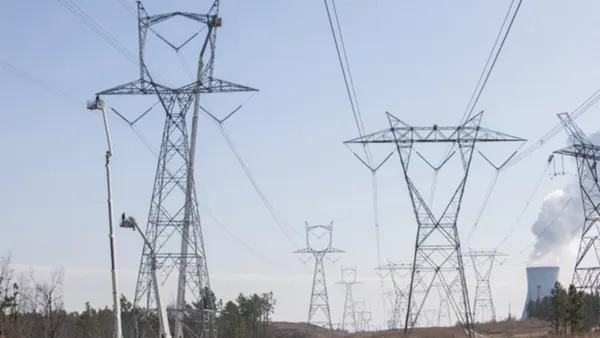

As skyrocketing demand, rising energy prices, and the urgent need for modernization challenge power grids, advanced conductors are emerging front and center on regulators’ desks.
Stakes are high: 70% of transmission lines are 25+ years old, many nearing the end of their useful life. America’s grids are reaching a tipping point, and regulators recognize the risks of letting infrastructure decay.
Advanced conductors offer a way forward. They alleviate congestion, lower costs, and increase resilience against extreme weather — the pain points of a modern grid.
With American tech giants building new data centers and our manufacturing sector undergoing a rebirth, demand will continue to surge. New policies are critical to accelerating the shift to advanced conductors, and ultimately, grids that meet 21st century energy needs.
Why Regulators are Turning to Advanced Conductors
US grids face the perfect storm. In the past two years, FERC’s 5-year peak demand forecast has grown 5x. Meanwhile, extreme weather is increasing blackout risk, costing the US economy $28–$169 billion annually.
Our infrastructure can’t keep up. Transmission capacity is expanding at less than 1% per year — far short of the 4-7% annual growth needed — driving $11.5 billion in congestion costs in 2023 alone, expenses ultimately passed to consumers.
Advanced conductors address multiple problems. They boost capacity on existing lines and resilience against extreme weather while keeping ratepayers’ bills affordable. As pressure mounts, regulators across state and federal governments are embracing them as a practical path forward.
Federal Action Paving the Way
At the federal level, the December 2025 High-Capacity Grid Act will “modernize America’s transmission system by requiring the use of best-available transmission conductors for new interstate transmission lines and rebuilds."
The Federal Energy Regulatory Commission (FERC) is also making strides, issuing Order 1920 in 2024 to improve regional transmission planning and cost allocation, requiring operators to consider grid-enhancing technologies (GETs) such as advanced conductors.
The DOE is also spearheading progress. Its $10.5 billion Grid Resilience and Innovation Partnerships (GRIP) program allocated over $600 million in 2024 to bolster grid resilience across states affected by Hurricanes Helene and Milton. This funding includes the use of advanced conductors.
Such sweeping federal action sends a powerful signal to grid operators and the market.
States Leading by Example
Across state lines, local governments are leading the charge. Montana’s 2023 HB 729, offers a higher rate of return for advanced conductors.
In 2024, momentum grew:
- Virginia and Minnesota passed laws requiring utilities to consider GETs, including advanced conductors, in integrated resource plans (IRPs)
- California enacted SB 1006, requiring utilities to assess which lines can be reconductored with advanced conductors.
- Massachusetts passed S.2967, mandating that utilities consider Advanced Transmission Technologies (ATTs), including advanced conductors, in new transmission projects.
These states triggered a legislative snowball effect throughout 2025:
- Utah signed HB 212, creating a framework to accelerate the evaluation and deployment of GETs.
- Indiana passed SB 422, requiring utilities to evaluate GETs in IRPs.
- South Carolina signed H 3309, requiring utilities to include a detailed transmission planning report in IRPs, suggesting technologies like advanced conductors. South Carolina is also home to a new advanced conductor manufacturing facility, announced March 2025.
- Maryland passed SB 937, mandating that new transmission projects use advanced transmission or GETs.
- Connecticut passed SB 4, requiring ATTs in Certificate of Public Convenience and Necessity (CPCN) applications. Utilities must also report on their compliance.
As of late 2025, 20+ US states have passed or are advancing legislation related to GETs or ATTs, with at least 10 enacting new laws in 2025 alone.
How Advanced Conductors Provide Relief
A shift is underway, and for good reason. Advanced conductors directly address the concerns driving regulatory action. They enhance grid resilience against modern challenges, plus their high-strength, low-sag cores make them more resistant to heavy loads of winter ice and reduce sag in summer heat, mitigating wildfire risk.
AECC conductors offer additional advantages. They can be installed using familiar tools and techniques, simplifying installation for line crews and streamlining grid modernization.
For capacity expansion, advanced conductors excel in reconductoring projects. These projects can be completed in a fraction of the time it takes to build a new transmission line, with transmission capacity of that leg growing by 2–3x.
The economics are compelling. Reconductoring existing US transmission lines with advanced conductors could save consumers $85 billion across the next decade, while quadrupling the current rate of transmission capacity expansion.
Turning Regulations Into Future-Proof Transmission Lines
America’s grids are scarred by a double-edged sword: while we celebrate technological advancements, the rise of electrification, and the surge of clean energy, our aging transmission infrastructure is buckling under the weight of these very achievements. Advanced conductors are the right solution at the right time. Regulatory action can accelerate adoption, bringing advanced conductors off the policy pages and onto transmission lines to achieve the high-capacity grids America needs.