Dive Brief:
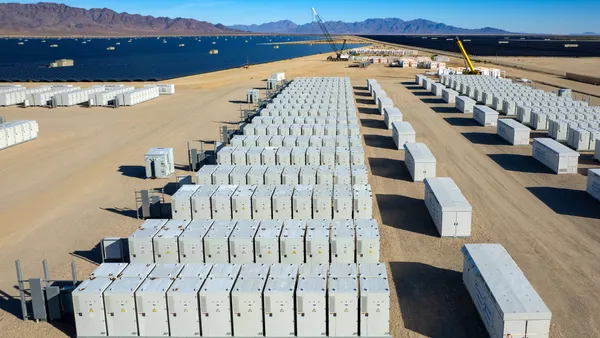
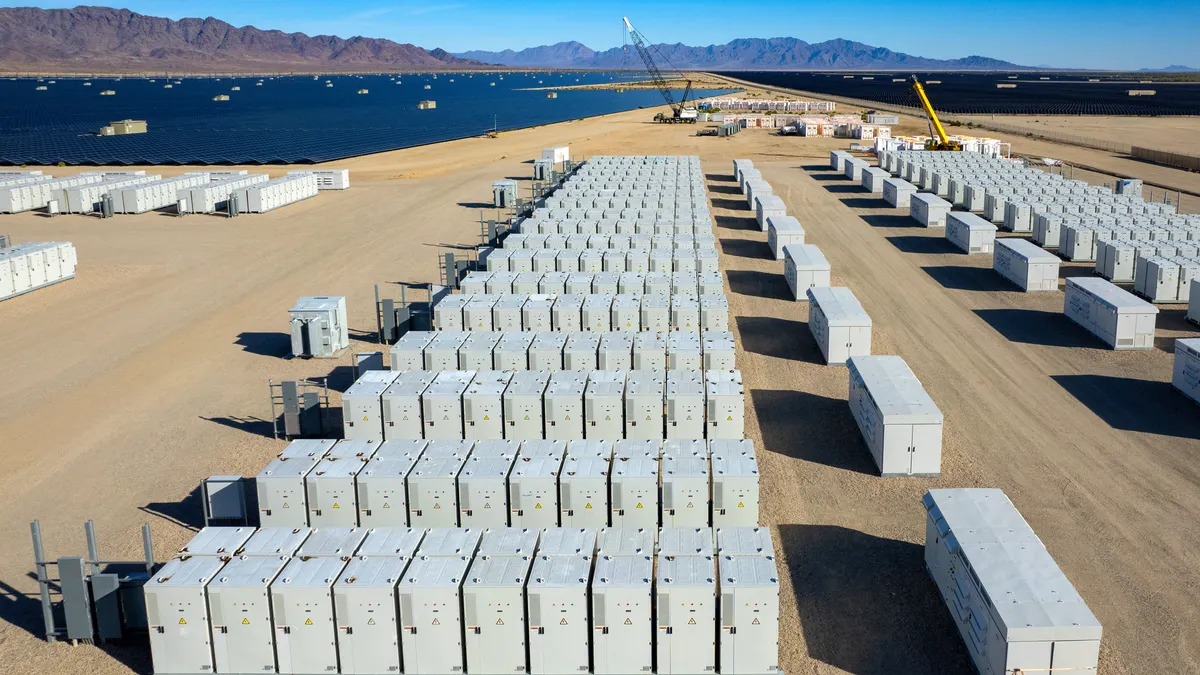
- U.S. battery energy storage deployments jumped 29% in 2025 to exceed 28 GW/57 GWh, driven by 16 GW/50 GWh of utility-scale installations, Benchmark Mineral Intelligence said in a report released Feb. 23.
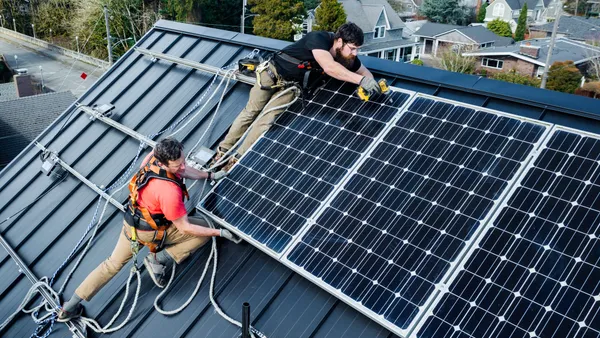
- In the Q1 2026 outlook, prepared for the Solar Energy Industries Association, Benchmark said behind-the-meter installations — including residential, commercial and industrial — constitute 12 GW/8 GWh of the total. The behind-the-meter share of installations remained steady at 13%, but residential installations increased before the Section 25D credit’s expiration at year end, Benchmark said.
- Benchmark expects energy storage installations to reach 35 GW/70 GWh in 2026, with 20.2 GW/62.4 GWh of that in the utility-scale market and 14.8 GW/7.3 GWh in the behind-the-meter market.
Dive Insight:
At the end of 2025, the U.S. had 137 GWh of utility-scale storage, 19 GWh of commercial and industrial storage and 9 GWh of residential storage, Benchmark said. By 2030, the consultancy expects more than 600 GWh of energy storage on the U.S. grid.
SEIA said the surge in storage deployments last year came despite “actions in Washington targeting clean energy.” Lawmakers have narrowed federal tax credits benefiting intermittent renewable resources, and the Trump administration has undertaken far-ranging legal and administrative efforts to slow utility-scale solar and wind deployment.
In a statement, Darren Van’t Hof, SEIA’s interim president and CEO, warned that current federal policy could compromise grid reliability and power affordability.
“Deployment is rising fast, but without a course correction from federal actions targeting the industry, Americans will face higher electricity prices and a less resilient energy system,” Van’t Hof said.
Though the One Big Beautiful Bill Act largely preserved favorable federal tax treatment for energy storage projects, uncertainty around the law’s complex foreign entity of concern provisions and Trump’s on-again, off-again import tariffs have caused headaches for battery vendors and energy storage developers. Prices for four-hour battery systems rose as much as 69% during the first half of 2025 as Trump layered on tariffs, according to energy intelligence firm Anza Renewables.
But the record-breaking pace of energy storage installations in 2025 appears to validate broad-based bullishness among industry analysts.
Joanna Martin Ziegenfuss, energy storage market development general manager for Wärtsilä, a Finnish multinational that markets flexible energy systems, said in a note last month that energy storage will benefit from the Federal Energy Regulatory Commission’s renewed focus on grid reliability and data centers’ willingness to accept non-firm utility contracts in exchange for faster interconnection.
“As BESS can step in as an immediate power supply for the duration of the interruptions, it delivers the flexibility customers need, especially when speed to power is imperative,” Martin Ziegenfuss said.
In its report last week, Benchmark cautioned that “early signs” point to data centers’ preference for gas in prime power generation and batteries “primarily for power quality and ramping.” That may change as data center companies learn more about how BESS works behind the meter and as gas turbine capacity tightens. Data centers could account for 83% of behind-the-meter commercial and industrial storage deployments by 2030, Benchmark said.
Meanwhile, the market for residential storage grew 51% in 2025, according to Benchmark. It attributes that growth, in part, to the Section 25D tax credit’s expiration at the end of 2025, which pulled demand forward as customers raced to take advantage of the expiring incentives. Residential installation volumes could decline in 2026 and “remain dampened out to 2030,” the consultancy added. States with growing virtual power plant programs, such as Massachusetts, California, Texas, Arizona and Colorado, could stay busier.
Though Texas overtook California as the largest utility-scale energy storage market by gigawatts deployed in 2025 — and it will likely do so in gigawatt-hour terms this year — California remains the runaway leader in cumulative storage deployments across all size classes, with 59.8 GWh deployed, Benchmark said.
Texas is second with 26.3 GWh, followed by Arizona (19.3 GWh), Nevada (6.3 GWh) and New Mexico (3.8 GWh).