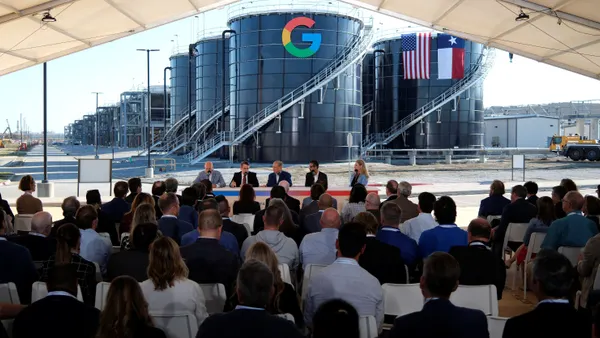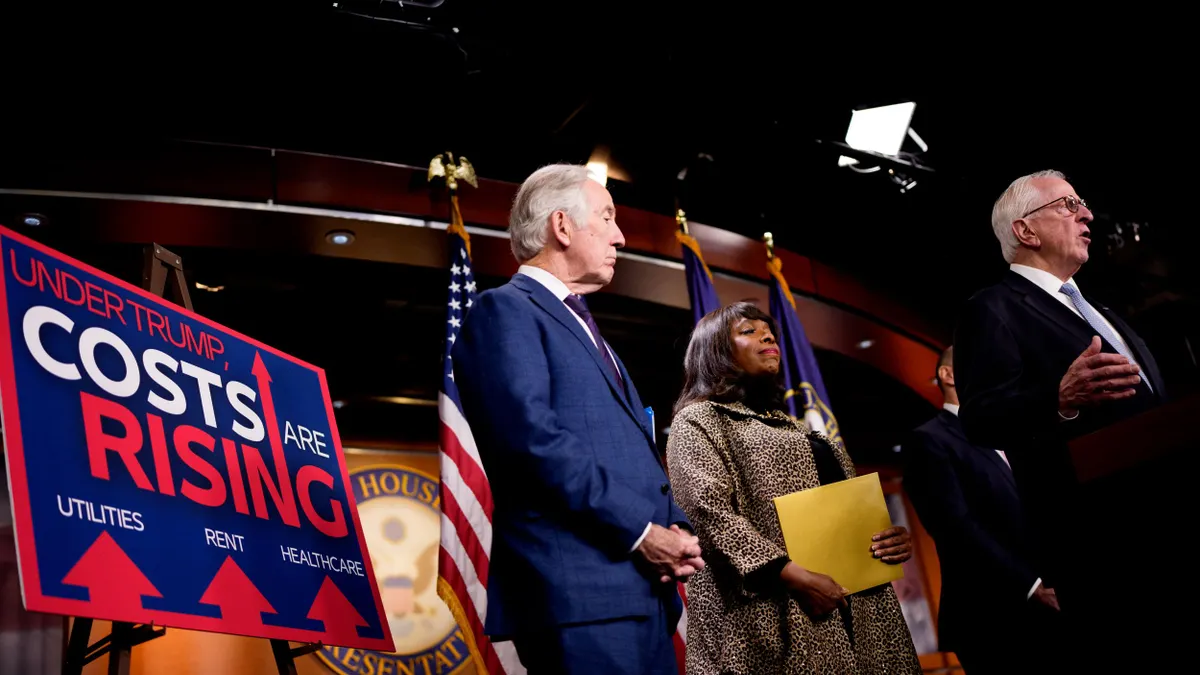
Concerns over rising electricity bills will guide changes in AI data center development, particularly around how they are powered, but are unlikely to slow the overall expansion and need for grid resources, analysts from Bank of America said in a Thursday report.
“The main risk to regulated utilities in 2026 likely will be affordability pressure as capital expenditures have accelerated customer bill increases in a political backdrop focused on affordability issues into the 2026 midterm elections,” wrote Ross Fowler, a research analyst at BofA Securities.
Three dozen states will elect a governor this year, and elections last year in New Jersey and Virginia have demonstrated “voter angst around inflation in utility bills,” Fowler wrote. “We'd expect more of the same this year.”
Immediately after taking office in January, New Jersey Gov. Mikie Sherrill, D, signed executive orders seeking to freeze electricity cost increases, issue bill credits and increase distributed energy resources, including utility-scale solar and battery storage.
In Virginia, Gov. Abigail Spanberger, D, issued an executive order directing a review of policies that could decrease energy costs. She has also vowed to rejoin the Regional Greenhouse Gas Initiative, which her predecessor withdrew the state from in 2023.
Rising residential electricity rates — up approximately 37% from 2020, according to the U.S. Energy Information Administration — may mean data center developers seek to lessen their grid dependence in the near-term, even if it adds cost, according to BofA Securities analyst Dimple Gosai.
On-site solar-plus-storage projects can be built within two years, but interconnection delays can add an additional five or more years, Gosai noted. Behind-the-meter gas-fired solutions, despite higher costs, can offer faster deployment timelines, she said, while batteries can sit between the data center and grid, smoothing demand.
A different analysis from energy research firm Cleanview found that computing facilities representing about 30% of all planned U.S. data center capacity plan to power their operations with behind-the-meter resources.
“In 2026, decision-making follows a simple hierarchy: secure power fast (gas turbines, engines, or grid-adjacent assets), firm and smooth with storage, then layer in solar as the lowest-cost marginal energy,” Gosai wrote. “Fuel cells remain niche, but hybrid systems are moving from concept to execution. The investment opportunity sits in fast-deployable power, storage integration, and hybrid architectures.”
“We view 2026 as the year storage becomes non-optional,” Gosai wrote. “As renewable penetration rises and load volatility accelerates, batteries shift from a project-level optimization to a grid and load-serving necessity.”
And battery supply risk is “easing,” she said, as companies shift from developing batteries for electric vehicles to grid-scale storage. Ford and GM have made recent moves to develop more stationary storage, and Tesla has been focused on the space for years.
The energy storage market broke records globally last year, with installations passing 100 GW, according to Wood Mackenzie, despite some policy and market headwinds.
Energy storage growth is projected to dip in 2026–2027 “due to the impact of 2024 tariff changes and future supply chain restructuring,” WoodMac said in a January report. “However, momentum will recover by 2028, driven by rising demand for grid flexibility and renewable integration.”