Dive Brief:
- The U.S. Department of Energy on Saturday and Sunday issued a series of emergency orders intended to help grid operators in New England, Texas and the Mid-Atlantic meet higher anticipated electricity demand during and after Winter Storm Fern.
- The 202(c) waivers, requested by PJM Interconnection, ISO New England and the Electric Reliability Council of Texas, allow generators to operate at maximum levels “notwithstanding air quality or other permit limitations.”
- The storm brought snow and ice to a wide swath of the United States, beginning Friday, and frigid temperatures are forecast to remain all week in some areas. More than 800,000 outages from Texas to Virginia were being tracked by PowerOutage.us on Monday morning.
Dive Insight:
All three grid operators that sought permission to run generators at maximum capacity said they had adequate power supplies, but made their requests in light of potentially record-high winter peak demand this week as frigid temperatures grip the country.
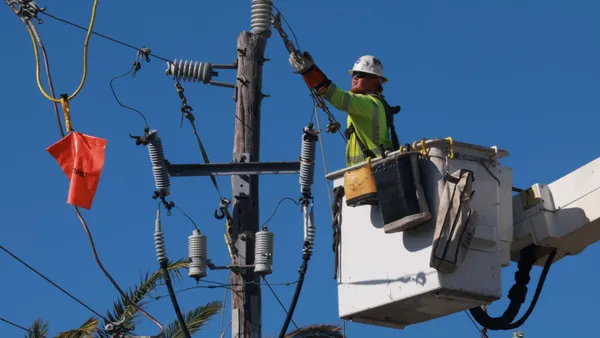
Despite almost a million homes without power Monday morning, most service disruptions have remained at the local distribution level, and utilities say they are working quickly to bring the lights back on.
Tennessee had the most outages, according PowerOutages.us, which aggregates utilility data. Nashville Electric Service reported 175,000 customers without power on Monday morning, with almost 100 broken poles and 70 distribution circuits in the process of being restored. Disruptions peaked at more than 230,000 customers, “marking one of the largest number of outages at one time NES has ever experienced,” the utility said in a social media post.
In Texas, CenterPoint Energy said it had only a couple of thousand customers without power on Sunday afternoon, so it released more than 500 contract frontline electric workers it had waiting in reserve to assist with recovery around its Houston service territory.
“Our system continues to perform well, but tonight and tomorrow are forecasted to be hard freezes hovering around 20 degrees, which may impact our equipment in some places,” CenterPoint Vice President of Resilience and Capital Delivery Nathan Brownell said in a statement.
Cold weather is forecast to remain across much of the country.
The New England grid operator on Sunday told DOE that while it was not currently experiencing emergency conditions, “given the forecasted long-duration extreme cold weather event, ISO-NE foresees the need to maximize the availability of all the generating resources in the New England region.”
DOE issued an order authorizing ISO NE’s request through the end of Saturday.
The Texas grid operator on Saturday told DOE its forecasts indicate a projected demand of approximately 84,000 MW on Monday morning and approximately 81,000 MW on Tuesday morning, “both exceeding ERCOT’s winter peak demand record of 80,560 set in February 2025.”
“This extreme level of demand raises a significant risk of emergency conditions that could jeopardize electric reliability and public safety,” it said.
DOE authorized ERCOT, through Tuesday, to “direct backup generation resources at data centers (including but not limited to hyperscaler facilities), and at other large load industrial and commercial customer sites ... to operate as a last resort” before requiring firm load interruptions.
PJM on Saturday told DOE it was forecasting temperatures reaching the single digits throughout its entire footprint and potentially below zero in some areas. The grid operator projected peak load of approximately 147,000 MW on the morning of Tuesday, potentially surpassing last year’s all-time high winter peak load of 143,700 MW set on Jan. 22, 2025.
DOE’s order “allows PJM to run all electric generating units located within the PJM region to operate up to their maximum generation output levels, notwithstanding air quality or other permit limitations or fuel shortages while the emergency lasts,” the grid operator said in a statement. The order is effective through Jan. 31.
“PJM currently has sufficient resources to serve load but may implement the order as appropriate given the record electricity demand expect this week,” the operator said.
And as a precautionary measure, PJM said it activated demand response customers in parts of the Mid-Atlantic on Sunday. The operator called on pre-emergency demand response in some areas “to address localized transmission constraints and to preserve the run-time of generators that will be needed for colder weather and higher electricity demand later in the week.”