Dive Brief:
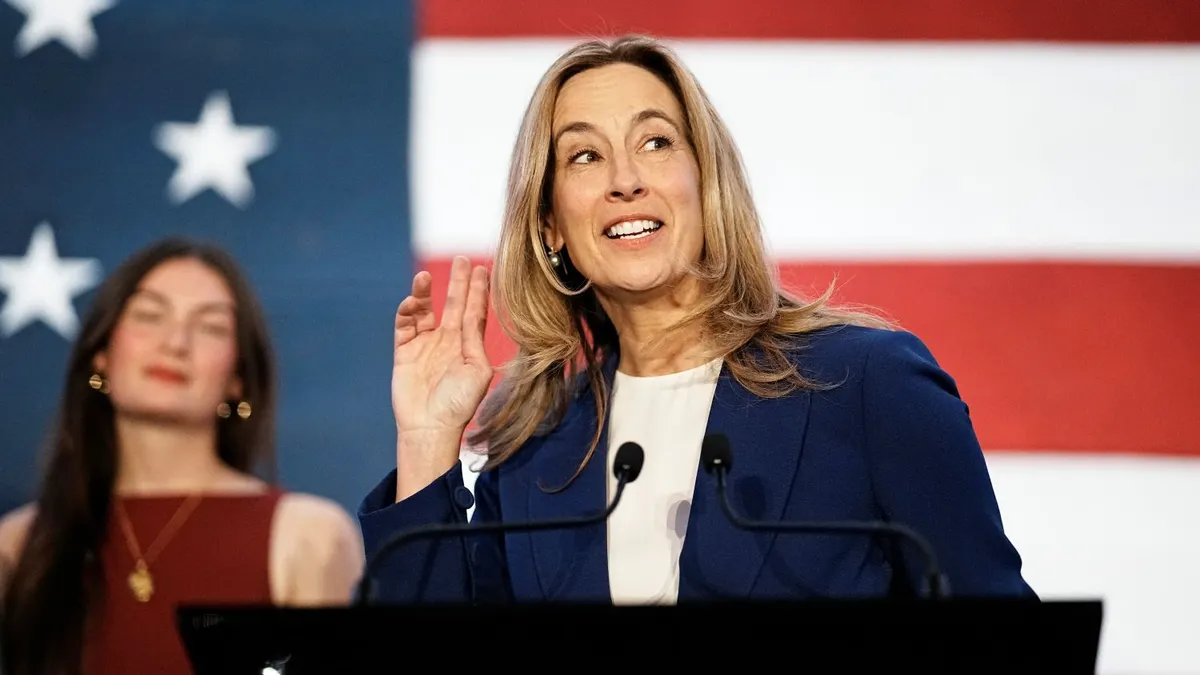
- On her first day in office Tuesday, New Jersey Democratic Gov. Mikie Sherrill signed executive orders seeking to freeze electricity cost increases, issue ratepayer relief in the form of bill credits, and increase distributed energy resources, including utility-scale solar and battery storage.
- One order directed the state’s Board of Public Utilities to ensure bill credits by July 1 and to “consider pursuing a pause, abeyance, or modification of the schedule governing any proceedings in which electric distribution utilities seek approvals for rate increases or cost recoveries.” It also ordered the board to publish a study within 180 days of how to “modernize” the traditional electric utility business model, including opportunities to make utility revenue models “less dependent on capital spending.”
- Another order focused on growing the state’s electricity supply and increasing efficiency. It directed regulators to initiate solicitations for solar and transmission-scale battery storage and to begin development of a virtual power plant program to be administered by electric distribution utilities and third-party suppliers in the state.
Dive Insight:
Sherrill, who made affordability and rising energy prices a focus of her campaign, said in her inaugural speech that the orders “will deliver relief to consumers and stop rate hikes.”
“This will also create the conditions to massively expand New Jersey’s power generation, because more power in-state will help lower costs,” she said.
Electric rates were a key issue in the governor’s race, particularly after bills spiked as much as 20% last year. Another increase is slated to go into effect this summer. The increases are a result of higher capacity prices in PJM’s recent auctions, which are held several years in advance and reflect both current and projected power demand.
Residential bill credits will rely on the same or similar funding sources used in August 2025 to provide credits, according to Sherrill’s first executive order. Last year, the BPU said all 3.9 million New Jersey residential ratepayers of Public Service Electric and Gas, Atlantic City Electric, Jersey Central Power and Light, and Rockland Electric would receive $100 in direct bill assistance.
PSE&G emailed a statement responding to Sherrill’s orders, saying “steps must be taken to safeguard long-term energy reliability and cost effectiveness for residents as New Jersey relies on imported electricity for more than 40% of its power.”
“We are confident that open dialogue and information sharing will lead to workable solutions,” the utility said.
Grid advocates hailed the governor’s focus on developing new sources of energy.
“These executive orders are tackling peak demand, unlocking customer-sited resources, and speeding deployment of solar and storage,” Katie Mettle, New Jersey state lead at Advanced Energy United, said in a statement.
According to the second executive order, the BPU has 45 days to initiate a solicitation “for qualifying solar facilities or solar facilities in combination with storage” under the state’s Competitive Solar Incentive program. Within the same timeframe, the BPU must also open 3 GW of capacity for registration under New Jersey’s Community Solar Energy Program, “endeavoring to expedite the registration process by any necessary and appropriate means.”
Regulators must also accelerate the development of grid-scale storage through the Garden State Energy Storage Program by holding a solicitation within 45 days, launching Phase 2 of the program within 90 days, and “thereafter establishing a specific tranche of capacity for electric distribution utilities to develop to support interconnection of distributed energy resources and grid stability.”
And, within 180 days, the BPU must begin development of a virtual power plant program that aims “to drive down peak demand by aggregating behind-the-meter distributed energy resources.”
“Virtual power plants are a proven, cost-effective way to lower peak demand, improve reliability, and put downward pressure on energy bills,” AEU’s Mettle said.
Allison McLeod, interim executive director of the New Jersey League of Conservation Voters, said the group was “particularly encouraged” by the actions aimed at solar and battery storage development.
“These are two of the fastest, most affordable tools we have to bring energy online and stabilize our grid,” McLeod said in a statement. “While taking some pragmatic steps to lower emissions and increase efficiencies in the near term with our existing fleet, New Jersey is continuing to lay the groundwork for a truly clean energy future.”