
Dive Brief:
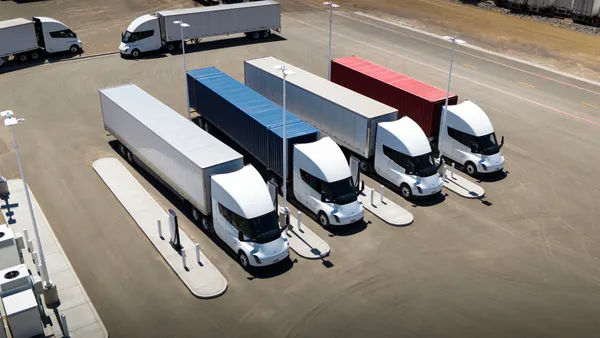
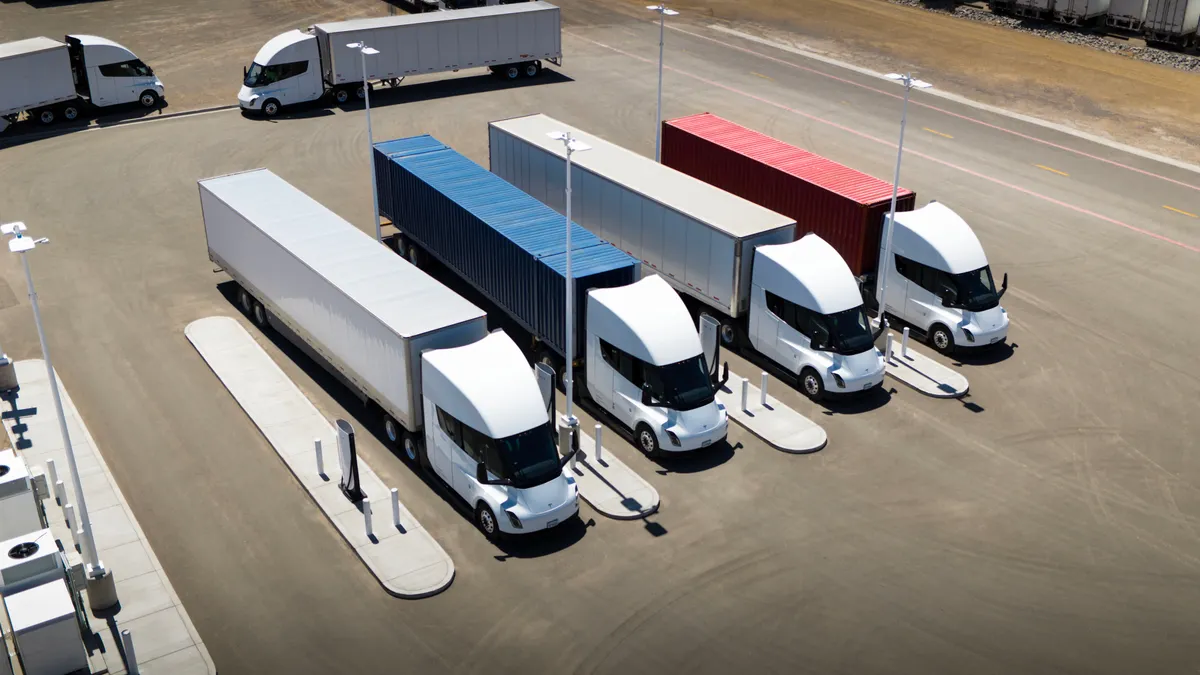
- Pilot Company has partnered with Tesla to build a series of electric semi-truck charging stations, according to a Tuesday announcement.
- The Tesla Semi Chargers will be installed at select Pilot locations along interstates 5 and 10 as well as other corridors that see high demand for heavy-duty charging, according to the announcement. The program is currently targeting about 20 locations, a Pilot spokesperson said.
- While this EV infrastructure will initially focus on charging Tesla’s semi trucks, it may expand in the future to also charge heavy-duty vehicles from other manufacturers.
Dive Insight:
This is not Pilot’s first exploration of electric semi-truck charging. The travel center company entered a partnership with Volvo in late 2022, showing that professional drivers using EVs are a cohort Pilot wants to target.
“The Tesla Semi charging sites are the first of their kind in Pilot's network,” said the Pilot spokesperson. “We value our partnership with Volvo and will continue to work with them as they further explore heavy-duty electrification."
Pilot’s Tesla Semi charging stations, which are slated for California, Georgia, Nevada, New Mexico and Texas, will host between four and eight charging stalls and use Tesla’s V4 cabinets, which deliver up to 1.2 megawatts of power at each stall. These chargers are expected to recharge trucks for most of their 500-mile range in around half an hour, according to the release.
“Helping to shape the future of energy is a strategic pillar in meeting the needs of our guests and the North American transportation industry,” said Shannon Sturgil, senior vice president, alternative fuels at Pilot. “Heavy-duty charging is yet another extension of our exploration into alternative fuel offerings.”
Construction will begin in the first half of this year, with the initial locations expected to open this summer.
Pilot is not the only travel center company looking at electric truck charging. TravelCenters of America announced plans for its own truck charging center in Ontario, California, in mid-2024. A LinkedIn post from BP earlier this year showed that a Pulse site in that town is close to coming online.