
Dive Brief:
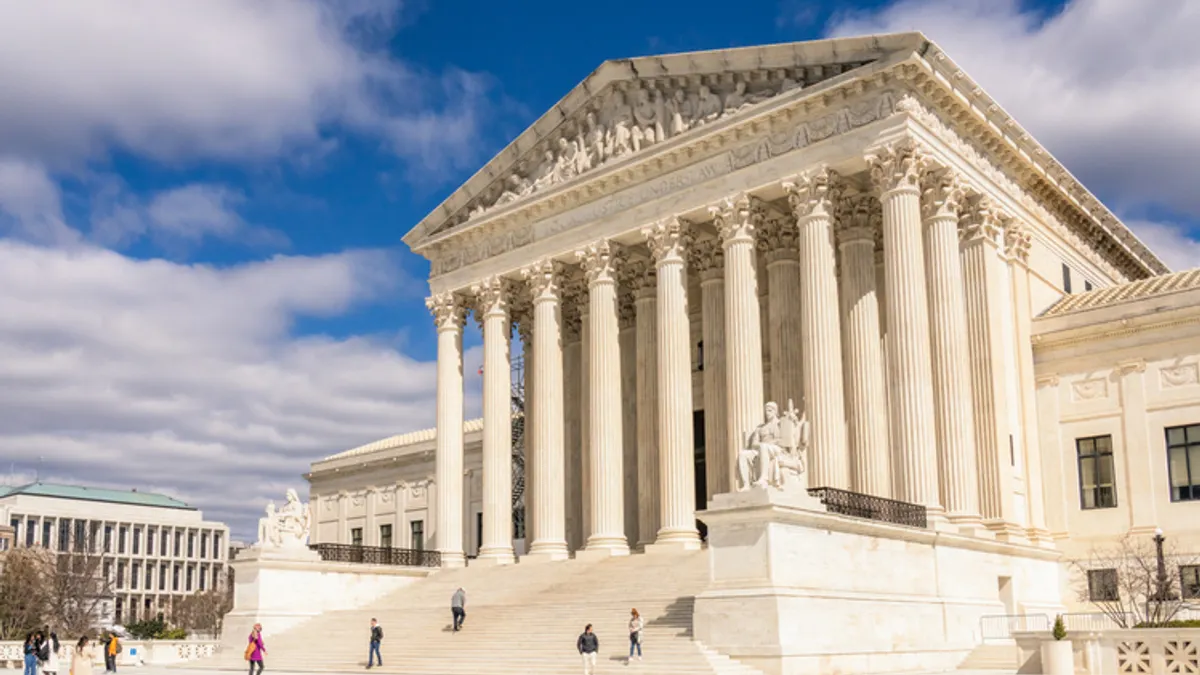
- The United States Supreme Court on Monday sided with the Trump administration and gas sector interests by sending a case involving non-condensing commercial gas water heaters and residential gas furnaces back to a federal appeals court.
- The action means that two energy-efficiency rules the U.S. Department of Energy finalized in 2023 and 2024 that would effectively eliminate non-condensing versions of the appliances from the market will remain in legal limbo until legal proceedings are completed.
- In a brief to the Supreme Court, U.S. Solicitor General D. John Sauer said returning the case to the appeals court would open a window for DOE to rewrite the rules. “The Department has determined that the rules at issue are factually and legally flawed, and the agency is considering a new rulemaking in which it would correct those errors,” Sauer said. Vacating the ruling and remanding the case “would permit the court of appeals to take account of those developments and the Department’s revised position … by potentially holding this case in abeyance pending a new rulemaking.”
Dive Insight:
The legal dispute centers on whether the venting system is a performance characteristic of the appliances. In its rules, DOE under the Biden administration said it’s not, and the U.S. Court of Appeals for the District of Columbia agreed.
Under that interpretation, DOE could move forward with its rules updating standards that would mandate, beginning in 2028, efficiency requirements that condensing appliances could meet but traditional non-condensing appliances could not.
With non-condensing appliances effectively banned, owners of those appliances, when they go to replace them, would be forced to purchase a condensing appliance, which could require them to make expensive retrofits, since condensing appliances aren’t typically vented using traditional vertical chimneys that non-condensing appliances use.
Critics of the rules sued, arguing that the standards violate the Energy Policy and Conservation Act, which prohibits DOE from setting standards that would force the removal of a class of performance characteristics from the market. By effectively banning non-condensing appliances, DOE is forcing the removal of products that use vertical venting systems, the lawsuit claimed.
In its ruling last year, the appeals court said venting is not a performance characteristic of the appliance. “Consumers do not buy small furnaces or commercial water heaters because of how the appliance vents,” the court said in the 2-1 decision.
In a dissent, Judge Neomi Rao said venting should be thought of as a performance characteristic because it’s inseparable from the appliance. “The ability to vent through a traditional chimney is exactly the kind of real-world feature Congress protected from elimination in the marketplace,” Rao said.
In their January petition asking the Supreme Court to consider the case, the American Gas Association and other critics of the rules cited Judge Rao’s reasoning.
“The law does not allow the government to use efficiency rulemakings to eliminate products that consumers need to be able to access,” AGA President and CEO Karen Harbert said when her organization and the others filed their petition. “This unlawful regulation … would increase costs ... and ban an entire product class of appliances.”
In his brief supporting the gas interests, Sauer said the case should go back to the appeals court to settle once and for all whether performance characteristics are limited to operational aspects of the appliances or apply more broadly to include aspects involved in setting up the appliances for operation, which would include the venting issue.
“The last four Administrations have adopted alternating positions on the meaning of ‘performance characteristics,’” Sauer argued. ”Were the D.C. Circuit to settle that important debate by squarely endorsing the previous Administration’s interpretation, the government could at that juncture seek this Court’s review in a cleaner posture.”
In sending the case back, the Supreme Court agreed the issue needed clarifying. “The case is remanded … for further consideration in light of the position asserted by the Solicitor General,” the court said in its order.
In an email statement, the Appliance Standards Awareness Project, which supports DOE’s rules, said the order extends the legal wrangling but isn’t likely to change the outcome.
“The circuit court already found that the standards are legally sound, and there’s no reason that should change now just because the current administration opposes them,” said Andrew deLaski, executive director of the Appliance Standards Awareness Project. “The facts of the case are fundamentally unchanged.”
In a letter last week asking DOE to reverse the rules and extend the compliance deadline, the American Gas Association and other gas interests praised the agency for its interest in revisiting the rules.
“DOE has acknowledged the legal flaws in the prior administration’s rule [and] joined our call for the Supreme Court to intervene,” Harbert said in the letter.