The PJM Interconnection has until the end of September to agree to governance and stakeholder reforms or the Federal Energy Regulatory Commission will impose them, the agency’s chairman, Laura Swett, said Thursday.
“PJM is facing a grave legitimacy crisis,” Swett said at a technical conference FERC held on the grid operator’s governance issues. “Some transmission owners are openly discussing leaving the RTO altogether. Put plainly, market participants have lost confidence in PJM's decision-making abilities.”
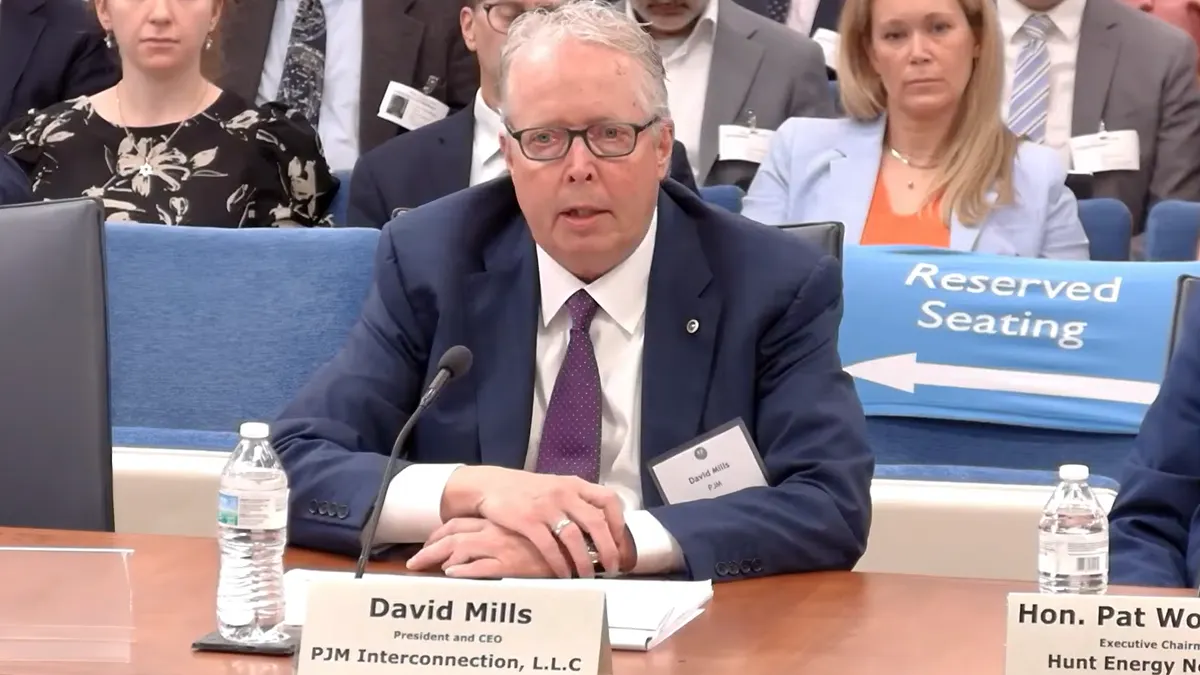
With PJM failing to attract significant new generation in its last two capacity auctions, the grid operator is ready for major changes in the way it operates, according to its new President and CEO David Mills, who officially took over the role in May after several months as interim leader.
“We are fully committed to rise to the challenge,” including capacity market reform, Mills said.
Potential reforms discussed at the meeting include increased board independence, a formal role for states at PJM, and giving states the right to file proposals at FERC — called “filing rights” — while also expanding PJM’s filing rights.
After taking post-conference comments, FERC intends to hold a dispute resolution forum in September with PJM stakeholders to develop a governance reform package, according to Swett. If an agreement isn’t reached by the end of that month, FERC will impose its own reforms on PJM, she said.
Capacity market exposes governance weaknesses
The technical conference comes about two years after capacity prices spiked in PJM as rising demand from data centers outpaced any increase in power supplies on PJM’s system, which spans 13 Mid-Atlantic and Midwest states and the District of Columbia. That price spike led to rate increases of 20% or more for some utilities and sparked intense interest from governors and policymakers.
PJM’s struggles in responding to the rapid shift in its supply-demand balance intensified governance problems that had been festering for years, Jodi Moskowitz, PSEG’s vice president regulatory — law, deputy general counsel and RTO strategy officer, said at the meeting.
Two problems highlighted at the meeting were the ability of PJM members to effectively fire the grid operator’s board members as well as its stakeholder process, which can be long and end without concrete results.
PJM uses a sector-weighted voting system in its stakeholder process, with a two-thirds majority of a sector-weighted vote required for a measure to pass. Under the system, members are divided into five categories — electric distributor, end-use customer, generation owner, other supplier and transmission owner.
One effect of the voting system is that two sectors can join up to block a measure they don’t like, which has happened repeatedly, especially on contentious issues, the RTO Governance Research Network said in comments filed at FERC.
During the meeting, representatives for American Electric Power and others said stakeholders should have an advisory role, like the one used by the Midcontinent Independent System Operator. Under that process, PJM’s board would get input from stakeholders, but final decisions would rest with the board.
Currently PJM members run the grid operator’s stakeholder process, which can lead to priorities getting offtrack, according to Asim Haque, PJM executive vice president, governmental and member services.
PJM’s failure to use authorities that it has and its failure to engage with states reflects the organization’s culture, according to FERC Commissioner David LaCerte.
“This is a cultural quagmire that they've developed by eroding the board in the past and creating this fear of [board members] being terminated to where they're not using their authorities,” LaCerte said “They're not engaging with the states because they don't want to get out of line with what the stakeholders want.”
The solution appears to be making the stakeholder process advisory, LaCerte said.
“I don't think we can do business as usual,” Haque said.
States seek expanded role
States want a bigger role at PJM. Currently, states meet with PJM’s board three times a year, but the meetings aren’t productive, according to Kelsey Bagot, Virginia State Corporation Commission chair.
Unlike in all other RTOs, PJM states lack section 205 filing rights, preventing them from filing proposals at FERC under that provision of the Federal Power Act.
PJM states have proposed that they have two pathways to interact with the grid operator: through a panel of state utility regulators and a separate panel of policymakers, said Jacob Finkel, deputy secretary of policy for Pennsylvania Gov. Josh Shapiro.
States, however, are open to other options, as long as states are listened to and respected, according to Finkel.
Utilities back changes
Representatives for AEP and PSEG said the utility companies support major changes at PJM.
AEP, which earlier this year said it is considering leaving PJM, supports giving states a bigger role at PJM, shifting to an advisory stakeholder structure and expanding PJM’s filing rights, according to Stacey Burbure, AEP senior vice president for transmission, regulatory engagement and compliance.
The utility company isn’t wedded to a particular approach, she said.
“Our focus is on: Have we fixed the problem? Have we resulted in a governance structure that drives solutions?” Burbure said.
PJM’s sector-weighted voting process “doesn't sufficiently align voting interest with accountability,” PSEG’s Moskowitz said. Although not its preferred option, PSEG is open to moving to an advisory stakeholder process, as well as increased state involvement, she added.
“We want PJM to have the tools and be empowered to act to get to better outcomes,” Moskowitz said.
Who does PJM serve: its members or public interest?
Some panelists called for explicitly requiring PJM’s board and staff to work in the public interest.
“The staff's goals should be specified as acting in the public interest, not acting in the interest of their members,” said Joseph Bowring, president of Monitoring Analytics, PJM’s independent market monitor. “Are their objectives to make the members happy, to do what the members ask them to do when members come and say, ‘I want a particular kind of rule.’ Is it their job to make that work, or is it their job to say ‘we don't think that's in the public interest’?”
The most meaningful reform that could be made at PJM is “firmly and clearly establishing public interest in PJM's mission and in its operating documents, and having that operationalized through what PJM does, both in its board and through the stakeholder process,” said Jameson Tweedie, Delaware’s ratepayer advocate.
Emerging agreement on key issues
There appeared to be agreement around some issues, such as giving states a bigger role at PJM and increasing the board’s independence, Jon Gordon, senior director at Advanced Energy United, a trade group for clean energy companies, said in an interview with Utility Dive.
“I was a little taken aback at how much consensus there was on a lot of these difficult issues,” he said. “There was a little disagreement around the edges, but most people seemed okay with the idea of the PJM board having more independence, being less controlled by the members, who you know I think we all agree have been focused on their own interests and not the larger interests of ratepayers.”
Mark Christie, a former member of FERC and the Virginia State Corporation Commission, said on social media that he was “cautiously optimistic” that there could be fundamental changes in PJM governance.
However, it is unlikely that stakeholders will reach an agreement on reforms and FERC will have to craft them for the grid operator, he said.
The most important takeaway from the meeting wasn’t any single proposal, according to Mona Dajani, global co-chair of Infrastructure, Energy and Real Estate at Cooley.
“It was the recognition that governance itself has become a strategic asset,” Dajani said in an email to Utility Dive. “In a period of unprecedented AI-driven demand growth, the ability to make timely decisions is no longer an administrative issue; it’s becoming a prerequisite for reliable markets, efficient capital allocation, and grid resilience.”