

With the U.S. facing an electricity affordability crisis and demand rising quickly for the first time in decades, experts say the Federal Energy Regulatory Commission’s June 18 order to system operators to provide transmission for flexible large loads underscores the urgent need to implement data center load flexibility.
Just a 1% to 2% reduction in data center peak demand can reduce electricity rates 0.5% to 2.8% and protect reliability, according to a 2026 Duke University Nicholas Institute study. And pilots and analysis led by the Electric Power Research Institute, or EPRI, show how flexibility is within reach that can also get data centers interconnected faster.
Electricity demand by artificial intelligence, or AI, data centers is driving a global urgency, Nat Bullard, chief strategy officer of research group Halcyon, reported in May. From Q1 2025 to Q1 2026, Amazon Web Services’ cloud business grew 28%, Microsoft Azure grew 40% and Google Cloud revenues increased 63%, he reported.
“Growth rates this high in already-mature businesses mean total revenue doubles in two years (or less),” Bullard wrote. “That revenue can only be serviced with compute, and that compute can only serve when energized.”
Experts told Utility Dive that public opposition to data centers, focused on local electricity costs, can be addressed by flexibility. Data center flexibility can reduce electricity demand, which reduces the costs to ratepayers of investments to protect reliability, the North American Electric Reliability Corp. acknowledged in its 2026 large load risk mitigation guidelines.
Flexibility can get a data center interconnected faster, make it a benefit to system reliability and increase system utilization which lowers rates, utilities, researchers and analysts agree. The challenge remaining is to resolve control issues between risk-averse utilities and impatient data center operators, they also agree.
The flexibility framework
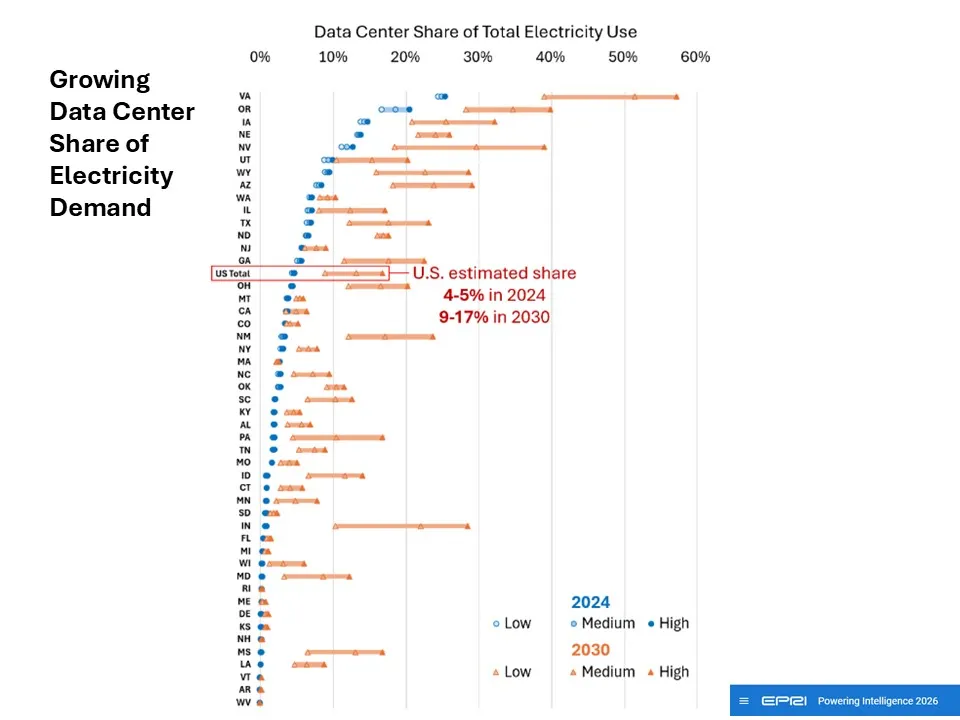
Power demand from U.S. data centers will reach 66 GW in 2027, up from 31 GW in 2025, with summer peaks growing to 8.5% in 2027 from 4.1% in 2025, Goldman Sachs reported May 20. Though AI proliferation is uncertain and growth will vary widely by state, data centers could consume as much as 17% of U.S. electricity usage by 2030, EPRI found.
Flexibility adds “headroom” to a power system by allowing system operators to add large loads and maintain reliability while minimizing rate raising infrastructure investments, EPRI’s FlexMosaic framework concluded. That is why data centers willing to be flexible can also maximize their “speed to power,” the institute’s analysis found.
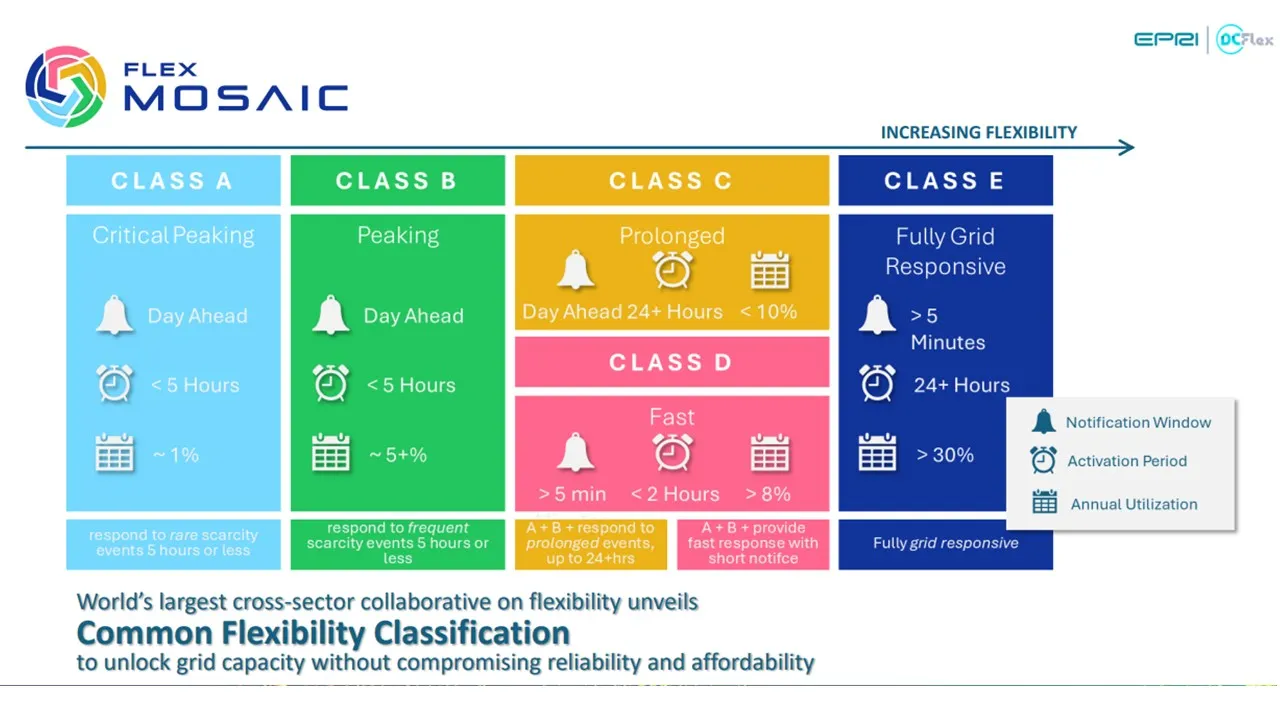
There are five flexibility “classes,” according to EPRI. Class A supports power systems during “infrequent extreme stresses” and Class B manages “daily or weekly” demand peaks. Class C meets long-lasting energy shortages, Class D protects in sudden supply or demand swings and Class E provides frequency stabilizing.
Key determinants of the flexibility class of a data center are the notification time it needs, the duration and frequency of its response, and the depth and quickness of its flexibility, FlexMosaic said.
FlexMosaic’s objective is to align incentives of data centers and utilities by linking faster and bigger data center interconnections with contractual agreements that protect utilities. Data centers with class D and E flexibilities that mitigate the local thermal overloads or voltage drops “unlock” the most system value, EPRI added.
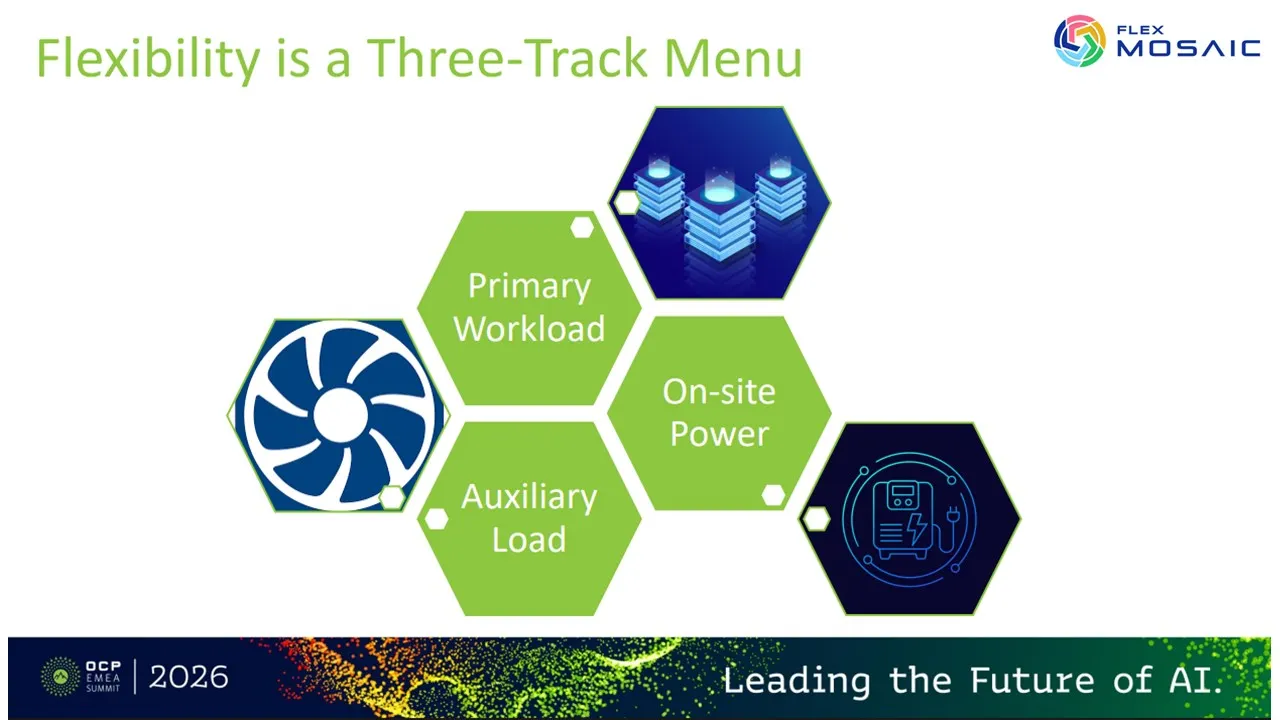
To be flexible, data centers can combine three flexibility pillars — managed workloads, reduced AI plant energy consumption and back-up power, said Anuja Ratnayake, the emerging technologies executive leading EPRI’s DCFlex Initiative. FlexMosaic’s aim is to standardize data center designs and utility programs that include flexibility, she added.
EPRI’s work contradicts the assertion that data centers cannot be flexible, said Ann Rendahl, president of the National Association of Regulatory Utility Commissioners and a Washington state utilities commissioner.
The findings from EPRI’s pilots and analysis will allow state regulators to require data centers to take the potential for flexibility seriously, Rendahl added.
The flexibility breakthrough
Using onsite or stored power during system emergencies and reducing building electricity use at operator requests is not new for data centers and other large loads. But FlexMosaic’s third pillar, data center workload flexibility, is a new opportunity to protect reliability and affordability that is now within reach.
Today’s AI data centers can “be designed with flexibility as a core operational principle,” Boston University researchers reported in June. Training and inference workloads “can offer between 18% and 55% flexibility relative to their average power consumption” and still meet quality of service requirements, modeling found.
Emerald AI “operates as an orchestration and optimization layer between utilities and data centers” and “does not directly control utility or data center operations,” Emerald AI head of product Mansi Shah said. “Utilities retain full dispatch authority,” she added.
Emerald AI “enables utilities to issue curtailment or flexibility requests to participating data centers through a secure software interface,” Shah continued. The platform “translates grid requirements into operationally feasible dispatch targets and provides telemetry, verification, and event compliance reporting back to the utility operator,” she said.
In short, Emerald AI coordinates “approved flexibility actions,” Shah said. The actions address “compute, cooling, energy storage, backup generation, and power infrastructure,” but always respect “predefined operational guardrails,” she added.
Every utility-data center interaction “is governed by operational parameters agreed upon by both parties in advance,” Shah said.
The utility defines the parameters of an event requiring flexibility, including “maximum magnitude, minimum notice period, frequency limits, and event duration,” Shah continued. But data centers set the “hard floors that protect critical workloads and infrastructure under all circumstances,” she said.
These terms give utilities “confidence that contracted flexibility will perform reliably,” and assure data centers “that operational and [technical] boundaries will never be violated,” Shah added.
EPRI’s demonstrations have delivered flexibility of up to 40%, but future AI infrastructure with designed-in flexibility can “materially” expand that, Shah said.
EPRI, NVIDIA and utility demonstrations with Emerald AI software have shown that training workloads “can be paused or slowed,” and inference queries “could be redirected” to a data center on a less stressed system, NVIDIA said in a July 2025 blog post.
In a peer-reviewed test of data center workload flexibility, Emerald AI’s platform gradually ramped an AI workload at electric utility Salt River Project 25% during a three-hour peak, the release said.
Another Emerald AI test shifted a data center workload from Virginia to Illinois without a loss of service quality.
A UK test showed Emerald AI software using NVIDIA hardware could reduce an AI load over a third in under a minute while protecting critical compute.
Emerald AI sent Portland General Electric’s signals to an Oregon data center and reduced power 20% in simulated weather emergency scenarios, Emerald AI reported in March.
Emerald AI has now proven “temporal flexibility” by “slowing or pausing AI workloads” with “customer-designated flexibility on completion time,” the company reported in March. It has also proven “spatial flexibility” by “seamlessly rerouting latency-sensitive loads” from a power-constrained data center “halfway across the country” to where power is available, it added.
In late 2026, EPRI, NVIDIA, Emerald AI and their partners plan to bring the 96-MW Aurora AI Factory online in Manassas, Virginia. It will validate workload flexibility at scale in a data center “designed for flexibility,” EPRI’s Ratnayake said.
The needed agreement
The missing piece in EPRI's DCFlex plans is a standardized binding agreement between utilities and data centers, stakeholders said.
A key parameter of that agreement will be explored in the next EPRI-led pilot. Emerald AI will flex an NVIDIA data center served by Silicon Valley Power, or SVP, which serves 58 data centers in its 20 square mile territory, Chris Karwick, its chief operating officer, said.
For phase one of the pilot, Emerald AI is developing “a bidirectional communication platform with the data center,” Karwick said. SVP “will see the NVIDIA data center load in real time, send a signal to reduce the load in response to simulated events like a forecasted heat wave or a sudden lightening strike, and see the load reduced,” he added.
SVP must also have “the safety net of 100% control of the loadside breaker if the data center wants to have the faster interconnection and additional capacity,” Karwick said. “That is non-negotiable,” and would be part of the interconnection agreement SVP makes with the data center, Karwick said.
The Portland General Electric, or PGE, large load study process already identifies each new data center’s flexibility capabilities, said Isaac Barrow, the utility’s senior manager of data centers and growth. But traditional bill credit incentives are too small to guarantee AI data centers will reduce their lucrative workloads when the utility sends a signal through Emerald AI, he added.
An interconnection agreement offering the right incentive structure will, however, “unlock the next wave of flexibility technologies,” Barrow said. For PGE, an agreement providing accelerated interconnection for a data center must guarantee “visibility” and “dispatchability” of the data center’s load, he added.
New utility regulations could simplify the agreement process by requiring data centers to have flexibility capabilities, said Joe Reele, vice president, solution architects, for energy technology company Schneider Electric. But regulations could require consent to a single digital platform by the power and data center ecosystems, he acknowledged.
With 50 state regulatory jurisdictions and many other local jurisdictions, “it is not an easy solution” with so many proprietary software platforms in use, Reele said.
Will they agree?
The value of a definitive flexibility agreement between data centers and utilities is clear.
“Power availability has become the gating issue for AI,” said Mona Dajani, c-chair of multinational law firm Cooley’s infrastructure, energy and real estate group. In constrained power markets, projects that have “credible, measurable, and contractually defined flexibility may increasingly receive more favorable treatment,” she added.
But the “pain point” remains utilities’ need for control and data centers’ need to choose how to respond to a utility signal for a load reduction, said EPRI’s Ratnayake.
A control mechanism like the one SVP’s Karwick described “is a really hard concept for data centers to embrace because they lose control,” Ratnayake said. Data centers need a more gradual load reduction because their highly sensitive hardware would be at risk and it is probably worth much more than many power system assets, she added.
Utilities need control because their experience with demand response programs shows they cannot always depend on voluntarily load reductions, Ratnayake continued. And “if a GW scale data center goes offline instantaneously it would create a whole host of other system issues,” she said.
Ultimately, the data center and the utility need a program structure defined in a contractual interconnection agreement, Ratnayake said.
The April memorandum of understanding between EPRI and the Open Compute Project Foundation, or OCP, is a major step toward that agreement and those protocols, Ratnayake said. It creates a channel for EPRI utility members and OCP’s tech community to collaborate on standards and protocols that work for both, she added.
Validating technologies, regulatory structures and market certainty will take time, but “it will unlock the power needed to keep pace with needs of AI,” Ratnayake said
Meanwhile, “the reality today is if you want grid power at scale, you cannot have 100% of the hours,” said James Kacergis, senior vice president of corporate and business development for Terawulf, which is building the 750-MW Mariner Lake AI data center for anchor tenants Core42 and Google-backed Fluidstack.
“A hyperscaler’s primary incentive is getting the interconnection to scale the business, and if it is not willing to work with the utility or system operator, a competitor will,” Kacergis said. But “it is not yet clear what the amount of load reduction and duration is that will attract data center customers because it's an emerging market,” he added.
Data centers are capable of slowing, capping or shifting workloads, “but it's questionable whether they want to do it,” added Steven Carlini, chief advocate of AI and data centers for Schneider Electric. If, though, the choice is “having 80% of the data center working or none of it, they would take 80%,” he added.
“Data centers want power as soon as possible and they want that power to be reliable, and utilities want to bring them online as quickly as possible and protect reliability,” said NARUC’s Rendahl. “Flexibility is a way to do what both want.”