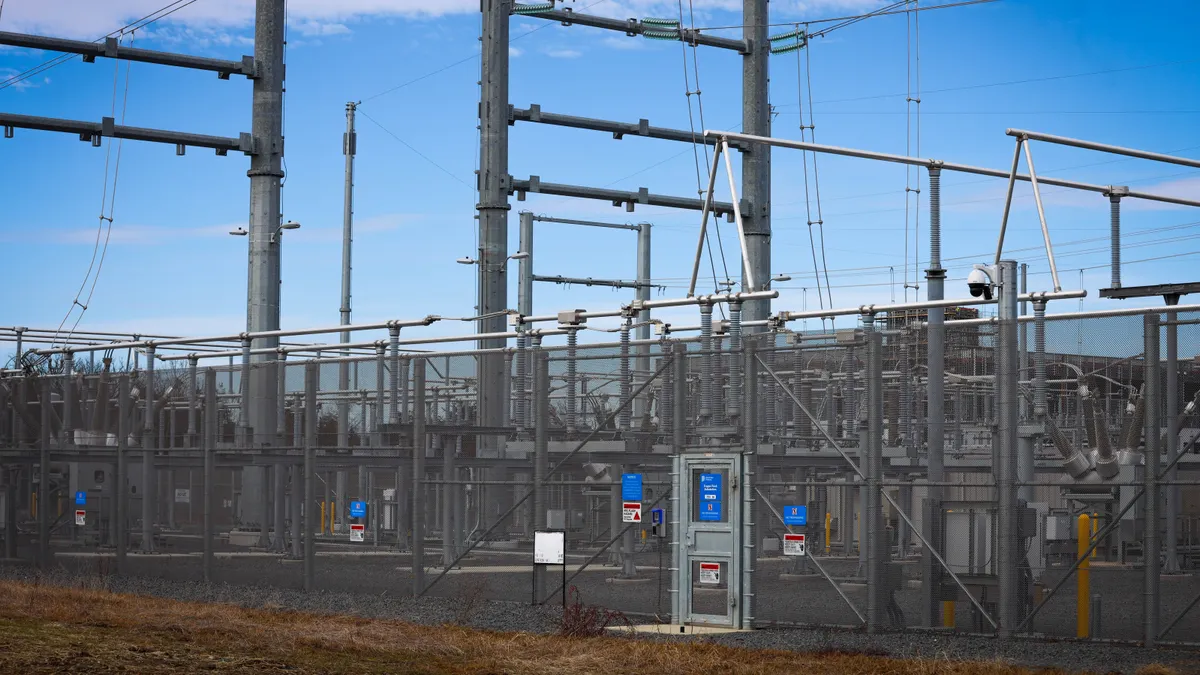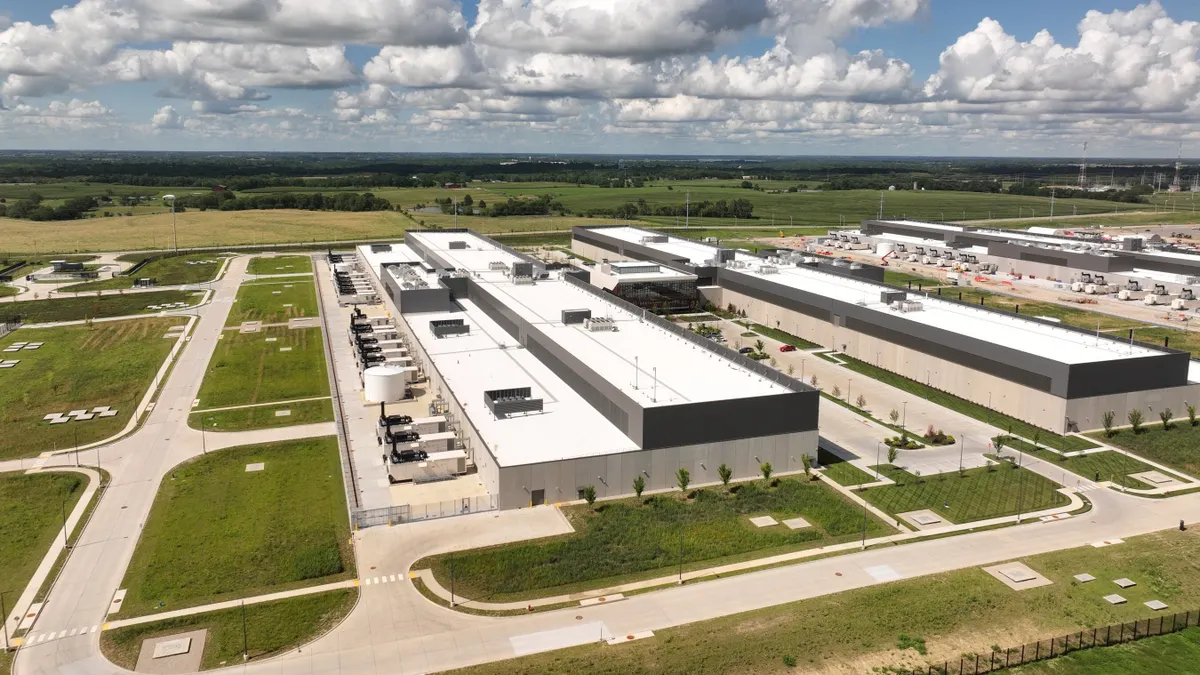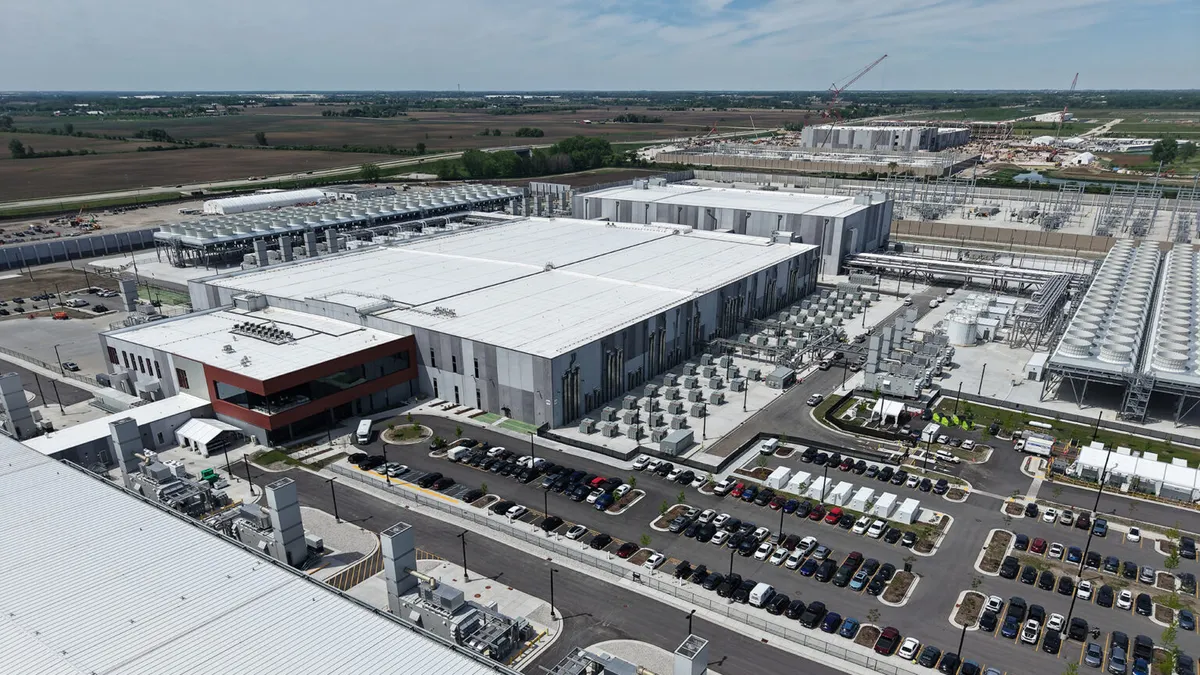
The pathway for adding data centers to the U.S. transmission system became clearer last week when the Federal Energy Regulatory Commission found that major grid operators’ rules for large load interconnections appeared to be inadequate.
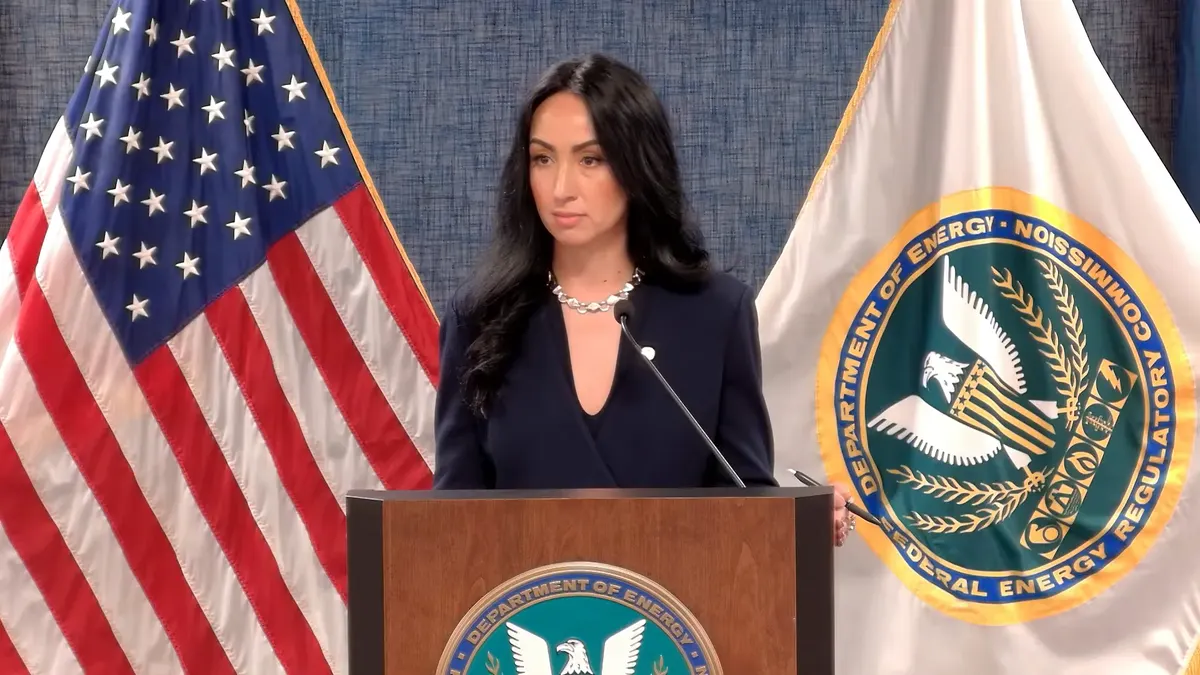
“We take historic action to push our country’s electric markets and economy into the future — a future of fair cost allocation, unprecedented transparency for the American ratepayer, respect for states’ rights, efficient markets and speed to power,” FERC Chairman Laura Swett said in a concurring statement with the six orders the agency issued Thursday.
In its “show cause” orders, FERC detailed five issues it wants regional transmission organizations and independent system operators to address in their large load interconnection rules:
- efficient transmission service application and study processes, including the consideration of alternative transmission technologies;
- prevention cost shifts and transparency into transmission costs;
- co-location and behind-the-meter generation;
- new transmission services for flexible large loads; and,
- a study process for generating facilities that serve “electrically proximate” large loads and co-located loads.
FERC’s decision was driven by a massive wave of data center development that started about two years ago, after years of generally flat electric demand growth in the United States. The development has sparked a race for data center developers to get power to their facilities as quickly as possible and created political backlash over rising electricity bills.
In October, the U.S. Department of Energy directed FERC to establish rules for enabling data center interconnection to the transmission system. FERC’s response to the DOE’s “advanced notice of proposed rulemaking” drew more than 3,500 pages of comments and was completed in roughly eight months.
“FERC's action is far more substantively ambitious than the ANOPR, and it enables region-specific investigation pathways that should be more effective than a uniform rulemaking,” Devin Hartman, a senior fellow at the R Street Institute, said in an email to Utility Dive.
Ultimately, new interconnection rules could provide greater cost clarity for electric utilities, according to Morningstar DBRS.
“For regulated utilities, the key benefit is a clear framework for determining the need for large-load-related infrastructure, who pays for it, and how long the large-load customer must remain financially responsible for the investment and to an extent mitigate customer affordability concerns," Zujian Li, Morningstar DBRS’ vice president of energy and natural resources ratings, said Monday.
For data center developers, FERC’s orders indicate that the agency is “committed to prioritizing projects that can prove they are real, financeable, operationally flexible, and capable of integrating with the grid without imposing unjustified costs on other customers,” Jane Rueger, Perkins Coie data center co-chair, said in an email to Utility Dive.
FERC’s orders were issued to: the California Independent System Operator; ISO New England; the Midcontinent Independent System Operator; New York Independent System Operator; the PJM Interconnection; and, the Southwest Power Pool.
Here are six takeaways from FERC’s landmark decision.
FERC opts for regional approach
FERC directed the RTOs and ISOs to develop their own data center interconnection rules that can best meet their specific needs.
“The era of one national standard for data center interconnection is over before it began,” Mona Dajani, a partner and the co-chair of Cooley's infrastructure, energy and real estate practice, said in an email to Utility Dive. “What replaces it is six regional answers to the same question, decided on six different timelines.”
As a result, data center developers face new diligence needs for near-term deals, according to Dajani.
“A term sheet signed against today’s PJM tariff carries different risk than one signed against today’s MISO or CAISO tariff, because each region’s show cause filing will land on its own schedule with its own substantive answer on cost allocation, co-location, and flexible load service,” she said.
FERC was smart to avoid a “one-size-fits-all approach,” according to Gretchen Kershaw, COO and vice president of strategy at Grid Strategies, a transmission-focused consulting firm.
“FERC did an admirable job of explaining the nuances of each region in the orders,” Kershaw said in an email to Utility Dive.
However, Kershaw said she would like FERC to take some action outside of RTOs as well. “The framework of vertically integrated utilities and bundled retail sales is distinct, but there is no part of the country where there is less transparency than in these regions,” she said.
Hartman echoed those comments. “I wish FERC had included non-RTO areas, which typically suffer from the worst transmission and interconnection practices,” he said.
About a third of Americans live outside of RTOs, former FERC Commissioner Allison Clements noted in an email. “By punting on the tougher jurisdictional questions, FERC has left these customers without the cost and transparency protections that will be made available to families in RTO regions," said Clements, a partner with digital infrastructure advisory firm ASG and principal of 804 Advisory.
FERC encouraged transmission owners outside of RTOs — such as much of the West and Southeast — to propose data center interconnection rules.
FERC ‘stays in its lane’
With its orders, FERC appears to have avoided conflicts over federal and state jurisdiction, a major concern that arose when the DOE ordered the agency to develop large load interconnection rules.
“We recognize that states will continue to regulate: (1) the specific terms of retail sales to large load; (2) which entities may make retail sales within their borders, including which entities are legally permitted to provide electricity to retail large load customers; and (3) any siting decisions and construction associated with the large load project,” FERC said in its PJM order. “Nothing in this order is intended to intrude upon state authority over retail service to large loads.”
FERC did a “great job” staying in its jurisdictional ambit, according to Kershaw.
“As a long-time FERC lawyer, I think FERC has more jurisdiction than it has asserted, but I recognize that fast and durable action is easier when litigation risks are reduced — and that is no more true than when sticking to existing jurisdictional lanes,” Kershaw said.
Protecting ratepayers from cost-shifts
In its orders, FERC said it was concerned that there appears to be a lack of transparency in how RTOs and ISOs determine how network upgrades are assigned and paid for. Also, grid operators appear to lack pro forma cost recovery agreements for network upgrades that can be required to safely interconnect new loads to the grid. Those agreements can help ensure that large load customers bear the risk and pay for their transmission service, including the cost of network upgrades, FERC said.
FERC, for example, directed PJM to explain whether its tariff remains just and reasonable without providing “robust, accurate, and systematic” and easily searchable data on its website on network upgrade costs.
FERC directed RTOs and ISOs to have “cost recovery agreements” to help make sure that large loads pay their share of the costs incurred to serve them, FERC Commissioner David Rosner noted in a concurring statement.
“We target speculative projects by establishing escalating readiness requirements for distinct phases of the study process to deter duplicative or speculative requests for transmission service,” Rosner said.
Options coming for flexible loads
“Load flexibility can avoid inefficient and costly transmission system build-out,” FERC said. “In addition, transmission services that reflect that flexible large loads are willing and able to limit their withdrawals from the transmission system under certain conditions could help timely interconnect flexible large loads.”
FERC’s orders reflect a growing recognition that data centers can be more flexible than traditional loads, Robert Montejo, a data center partner at the Duane Morris law firm. “The ability to curtail or operate flexibly could become one of the most valuable tools for getting new projects connected faster,” he said in an email.
FERC’s orders preliminarily find that the agency should extend the transmission services developed in PJM’s co-location proceeding — interim network integration transmission service, firm contract demand and non-firm contract demand — to new types of load and new regions, FERC Commissioner Judy Chang said in a concurring statement.
“While these services have the potential to facilitate more efficient use and build out of the transmission system, they also contemplate running the system ‘tighter’ than we have done in the past, potentially with more loads on the system served by co-located or behind-the-meter generation, and potentially more use of batteries, load control systems, and backup resources to manage demand during system peaks or other stressed conditions,” Chang said.
FERC calls for ATT evaluations
In its orders, FERC called on grid operators to consider alternative transmission technologies — such as advanced power flow control devices, synchronous condensers, advanced conductors and dynamic line ratings — when conducting transmission service request studies for data centers and other large loads.
If a grid operator decides traditional network upgrades are needed, they should clearly show why ATTs are infeasible or would not lower costs or offer a faster timeline for interconnecting a large load, according to FERC.
“The goal is to respect transmission providers’ engineering judgments while protecting against upgrade costs when ATTs could solve transmission needs faster and with a lower bill,” FERC Commissioner Lindsay See said in a concurring statement.
ATTs can “unlock every megawatt of existing capacity from our current transmission system,” FERC Commissioner David LaCerte said. “We have the technology. We should use it now to enable faster interconnection of large loads, lower costs to customers, and help prevent cost shifting.”
Reform timeline could be challenging
FERC gave the RTOs and ISOs 60 days to respond to their show cause orders. However, within 45 days, they can request 90-days extensions to be added to the initial 45 days.
That timeline may result in “relatively cursory reports, not detailed reform proposals,” Hartman said in a social media post. “Regional stakeholders have to rapidly diagnose deficiencies and identify reforms for issues that often take multiple years to develop remedies.”
The timeline is “really aggressive” and there may be governance barriers to meeting it, according to Kershaw.
“I expect we'll see some requests for abeyance,” she said. “I will also be watching the PJM governance technical conference carefully for how FERC is thinking about reforms that can result in expedited filings like those envisioned by the show cause orders.”
LaCerte warned that the agency expects solid responses from the RTOs and ISOs, saying the agency used “considerable restraint” through its show cause orders.
“The commission has very broad jurisdiction over transmission that we will not hesitate to utilize as necessary to ensure that we meet our objectives in all show cause proceedings,” he said in a concurring statement to the orders.
If the grid operators fail to adequately address the large-load-related concerns identified by FERC, the agency will dictate the solutions, according to LaCerte.
“I say this not as a threat, but as a statement of duty,” LaCerte said. “While you may not like our remedies — I have often said that the federal government generally does not come up with the best solutions — this is an outcome we are prepared to pursue given the gravity of the moment and our statutory obligation.”