Dive Brief:
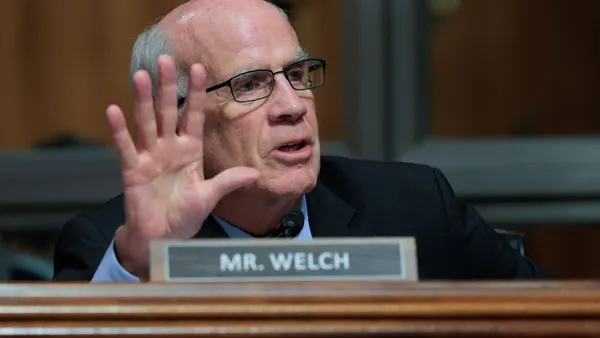
- A bill to bolster the adoption of microgrids with a $200 million U.S. Department of Energy pilot and $500 million in state grants was introduced in the Senate Wednesday by Sen. Peter Welch, D-Vt., ranking member on the Senate Agriculture Subcommittee on Rural Development, Energy, and Credit.
- The STRONG GRID Act, which stands for Supporting Transformative Resilience, Operations, and Next-Generation Grid Innovation Deployment, aims to make microgrids and distributed energy resources eligible for funding under state energy program grants and establish state-run grid resilience programs to support their deployment.
- The National Association of State Energy Officials, the GridWise Alliance and manufacturers and distributors of grid equipment have endorsed the bill, saying it could help advance the national conversation around grid modernization. “Microgrids, generally, they're not new. But they’re new to a lot of policymakers and states,” Peter Ferrell, senior director of government relations at the National Association of Electrical Manufacturers, told Utility Dive.
Dive Insight:
Over the last four to five years, much of the national electric conversation has focused on the “macro grid,” Ferrell said, culminating in the current discussion around how to bring growing numbers of large loads like data centers online quickly.
As those conversations focus on the challenges involved, particularly around reliability, “microgrids have become a little more front and center,” Ferrell said.
NEMA’s support for the Welch legislation goes beyond the bill’s particulars; it’s focused on broadening state and regulatory understanding of the technology and its ability to strengthen the electric grid, Ferrell said. Microgrids can provide options for grid modernization on constrained systems while also freeing up capacity to serve loads of all sizes, from electric vehicle chargers to data centers and manufacturers, he said.
“Microgrids are a tool to help provide more options to get those customers onto the grid in a responsible, reliable way,” Ferrell said.
Welch’s bill would direct DOE to establish a $200 million pilot program within one year to award competitive grants to projects demonstrating microgrid capabilities, including:
- Providing ancillary grid services and supply and demand management.
- Aggregating distributed energy resources into virtual power plants.
- Facilitating load transfers to alleviate transmission congestion; and
- Managing voltage instability or collapses.
And it would appropriate $500 million for state energy program grants for:
- Conducting a microgrid needs assessment or feasibility study.
- Designing and engineering a microgrid, including a solicitation of technical assistance.
- Constructing a microgrid and its energy resources, including generation assets and energy storage; and
- Implementing advanced cybersecurity systems.
The U.S. electric grid “is under more pressure now than at any point in our history, and extreme weather events are exacerbating that strain,” Sen. Welch said in a statement. “Our bill capitalizes on the potential of microgrids to help keep essential services online and reduce the economic impact of natural disasters.”
In May, NEMA forecast annual U.S. electricity consumption will grow more than 55% by 2050.
“As grid operators issue resource adequacy warnings and utilities revise demand forecasts upward at an unprecedented pace, tapping into local resources is an increasingly important way to protect communities from reliability risks,” GridWise Alliance CEO Karen Wayland said in a statement.
Welch’s legislation offers “a faster path to microgrid deployment in areas at high risk where extending or hardening traditional infrastructure can take years,” Wayland said.