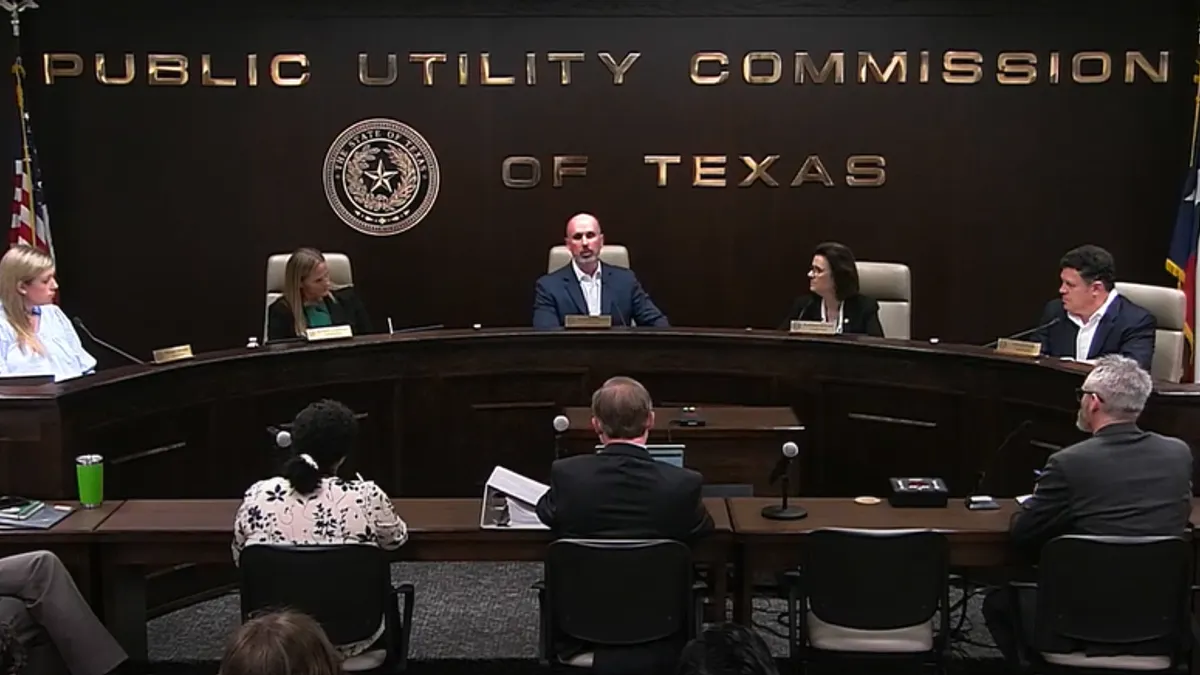
The Public Utility Commission of Texas on Thursday approved rules for the state’s grid operator to process large load interconnection requests, including data centers. The first set of projects to navigate the new process is called “Batch Zero.”
The Electric Reliability Council of Texas says it is tracking more than 438 GW of large-load requests, and nearly 90% are from data centers.
The PUCT’s decision mirrors a national conversation around data center load growth and how to interconnect projects to the electric grid. The Federal Energy Regulatory Commission on Thursday concluded most grid operators’ rules for large load interconnections are insufficient to the moment, and directed them to develop their own data center interconnection rules based on regional needs.
Under the Texas framework, ERCOT will look at batches of projects that are 75 MW or larger in a single study to “assess the full picture of future electricity demand at once,” the grid operator said.
Officials said the process will protect grid reliability and support economic growth while eliminating a project-by-project evaluation that had become “lengthy and repetitive” as large loads rushed to interconnect.
"Texas is experiencing an energy transformation unlike anything we have seen before," ERCOT President and CEO Pablo Vegas said in a statement. "This new process represents a fundamental shift in how ERCOT manages the significant growth of large load interconnection, providing a structured, transparent path forward.”
Texas data center announcements continue to mount. On Monday, Microsoft said it planned to build a 2-GW data center in Pecos, Texas, with the company funding all of the energy infrastructure.
Batch Zero applicants will be informed of their inclusion in the initial study in August, and ERCOT said a final transmission plan covering the batch is expected to be published in the fall of 2027. Applications for Batch 1 are expected to open in the summer of 2027.
“While not all interconnection requests result in built projects, ERCOT data shows the majority expect to be operational by 2030,” the grid operator said.
The grid operator also said the principles established through the Batch Zero framework will be the basis for an “ongoing, comprehensive transmission planning process” to be developed in partnership with stakeholders later this year.
The framework includes provisions for large loads to develop their own generation on-site. The process also creates a path to interconnect large load customers who agree to let ERCOT curtail their power use in response to local constraints.
“Facilities that are truly islanded with no grid connection would generally fall outside ERCOT's interconnection process, though they may still be subject to registration requirements with the PUCT,” the grid operator said.
Projects eligible for Batch Zero inclusion will meet a “maturity criteria” based on having completed certain steps, Jeff Billo, ERCOT vice president of interconnection and grid analysis, told commissioners before their vote. And the grid operator expects to allow projects to meet those qualifications through an attestation by an affiliate.
Texas energy expert Arushi Sharma Frank called ERCOT’s Batch Zero approach “the first market design that is ready-to-ship for large loads that actually solves reliability risk, transmission affordability, and siting loads to benefit all ratepayers, simultaneously.”
Sharma Frank, principal at Luminary Strategies, also noted FERC’s Thursday decision and said the federal regulator “punted the market design decision to dozens of individual utility operators” because of the need to take a regional approach.
“It is unavoidable. It is not red tape,” she wrote. “The physics of a grid determine what solutions work — ERCOT is lucky that its regulator directly governs physics-based solutions.”