Dive Brief:
- Booming demand for energy storage propelled Tesla’s stationary battery deployments to a fresh record in the fourth quarter of 2025 as its electric vehicle deliveries slowed sharply, the company said on Wednesday.
- Two Korean battery manufacturers, LG Energy Solution and Samsung SDI, also reported strong stationary storage demand last quarter and said they expected more of the same in 2026. Both said their energy storage businesses helped offset slowing North American EV demand.
- The Korean manufacturers said U.S. tax credits for battery manufacturing and deployment would drive business in the coming quarters. Tesla executives also said its energy storage business would expand despite ongoing uncertainty around U.S. tariff policy.
Dive Insight:
Tesla deployed 14.2 GWh of energy storage in the fourth quarter of 2025 and 46.7 GWh in the full year. The quarterly and annual figures were up 29% and 49%, respectively, from the same period in 2024.
Meanwhile, Tesla’s vehicle deliveries fell 16% year over year in the fourth quarter.
Across the board, North American EV sales fell 46% from a record third quarter after the U.S. tax credit for consumer EV purchases and leases expired, according to Cox Automotive. EV sales growth remains strong outside North America, rising about 20% globally in 2025.
Tesla said its energy business, which produces stationary storage and solar PV systems, saw record profit margins for the fifth consecutive quarter. Demand was strong “in all regions” and across the company’s Powerwall home battery and Megapack grid-scale product lines, Chief Financial Officer Vaibhav Taneja said Wednesday.
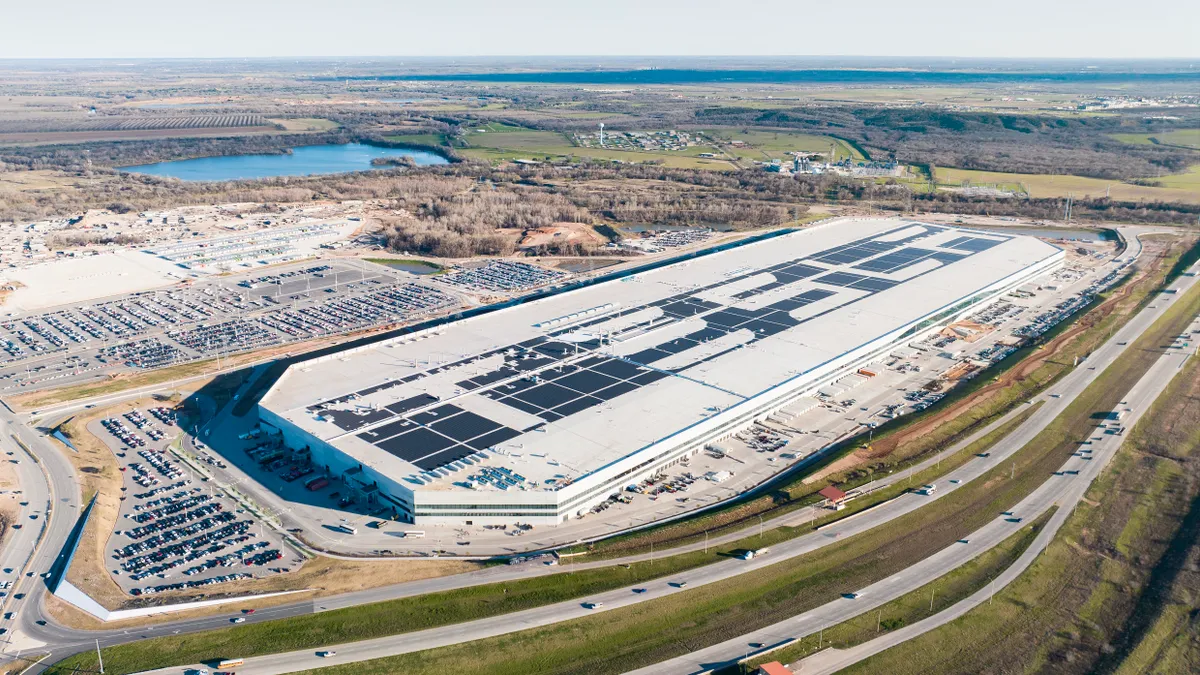
Tesla plans to begin Megapack production this year at a new plant near Houston. The factory will produce up to 50 GWh of Megapack 3 systems annually, the Houston Chronicle reported in September. Tesla already has 80 GWh of combined Megapack production capacity at factories in California and China.
“We are building more manufacturing capacity and expect that energy will have very high growth for as far into the future as we can imagine,” Tesla CEO Elon Musk said Wednesday.
Some industry analysts expect solar deployments to slow later this decade as the industry adjusts to new rules on foreign sourcing of components, federal permitting roadblocks and the accelerated expiration of U.S. investment and production tax credits. Wood Mackenzie’s most recent U.S. solar market forecast sees installations dropping from around 40 GW in 2025 to about 30 GW annually from 2028 to 2030.
But Musk said Tesla would continue to invest in solar PV production, which he framed as complementary to its stationary storage business.
“The solar opportunity is underestimated. We think the best way to add significant capability to the grid is solar and batteries on Earth and solar in space,” he said, adding that Tesla was “going to work towards getting 100 GW a year of solar cell production integrating across the entire supply chain from raw materials all the way to finished solar panels.”
Musk did not give a timeline for the solar production ramp, but shares of First Solar — a top U.S.-based competitor — fell following his remarks. In an investor note today, analysts with the investment bank Jefferies questioned how quickly Tesla could scale panel production, saying “it does not appear [near-term] and [is] not baked into the company’s capex.”
Samsung SDI and LG Energy Solution did not say how much energy storage they deployed last quarter, but both said the technology helped offset broader weakness caused by slowing North American EV demand.
LG Energy Solution said it expects global energy storage production growth to outpace EV production growth by a factor of four to one in 2026. It’s targeting 90 GWh in stationary storage orders and over 60 GWh of production capacity — 80% of it in North America — by the end of the year, driven by long-term contracts with utilities and energy storage developers.
Energy storage is set to represent about half of total North American battery demand “on the back of tech companies’ investment in data centers and policy support including the maintenance of [the] clean energy investment tax credit,” it said.