
As utilities work to expand system capacity and improve power quality, one challenge continues to surface: how to add capability without adding more equipment, more maintenance and more space.
Traditionally, capacitor bank applications require multiple devices to perform separate functions. One device energizes and de-energizes the bank. Another provides protection. Additional equipment may be required to manage switching transients and inrush currents.
Today's advanced medium-voltage breaker technology changes that equation.
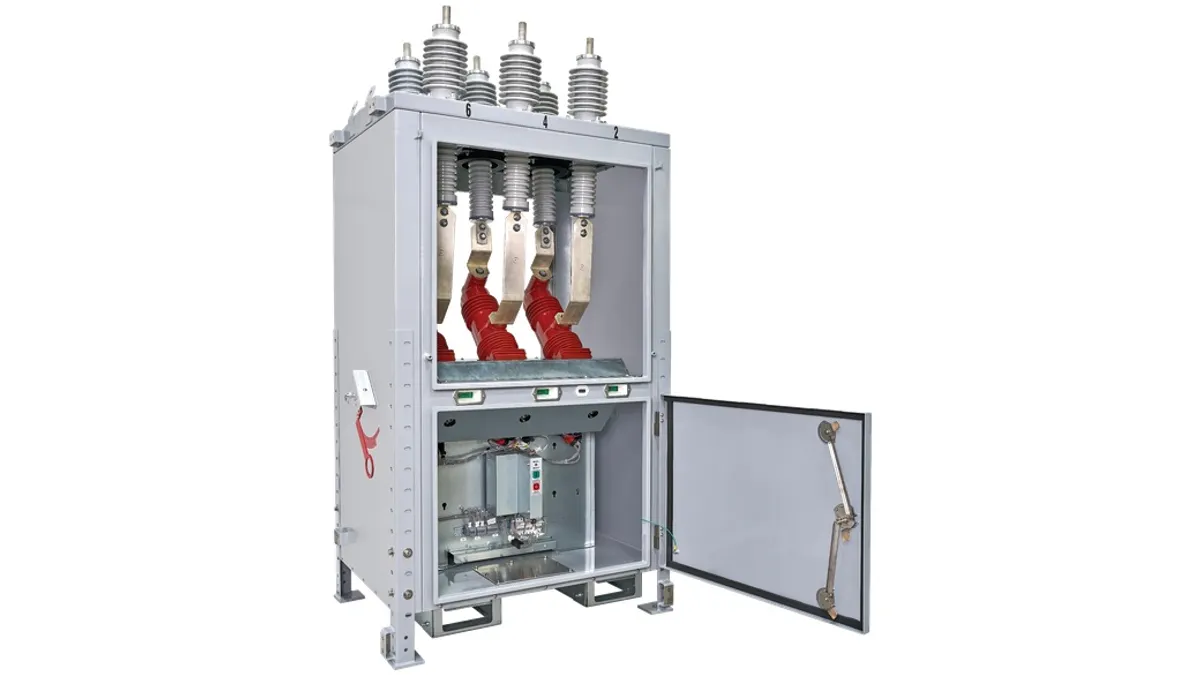
By combining point-on-wave switching and protection in a single breaker, utilities can eliminate separate switching devices while maintaining precise capacitor bank control. The result is a simpler installation with fewer components, a smaller footprint and lower overall system complexity.
More functionality in less footprint
In many substations, available space has become a valuable asset. Adding new equipment often means expanding infrastructure, increasing costs or limiting future growth.
Advanced breaker technology can serve as both the energizing device and the protection device for capacitor banks, eliminating the need for separate switching equipment between the breaker and the bank.
With fewer devices installed in the yard, utilities can:
- Reduce substation footprint
- Simplify installation and commissioning
- Lower equipment and maintenance costs
- Create room for future expansion
- Improve overall system reliability
Rather than adding more components to solve power quality challenges, utilities can accomplish more with less equipment.
Consistent performance in real-world conditions
Modern utility equipment is increasingly being asked to operate in environments that are far different from traditional indoor substations. Installations may be exposed to extreme temperatures, dust, humidity and rapidly changing operating conditions.
Conventional switching technologies often depend on highly controlled operating conditions and precise timing. Variations in voltage supply, temperature or environmental conditions can impact performance.
New actuator and control technologies provide highly repeatable operating performance regardless of environmental conditions. Whether deployed in a hot industrial facility, an outdoor substation or a region with significant temperature swings, the breaker delivers the same switching performance time after time.
This operating consistency helps utilities improve reliability while reducing concerns about environmental impacts on equipment operation.
A new approach to capacitor bank control
Point-on-wave switching provides another significant advantage by minimizing the transients typically associated with capacitor bank energization.
When switching occurs at the optimal point on the voltage waveform, utilities can reduce inrush currents and power quality disturbances that may otherwise require additional mitigation equipment, significantly reducing transient and ripple effects over conventional switching.
Because the breaker itself provides both switching and protection functions, utilities can simplify capacitor bank designs while achieving better overall performance.
Configured as either single- or three-phase operation, the breaker can switch individual phases independently when the application requires it. This flexibility helps utilities better manage faults, improve power quality and maintain service continuity in situations where traditional three-pole operations would interrupt more customers, potentially improving SAIDI & SAIFI scores by as much as 70 percent.
Building smarter systems
Utilities are under increasing pressure to improve reliability metrics, increase system flexibility and support growing energy demands without dramatically expanding infrastructure.
The most effective solutions are often not the ones that add more equipment. They are the ones that allow existing systems to do more with fewer components.
By combining protection, capacitor bank switching, transient mitigation and advanced control capabilities into a single platform, utilities can reduce complexity, improve reliability and create space for future growth, all while delivering better service to customers.
Working with a trusted future-forward partner who understands both the demands of new modern infrastructure and how to upgrade legacy installations is critical to this transition.