
For most businesses, bad weather is an operational problem. For utility companies, it can stress test the entire organization.
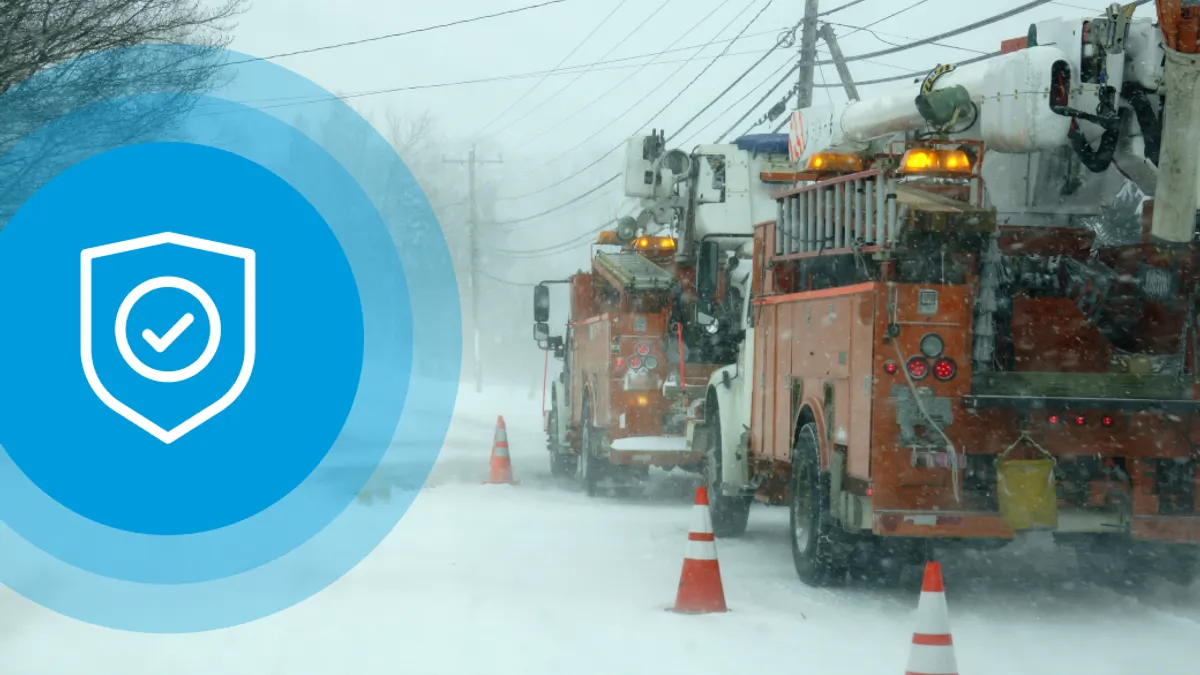
When a major storm hits, crews can't simply wait for conditions to improve. Customers need power restored and your employees will have to travel through blocked roads, damaged infrastructure and dicey conditions that can change from one hour to the next.
That puts utility leaders in a difficult position: keep people moving without losing sight of safety.
The most effective response isn't a single policy or a stricter rule. It's a different way of managing risk — one that assumes conditions will change and builds the operation to respond accordingly. This response is based on three habits: read, reroute and recalibrate.
Read: make current conditions part of the decision
Checking a weather report before the morning dispatch is useful. By midday, it may be largely irrelevant.
Conditions can change quickly, and they can vary considerably across a service territory. Fog develops. Rain intensifies. Roads become flooded or covered with debris. Visibility drops.
As conditions worsen, risk escalates. The Lytx® 2026 Road Safety Report found that fog alone makes severe crashes nearly three times more likely. Similarly, data from the Federal Highway Administration shows that a large majority of weather-related incidents involve wet pavement (75%) and active rainfall (47%).
For senior leaders, the takeaway is bigger than weather: decisions are only as good as the information behind them.
A safety program built around yesterday's — or even this morning's — weather will struggle when the operating environment changes. For crew safety and success, it's critical to have near-real-time feeds of field conditions.
Reroute: build flexibility into the operation
Routing can't be "set it and forget it" for utility crews. When uncontrollable conditions are involved, the safest way to reach a job is often different from the route that looked best at dispatch.
Fleets that use current information and dynamic routing can adeptly respond to changing conditions, keeping crews safe while getting the job done.
For fleet executives, this raises a broader operational question: where have we built flexibility into our plans?
A resilient operation isn't one that predicts every disruption correctly. It's one that can adjust when the prediction is wrong. Treat routing as something that changes mid-shift as conditions change, not a fixed plan.
Recalibrate: put driving behavior in context
This is the part that's often overlooked.
Many organizations have clear standards for driving behavior, and they should. Consistent expectations give drivers and managers something to work from. But consistency can become a problem when the rule becomes more important than the circumstances surrounding it.
Take speed. What's considered a safe speed on a clear, dry highway can be unsafe in heavy rain or dense fog. Safe speed for conditions matters, and determining what was happening when a risky behavior occurred provides essential context.
This is an important distinction for fleet leaders building a safety culture. The goal of reviewing driving behavior isn't merely to find violations. It is to understand risk, identify patterns and help people make better decisions the next time conditions change.
Read and reroute address the changing environment. Recalibrate applies that same "real-time, conditions-first" thinking to the human behavior within it.
Ask the questions
For fleet and safety leaders in the utilities industry, there are three questions worth asking:
Do we read conditions continuously?
Can our routing adapt when conditions change mid-shift?
Does our coaching account for the context in which driving behavior occurred?
The answers can reveal something important about how your organization manages risk — not just when a storm arrives, but every day.
Discover how your fleet can master every mile and proactively navigate through ever-changing risk with Lytx.