Dive Brief:
- Dominion Energy will need to change its transmission cost allocation policy to directly assign the cost of certain transmission infrastructure to the new large-load facilities — such as data centers — which made that infrastructure necessary, the Virginia State Corporation Commission said in an order filed July 31.
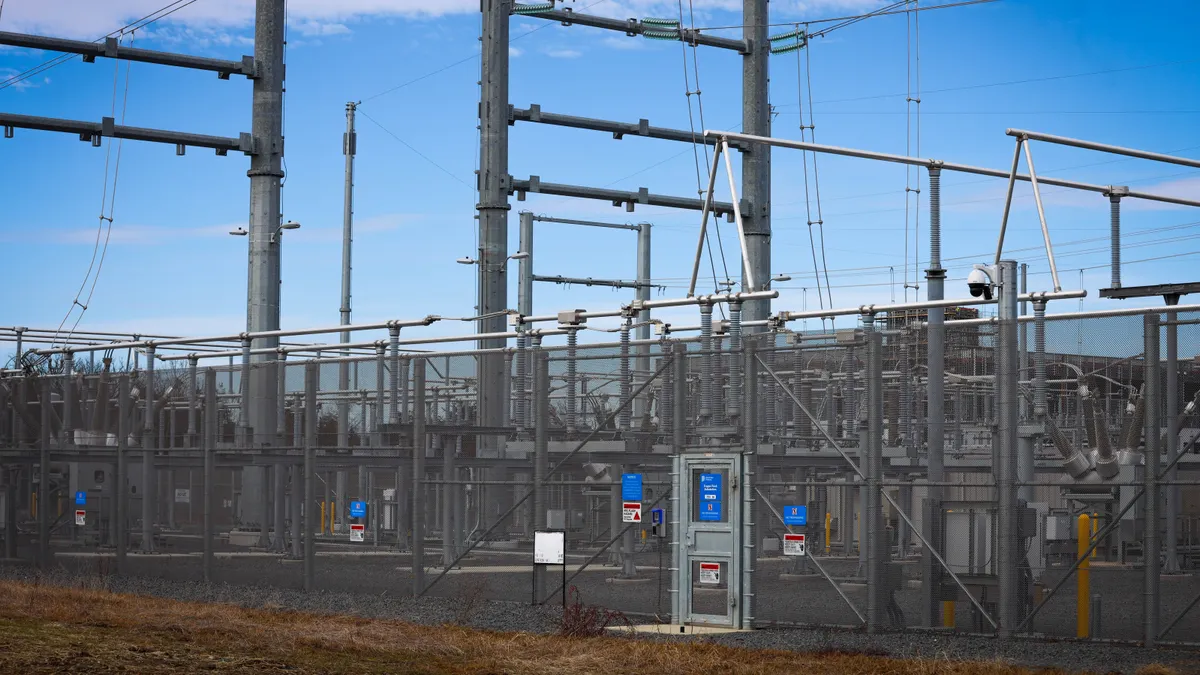
- The mandatory contribution in aid of construction, or CIAC, will apply to “direct connect” facilities, and apply to the cost of the substations and the transmission lines which connect those facilities to the grid.
- The SCC’s case concerned Dominion’s proposed increase to its Rider T-1 line-item charge for cost recovery for transmission investments, as the company sought to recoup around $1.5 billion. The commission approved an amended version of Dominion’s new 12 coincident peak demands allocation factor, or 12CP, reducing the proposed monthly cost increase for a typical residential customer from $2.90 per month to $0.94 per month — a 67.5% decrease.
Dive Insight:
“At the extremes, this minimum demand adjustment decreases the residential class’s allocation factor by 2.84% and increases the GS-4 rate class’s allocation factor by 4.33%,” the SCC wrote in its order. Dominion’s GS-4 rate class applies to large commercial or industrial customers that demand at least 500 kW and receive power directly from the grid.
The SCC ordered Dominion to craft an amendment to its existing line extension policy “that would require a mandatory CIAC for defined types of transmission facilities,” and directed Dominion to file that proposed amended policy in a new docket within 90 days from the date of the final order.
“Under the SCC’s oversight, we already have among the strongest protections in the country to prevent data center driven costs from being borne by our residential customers,” Dominion spokesperson Jeremy Slayton told Utility Dive in an email. “When we file our amended line extension policy, we will be adding even more protections for our residential customers to ensure our more energy intensive customers continue to pay their fair share.”
Michael Barber, a senior energy infrastructure policy analyst with The Piedmont Environmental Council, said the SCC’s decision is a “huge step in the right direction” in the eyes of the nonprofit, which testified before the SCC in the case and filed in the docket.
The case was a “really short proceeding,” taking place over just 90 days, Barber said in an interview with Utility Dive. “So I think the order that the commission made was probably the most in-depth they could go into direct assignment.”
“I think we got an amazing outcome given that,” he said. “What the commission didn't do was define any other classes of transmission projects that would also be primarily caused by a given data center or multiple other data centers, and order Dominion to develop direct assignment procedures for those projects.”
However, Barbed added, “the commission stated in their final order that they are open to considering the concept of direct assignment for some of those higher-level, more upstream transmission costs in the future, and we're really excited.”
The SCC said it may use the new docket to consider whether the amended line extension policy “could or should” be extended to those higher-level costs, as well as the merits of “a blended approach” where those higher-level costs are directly assigned to Dominion’s new GS-5 rate class for energy users requiring 25 MW or more.
Hyperscaler companies including Google and Amazon also testified in the SCC’s hearings about the case, and both of those companies requested the introduction of voluntary CIACs, but the SCC ruled that the payments will be mandatory.
Barber said he thinks Virginia is a national “bellwether, or canary in the coalmine, if you will” for these particular cost allocation issues around energy infrastructure, and that he anticipates that there will be “a lot of eyes” on Dominion’s upcoming filing in the new SCC docket.