Dive Brief:
- Customers participating in Pacific Gas & Electric’s flexible interconnection pilot, which offers expedited hookups for agreeing to have the utility limit their capacity when the system is constrained, have been able to tap the distribution grid for their needed capacity in 90% of hours during its first two years, the program manager told Utility Dive this month.
- Active Flex Connect participants have seen operational loads impacted less than 1% of the time during “the rare confluence of events” when the local grid is constrained and their demand remains high, Alex Collins, PG&E’s manager of execution operations and distributed energy resource management systems, said in an interview.
- Unlike many other utility pilot programs, Flex Connect grew out of feedback from customers rather than a commission mandate, but PG&E is now working to formalize the program with the commission’s oversight, Collins said.
Dive Insight:
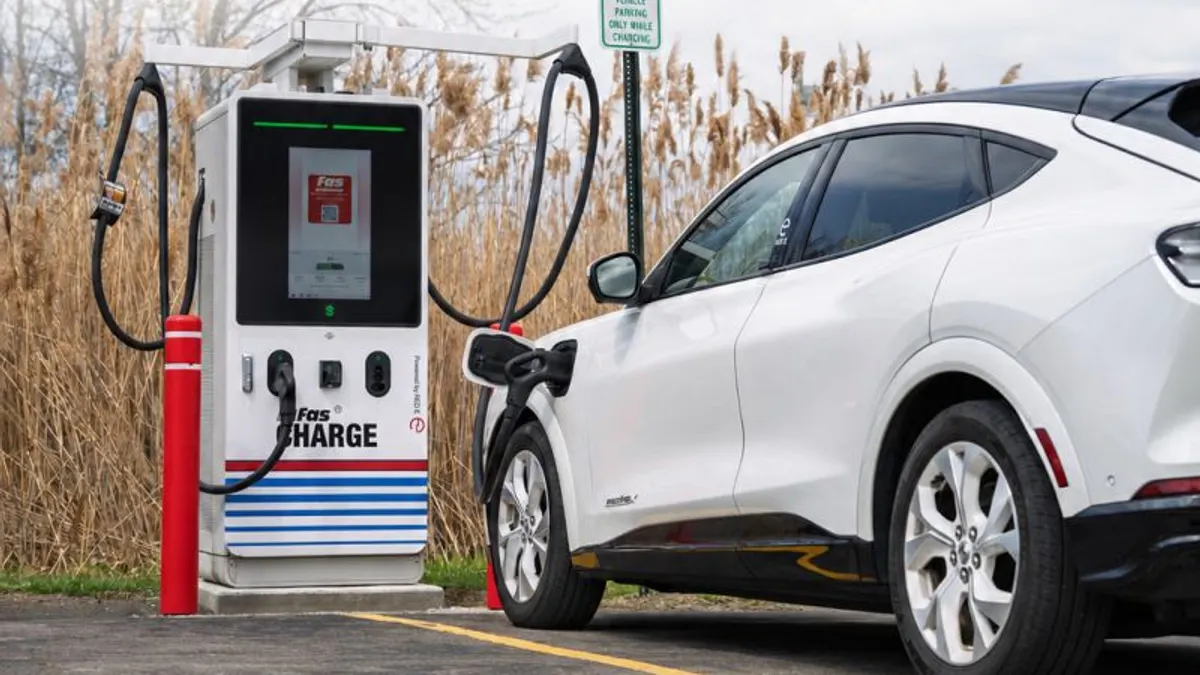
Most of PG&E’s five current and roughly 85 prospective Flex Connect customers are in the electric vehicle charging business, but the pipeline also includes smaller data centers, advanced manufacturing facilities and battery energy storage facilities looking to participate in California’s wholesale market, Collins said.
Most active and potential Flex Connect sites range from 2 MW to 5 MW, though some data center and manufacturing prospects push 10 MW, he said.
A Flex Connect customer links their energy management system to PG&E’s grid management system, which “provides scheduled or real-time capacity limits based on grid availability” for the customer’s load to follow, according to a PG&E one-pager on the pilot.
PG&E saw an emerging need for flexible interconnection a few years ago amid a “huge amount of applications for new service outpacing the typical trajectory we’ve seen and our timelines for building out new capacity,” Collins said.
A fact sheet for interested EV fast charging customers describes a six-step interconnection process that can last roughly four to eight months from an initial capacity assessment to site commission. Before the utility developed Flex Connect, some such customers were looking at one- to three-year waits for firm interconnection at full requested capacity, Collins said.
In the meantime, those customers would be limited to a fraction of their requested capacity at all times, he added. PG&E’s one-pager cited a hypothetical 2-MW EV charging customer limited to 500 kW of service until the necessary upgrades were made.
Those upgrades do eventually happen. Collins said two Flex Connect customers have so far “graduated” out of the pilot after an average wait of about 18 months.
Early customers appear happy with the results, Collins said, noting that as as PG&E has worked to grow Flex Connect from pilot to full scale, its initial participants have come back with bigger asks.
“It has unlocked something in their minds: ‘Hey, this actually works, this is not just an empty promise but can actually drive my business forward … so here is my entire pipeline, what can you do for me?’” he said.
One of those early customers is a WattEV electric truck charging depot in Fresno, California, with 15 240-kW charging ports and seven ports capable of delivering upwards of 1 MW of power each.
In a June news release announcing its opening, WattEV said the facility was one of four freight hubs planned to connect inland Northern California with the Port of Oakland, following a similar buildout across Southern California.
The Fresno depot “is within easy reach of both the Port of Oakland and our … Bakersfield depot, which is the gateway to our Southern California network,” Salim Youssefzadeh, WattEV’s CEO and founder, said in a statement at the time.
Flex Connect helped WattEV get online in Fresno “well ahead of traditional timelines … while longer-term upgrades are underway,” Josh Simes, the area’s top PG&E executive, said in a separate statement. The site can draw up to 3.6 MW “during most hours of the year,” Simes said.