The PJM Interconnection intends to assess SoftBank Group’s roughly 10-GW AI data center complex planned on federal land in Ohio, and the generation and transmission needed to serve it, under a “state agreement approach” framework, according to a study agreement filed Tuesday at the Federal Energy Regulatory Commission.
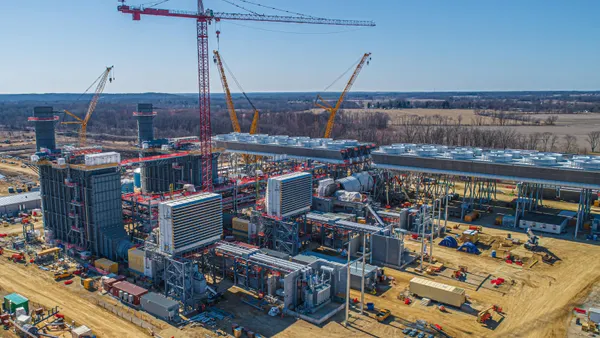
The project, dubbed “Flagship,” was announced by the White House in mid-February as part of a $550 billion trade deal with Japan. It includes an estimated $33 billion for 9.2 GW in gas-fired generation for the project.
An AEP Ohio data center tariff will serve an initial 800-MW phase of the project, according to PJM. The PJM study agreement covers an additional 9.6 GW of load and 10.2 GW of new gas-fired generation to be built by SB Energy, a SoftBank company, in phases through 2032.
AEP Ohio plans to build three 765-kV transmission lines and related infrastructure to serve the project, according to PJM.
Most of the Flagship project being developed by SB Energy and other SoftBank affiliates would be built at the U.S. Department of Energy’s Portsmouth Gaseous Diffusion Plant, a former uranium enrichment facility in Pike County, Ohio. Some of the generation would be built about 30 miles away, according to PJM.
In its filing at FERC, PJM noted that the agency has encouraged grid operators to integrate their studies of load and generation.
“The Study Agreement provides a means for PJM to undertake such an integrated evaluation in response to Ohio’s specific [State Agreement Approach] request while PJM continues development of a more formalized process to study requests of this nature,” the grid operator said.
PJM’s SAA framework allows a state or group of states to ask the grid operator to study specific projects needed to meet state policies. Projects that are built under the framework are paid for by consumers within the state requesting the agreement.
With the Flagship project, SB Energy intends to pay for any generation and transmission infrastructure that is built to serve the data centers.
“Consistent with the Ratepayer Protection Pledge, SB Energy has committed to bringing new generation to support the project and paying for required power delivery infrastructure and network upgrades through arrangements designed to protect other customers from project-related costs,” PJM said.
SB Energy’s commitments include infrastructure payment obligations that apply regardless of how much electricity the data center complex uses and making excess generation and transmission capacity available to the grid, PJM said.
The specific cost allocation and cost recovery mechanisms remain subject to future Public Utilities Commission of Ohio and FERC proceedings, the grid operator said.
In its study, PJM will assess whether the transmission facilities AEP Ohio identifed are sufficient to support the Flagship project and if additional infrastructure is needed, the grid operator said.
“The studies will provide the technical basis for Ohio to determine whether to proceed, but they will not themselves select transmission projects or designated entities, establish cost allocations, or grant the Flagship Project transmission service or interconnection rights,” PJM said.
While PJM conducts its grid reliability studies for the project, it said it intends to work with Ohio and other parties at the same time to develop a cost allocation methodology that would apply to any “state agreement public policy projects” that PUCO decides to sponsor.
PJM asked FERC to “accept” the study agreement and make it retroactively effective on Sept. 25, 2026 — the date it was executed.