
In every utility service territory, structures are sited in challenging locations, support high-value equipment and circuits, or persistently drive maintenance and replacement activity. Choosing the optimal poles for these sites is not a routine materials decision—it’s a strategic lever for improving reliability, resiliency, and long-term asset performance.
Composites made of fiber-reinforced polymers stand out among pole options, not just as premium or specialized solutions, but as the best choice when performance and the cost of failure are critical. Their long service life, superior durability and reduced lifecycle costs provide clear advantages over traditional materials in demanding environments.
Targeted deployment of composites, guided by a robust decision-tree framework, ultimately leads to both optimal system performance and return on investment.
The total cost of ownership advantage
While composite poles typically carry a higher upfront cost than wood, steel, or concrete, their durability, longevity, and event resilience fundamentally change the lifecycle economics.
“In 20 years, we’ve never experienced a directly weather-caused failure of one of our composite poles, and that reliability changes the way utilities plan their assets,” said Scott Holmes, CTO of Resilient Structures, a leading composite pole manufacturer.
A pole that avoids failure saves far more than repair cost—it safeguards equipment, prevents outages, and eliminates the customary pole replacement cycle. For utilities, the key to maximizing value is deploying composite poles where their superior capabilities deliver the strongest benefit and return.
“For many utilities, the value of the targeted deployments of composites poles is only one storm or wildfire away and the system performance data is there to prove it,” said John Higgins, CEO of Resilient Structures.
By pinpointing the structures and circuits where reliability, durability and low-maintenance performance are most critical, utilities can deploy composite poles that provide the greatest long-term value to the system.
Strategic use case #1: Critical structures and high-value circuits
Structures carrying transformers, reclosers, regulators, and other high-value equipment entail operational and financial risks. When these poles fail, the equipment they support often fails with them, creating complex and costly restoration scenarios. Critical circuits that power hospitals, substations, and essential community infrastructure amplify the stakes of these failures.
Many of these assets still rely on aging wood poles whose strength diminishes over time due to weathering, pests, and environmental exposure. Targeted deployment of composite poles on critical structures and circuits can dramatically improve system performance. Resilient Structures’ composite poles deliver superior strength—providing a substantial margin above published class ratings—along with non-conductive, fire-resistant properties and an 80–100-year service life. In high-load conditions, they can flex and absorb stress without breaking, helping prevent a single failure from causing neighboring poles to collapse.
This was demonstrated during a December 2021 tornado outbreak in Western Kentucky. Within Pennyrile Electric’s service territory, more than two miles of 13 kV wood distribution poles were downed in a wind-induced cascade. However, three composite poles installed by the rural electric cooperative in 2012 were undamaged, averting three separate cascading failure events on the circuit. By keeping the equipment aloft, the composite poles protected nearby substation components and prevented further system damage, accelerating restoration and minimizing outage impact.
Strategic use case #2: Challenging or remote installations
Rear-lot installations, steep terrain, wetlands, remote corridors, and other challenging environments sharply increase installation and maintenance expenses. Every return visit for repairs or replacements amplifies these costs, making upfront decisions critical.
Composite poles address these challenges by reducing operational complexity and avoiding the repeated high-cost conventional structure installations that would take place over the lifespan of a single composite pole. Their modular, lightweight design allows them to be deployed in locations that are difficult for traditional structures to reach, while minimizing the need for heavy equipment and extensive staging. This simplifies installation, reduces crew risk, and lowers the likelihood of repeated mobilizations. Over the long term, these factors translate into fewer interruptions, lower maintenance costs, and more reliable service in hard-to-access locations.
In Western Colorado, San Miguel Power Association (SMPA) is upgrading a mountain transmission line that provides backup power to the towns of Ouray and Ridgway. Built in 1928 to serve local mines in Red Mountain Pass, the line was maintained, repaired, and upgraded many times before reaching the end of its functional life. SMPA engineered the replacement line using modern design practices and composite poles, improving reliability across steep, mountainous terrain and reducing the long-term maintenance burden.
Strategic use case #3: Harsh environments
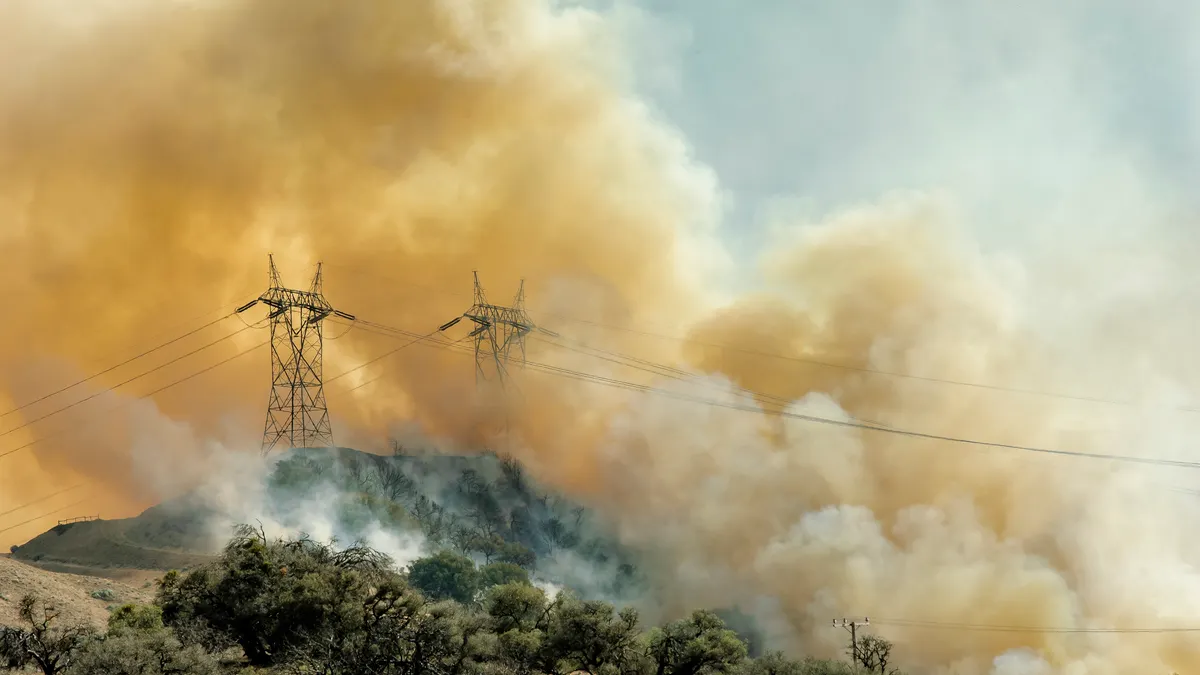
High winds, ice storms, wildfires, moisture, corrosive coastlines, and pests accelerate the degradation of wood, steel, and concrete poles, shortening their lifespans.
“Some regions are just really hard on conventional pole types,” Higgins said. “That reality drives maintenance costs up and leads to more frequent outages, underscoring why utilities need to focus on durability in extreme settings.”
Composite poles are designed to withstand these challenging environmental conditions. They are chemically inert, impervious to decay, non-conductive, fire resistant and self-extinguishing. Their reserve strength beyond class load allows them to maintain structural integrity where traditional materials degrade.
“With composite poles, utilities don’t have to repeatedly harden the same asset. You pay for resilience once that endures for 80+ years,” Holmes said.
Nearly 16 years ago, Grand Bahama Power hardened a critical 22-mile, 69-kV transmission line using 500 composite utility poles engineered to withstand 150-mph winds. That decision proved decisive during Hurricane Matthew in 2016, when winds reached 140 mph, and again during Hurricane Dorian in 2019, with gusts exceeding 220 mph. While these storms destroyed thousands of wood poles, the composite structures remained intact. Today, the line continues to deliver service, illustrating how deliberate infrastructure choices can drive long-term resilience under extreme conditions.
Unlocking maximum grid value
Strategic, targeted deployment of composite poles creates a more reliable grid and lowers costs on critical structures, remote installations, and circuits exposed to extreme conditions, delivering value where the stakes are highest. This approach enables utilities to protect assets, streamline operations, and prevent failures for decades.
Targeted deployment ensures that every investment in composite poles delivers maximum long-term value, turning durable infrastructure into a strategic system advantage. Contact Resilient Structures to learn how strategically deploying composite poles can deliver the greatest value for your utility.