Dive Brief:
- Colorado electric cooperative Holy Cross Energy announced Tuesday that in March it provided renewable electricity equivalent to 100% of its members’ needs for the first time — bringing the co-op closer to its goal of doing so continually from 2030 onward.
- HCE said that the utility’s success in March was “driven by a combination of mild temperatures and favorable conditions for the production of electricity from HCE’s robust portfolio of renewable energy resources.”
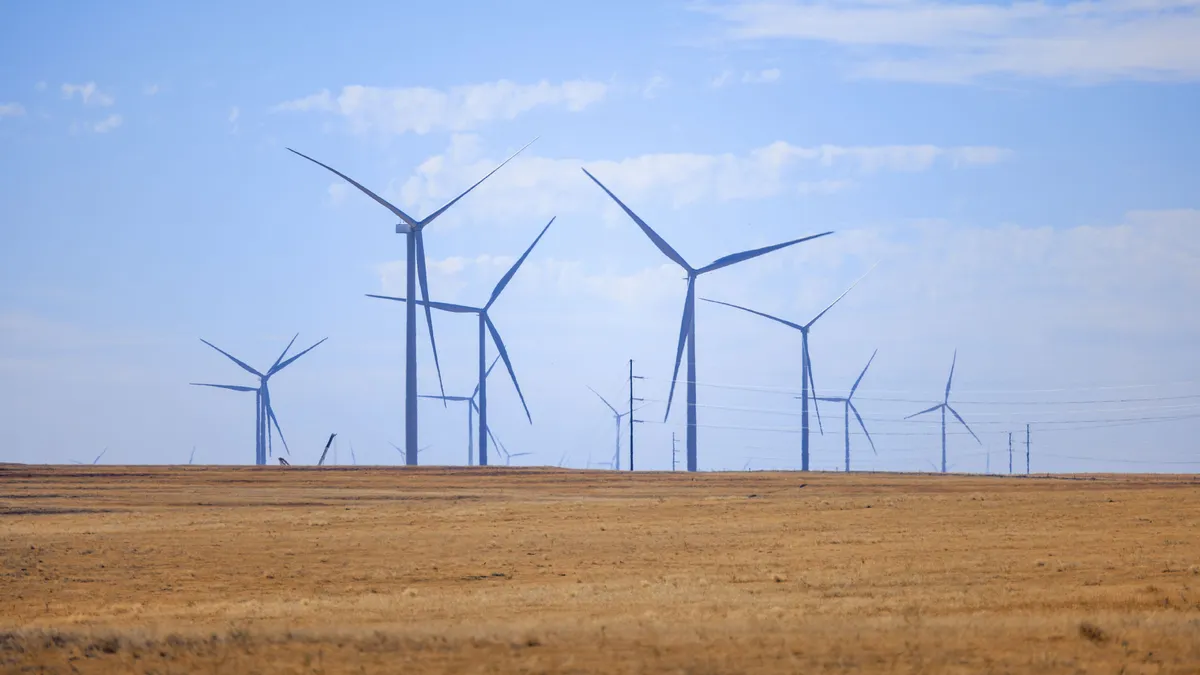
- Those resources include shared use of the 200-MW Bronco Plains II wind farm, shared use of the 75-MW Hunter Solar array, “three solar-plus-storage facilities directly connected to the HCE distribution system, and a variety of distributed solar and hydro facilities through HCE’s service territory,” the utility said.
Dive Insight:
“While this is a proud moment, we still have important work ahead to achieve our 2030 goal throughout an entire year, in a responsible way that continues to safely provide the affordable and reliable electricity supply we all depend upon,” HCE President and CEO Bryan Hannegan said in the release.
In an email to Utility Dive, Hannegan said some of that work will include continuing to “selectively add new flexible renewable resources that help fill in the final gaps during non-solar hours and winter months of high demand, while continuing to first prioritize system reliability and overall costs to members.”
“We will also expand our existing programs for smart electrification and demand flexibility, to better align the use of electricity with the times renewable supply is available,” he said. Hannegan said HCE’s peak system demand in March was 222.6 MW. The utility serves more than 45,000 members.
HCE said it has delivered “an average of 92% clean energy to its members year-to-date in 2026 through the end of April, with some hours surpassing 100% and others dipping below — requiring supplemental non-renewable generation to meet demand.”
“In 2026, roughly 60% of HCE’s clean energy has come from projects built specifically for and contracted to HCE, providing electricity that is time-matched with Renewable Energy Certificates,” HCE said.
The utility’s release also noted that its “strategic partnership” with The Energy Authority, a non-profit public power organization, “played a key role” this spring as TEA partnered with HCE’s staff and used analytics to “maximize renewable energy procurement while maintaining grid reliability and affordability.”
“Residual energy supply and capacity needs are met through HCE’s wholesale power supply agreement with Xcel Energy, which itself is increasing its renewable power supply,” HCE said.