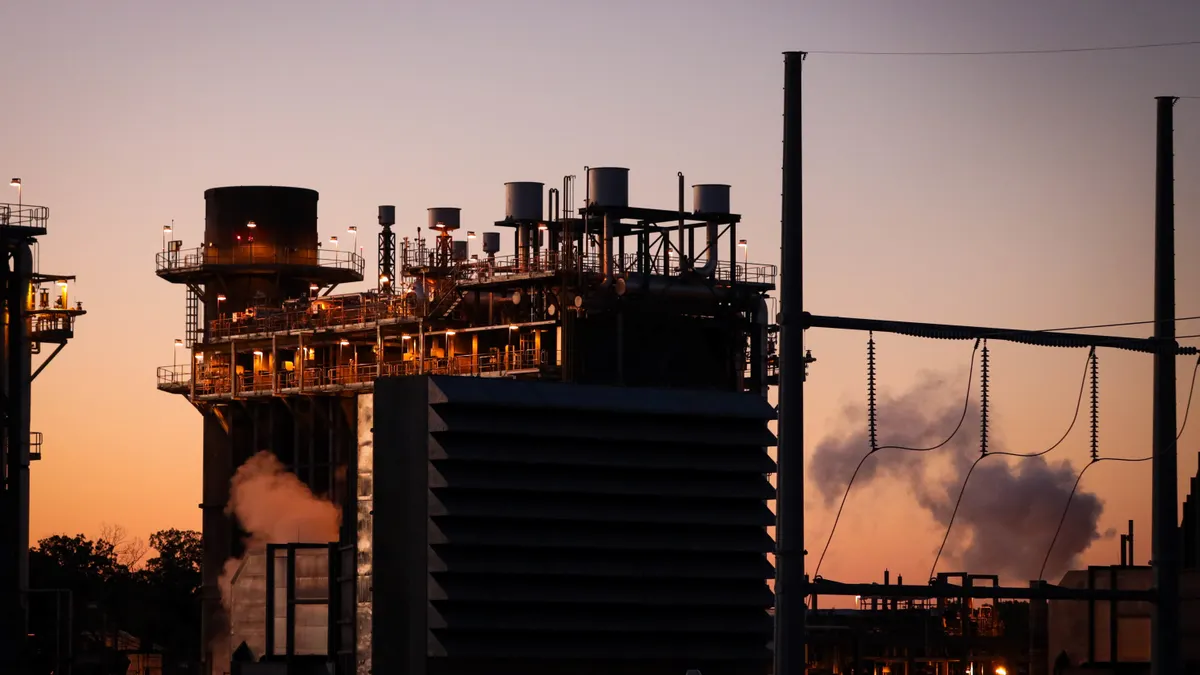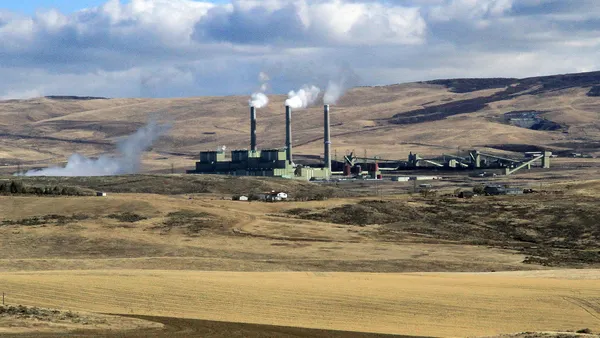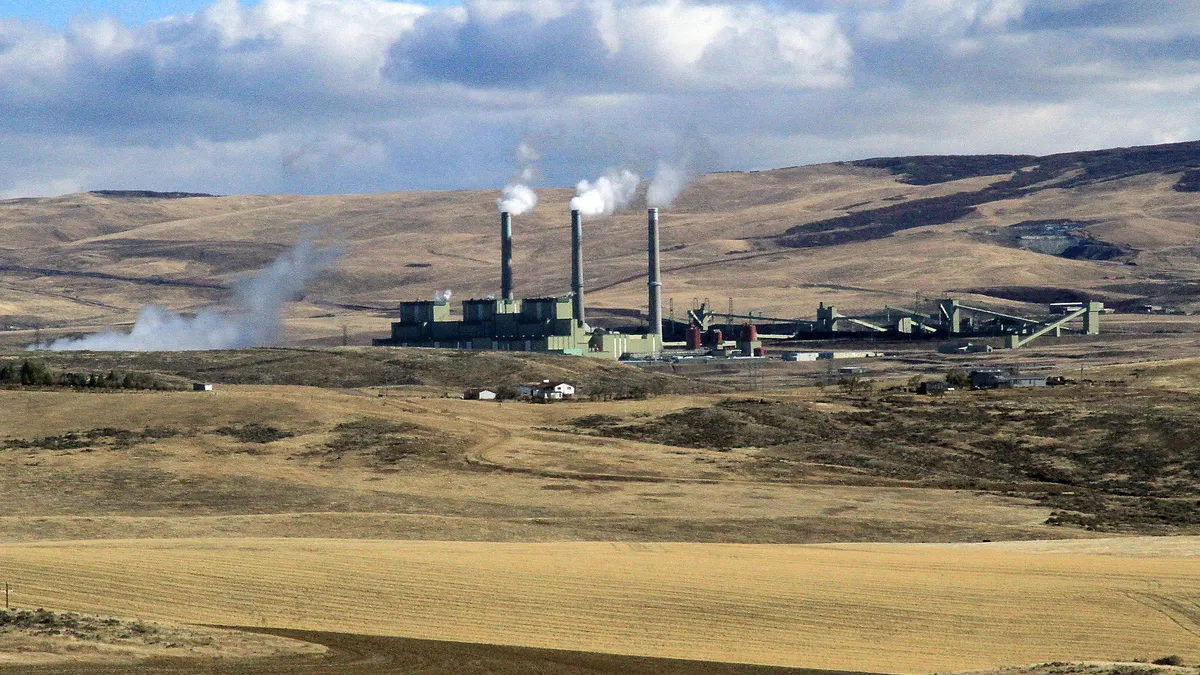
The owners of a Colorado power unit say the Department of Energy violated their Constitutional rights when it ordered them to continue running a coal-fired generator they had been planning for years to retire at the end of 2025.
By mandating the generator’s availability to operate, the order “constitutes both a physical taking and a regulatory taking” of property by the government without just compensation or due process, in violation of the Fifth Amendment of the U.S. Constitution and federal law, the Tri-State Generation and Transmission Association and the Platte River Power Authority said in a Jan. 29 request for clarification and rehearing.
Moreover, they said, keeping the unit available to operate “will not best meet DOE’s goal of securing dispatchable electricity resources in the northwestern United States.”
Energy Secretary Chris Wright invoked his emergency powers under the Federal Power Act’s section 202(c) when he issued the order on Dec. 30, the day before the 427-MW coal-fired Unit 1 of the Craig Generating Station was slated for retirement. He justified the action based on an alleged power supply shortfall in a region covering Colorado, Idaho, Montana, Oregon, Utah, Washington and Wyoming.
The generating unit is owned by Tri-State, a nonprofit wholesale supplier, and Platte River, a public power entity.
Over the past year, the Trump administration has made no secret of its view that coal and gas-fired generators are more reliable than renewables, and has sought to keep fossil fuel resources from retiring.
DOE last year prevented six power plants totaling about 4,300 MW from retiring. Five of the power plants burn coal. They are in Colorado, Indiana, Michigan and Washington. DOE also ordered Constellation Energy to continue running two oil- and gas-fired units totaling 760 MW at its Eddystone plant in Pennsylvania. So far, DOE hasn’t let any of its 90-day orders for those power plants lapse.
Tri-State and Platte River contend that DOE failed to show there was a pressing emergency that requires the Craig unit to continue operating, noting the lengthy resource planning process that was circumvented by the emergency order.
“The government must do more than reference the word ‘emergency’ — rather, it must show that the kind of emergency that requires such fast-moving action has occurred,” the utilities said. “The Order’s asserted emergency is no such emergency. And the Order disrupts a considered resource planning effort.”
Tri-State and Platte River said the unit had become uneconomical to run, requiring frequent repairs. In fact, they said they had to undertake repairs just to make the unit operable in order to comply with the order.
“The costs of compliance fall directly on their members and customers, who must now pay to respond to the DOE’s finding that utilities in the northwestern United States have ‘a shortage of electric energy, a shortage of facilities for the generation of electric energy, and other causes,’” they said. “The members and customers must pay those costs even though neither Tri-State nor Platte River are experiencing these shortages and not all the members and customers served by Tri-State and Platte River are located in the region identified by the Order.”
The petitioners also noted that their customers have already paid to replace the unit.
Also, some of their members — such as Tri-State’s members in New Mexico and Nebraska — will have to pay their share of those expenses but won’t benefit from keeping the unit online.
As part of Tri-State’s plan to replace the unit, it bought the 145-MW Axial Basin solar facility that will use transmission capacity dedicated to the Craig Unit 1. Tri-State may have to curtail the solar plant if there is inadequate transmission capacity when the coal-fired unit is running.
Further, Tri-State and Platte River said they won’t be compensated for their expenses by the government.
Federal Energy Regulatory Commission “cost recovery shifts costs onto ratepayers; it does not assure compensation from the government,” the utilities said, noting that neither the Bonneville Power Administration nor the Western Area Power Authority — massive federal entities in the region — fall outside of FERC jurisdiction.
“It is not immediately clear how the FERC rate-making process could be used to secure cost recovery from utilities serving areas located within the scope of the emergency but over which FERC lacks jurisdiction,” Tri-State and Platte River said.
DOE’s emergency order runs counter to the Federal Power Act because it “requires the operation of an uneconomic resource and disrupts ordinary and orderly planning, development, and investment in generation resources,” Tri-State and Platte River said. “It is, therefore, arbitrary and capricious.”
Separately, the Sierra Club and Environmental Defense Fund, and Earthjustice, on behalf of GreenLatinos, Vote Solar and Public Citizen, have asked DOE to reconsider its emergency order for the Craig unit.
The rehearing requests are a required step before the advocacy groups and utilities can ask a court to overrun the DOE order.
Lawsuits are pending in federal court to overturn some of those orders. In part, the suits say DOE failed to show there are emergencies affecting the power systems in the Upper Midwest or the Mid-Atlantic region.