Adding transmission capacity between U.S. regions could save consumers billions in power supply costs by allowing lower cost power flow to high cost areas, according to a research paper released Tuesday.
Low-cost generators in the Midwest and Great Plains states could see a significant revenue increase if electricity from their resources could flow freely to high-cost East Coast areas, the study published in Proceedings of the National Academy of Sciences found.
The researchers found that improved transmission connections between U.S. regions would have saved $5.8 billion to $7.1 billion in generation costs in 2022 — a year with high natural gas prices — and $3.4 billion to $5 billion in 2023.
It is likely that cost savings would be even higher, according to the study, which didn’t model the benefits of increased transmission capacity during extreme weather and other factors.
However, those savings — which would mean reduced revenue for some generators — are an incentive for power plant owners to fight against more efficient regional power flows, the paper’s authors said.
“The U.S. process for siting, building, and paying for new transmission lines gives incumbent companies many opportunities to delay or block projects that are not in their private economic interest,” the authors — Dasom Ham, Owen Kay and Catherine Hausman — said. “As analysts and policymakers propose grid reforms, it will be important to consider the incentives of suppliers and therefore the role of grid governance.”
Hausman is an associate professor at the Gerald R. Ford School of Public Policy at the University of Michigan and a research associate at the National Bureau of Economic Research. Kay is a research economist at the Dallas Federal Reserve and Ham is a PhD student at the University of Michigan.
The savings from allowing lower cost power to flow to higher cost areas could reduce revenue for some power plant owners by more than $20 million a year, according to the study.
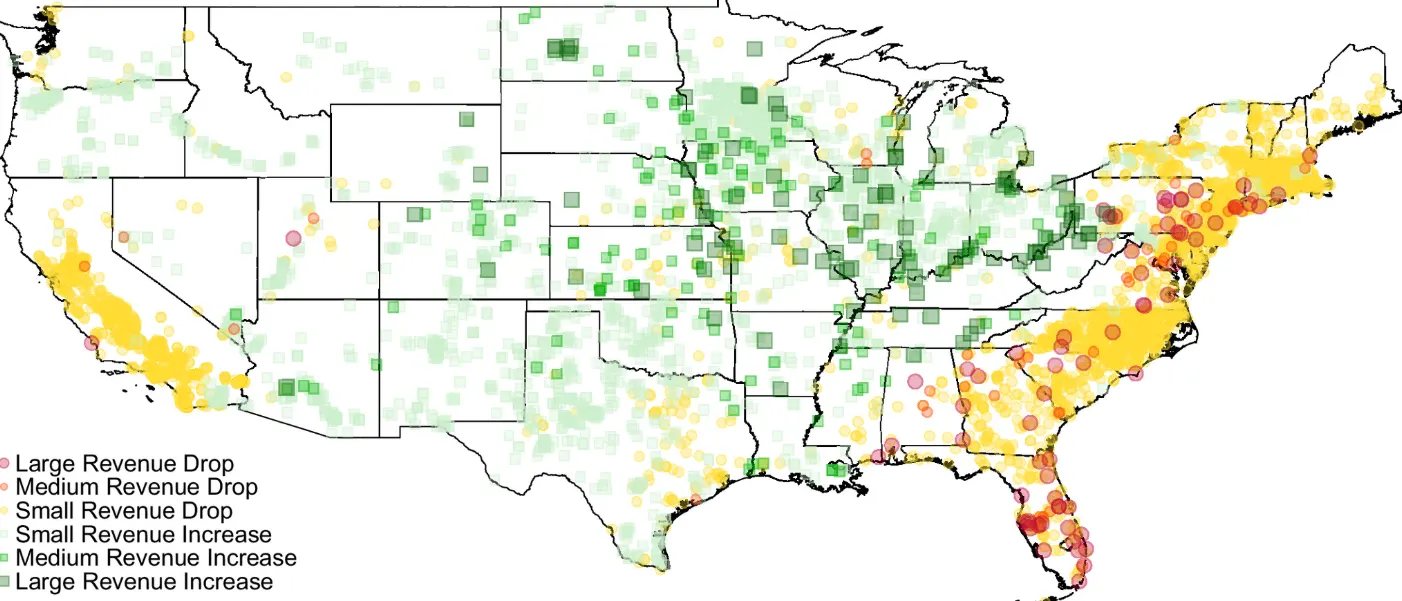
Market integration would benefit generators in the Great Lakes, Great Plains and Rocky Mountain regions but hurt power producers in the Northeast and Southeast, the researchers said.
There has been little interregional transmission development in recent years, with interregional lines making up only 2% of new circuit-miles installed from 2011 through 2020, the study noted.
In some cases, incumbent generators have fought interregional transmission projects, with NextEra Energy Resources and other power plant companies opposing a transmission line to bring hydropower from Canada into New England and Entergy opposing power projects linking the Southeast and Texas, the study’s authors said.
Integrating power markets would make it more attractive to build gas-fired power plants in the Midwest, Northwest and the Rocky Mountain region and less attractive to build in the Northeast, Southeast and California, the authors said.
FERC sends transmission report to Congress
Meanwhile, the Federal Energy Regulatory Commission on Wednesday gave Congress a staff report on the North American Electric Reliability Corp.’s Interregional Transfer Capability Study.
"Increasing interregional transfer capability can be a potent tool in addressing reliability issues and warrants further examination,” FERC Chairman Laura Swett said in a statement. “However, it is crucial to recognize that this measure is not a cure-all solution and should be considered in conjunction with potential economic impacts and other reliability strategies."
The NERC study delineated 35 GW of “prudent” interregional transmission additions that could improve grid reliability. It didn’t make specific project recommendations and FERC staff didn’t offer any recommendations to Congress on potential statutory changes.
FERC staff said that nearly all public comments on the NERC report supported a process to evaluate transfer capability between neighboring regions.
Any follow-up studies could also consider economic factors, such as the costs of building transfer capability, as well as alternate solutions, including intra-regional transmission, generation additions, storage, improved gas-electric coordination, demand-side management and operational practices and controls, FERC staff said.