Demand for gas turbines — and nuclear power — has already met or exceeded expectations just three months into Mitsubishi's 2026 financial plan, according to Mitsubishi Heavy Industries Senior Vice President and CFO Hiroshi Nishio.
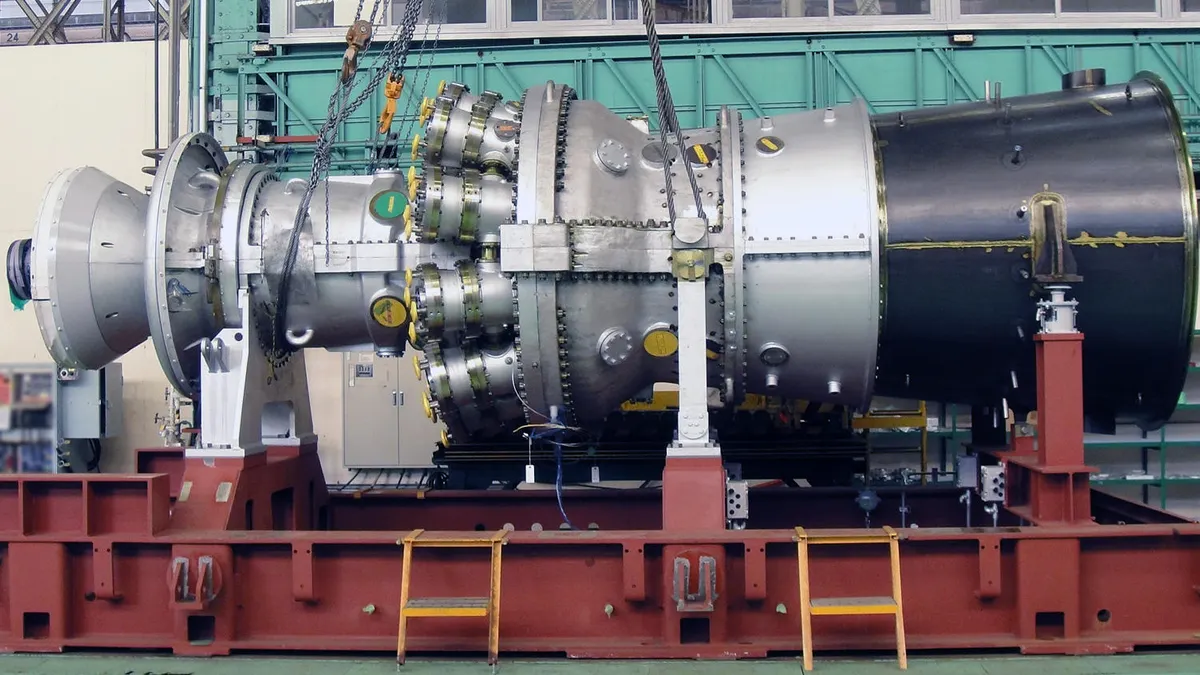
Mitsubishi's newly restructured Energy Systems division saw order intake rise 56% year over year in the first quarter of the company's fiscal year, which begins in March. The company booked 10 orders for large-frame gas turbines — four bound for the United States and six for Japan — during the first quarter, Nishio said during a briefing on August 6, according to an English-language transcript provided by the company.
Mitsubishi sold 35 large-frame gas turbines, for a total of 16 GW, in its 2025 fiscal year, according to the company’s financial release. Its current backlog for the turbines is 35 GW, up from 23 GW a year earlier.
“Demand for large-frame gas turbines remains broadly in line with, or slightly above, the strong level we had anticipated,” Nishio said.
Nishio told analysts that the company still plans to double its production capacity relative to 2024 levels. While he said the expansion is “progressing smoothly,” he also told analysts that Mitsubishi continues to evaluate the need for additional capacity and that it would provide a more detailed explanation of its growth plans and progress in the second half of the year.
Mitsubishi does not plan to immediately begin taking twice as many gas turbine orders, Nishio said. He indicated that orders booked this past quarter are currently scheduled for delivery between 2028 and 2030.
“In the large frame gas turbine market on which we focus, particularly among our core U.S. utility customers, we are being selective in the projects we contract,” he said. “Within this market and customer segment, there has been no change in the strong supply-demand environment or in the trend of improving profitability on new orders.”
Mitsubishi reported ¥10 billion ($63 million USD) in one-time earnings related to the sale of interests in power generation systems in South America and elsewhere, plus ¥15 billion ($94 million USD) from a single, large power generation project contract that Nishio described as not yet fully settled. Nishio declined to answer questions related to the project.
Although large gas turbine orders made up a large portion of the increased Energy Systems sales, orders of light-water nuclear reactors, nuclear fuel and other nuclear power solutions also rose some 53% year-over-year, according to financial disclosures released by the company on Aug. 4.
Mitsubishi Heavy Industries restructured its business on April 1, moving the company's data center and energy management business into the new “Industrial Solutions” division that oversees engines, air conditioning and refrigeration systems, turbochargers and automotive thermal systems. The new division replaces the “Logistics, Thermal & Drive Systems” division, following the sale of Mitsubishi's forklift manufacturing operations to private equity firm Japan Industrial Partners.
The Energy Systems division oversees gas, steam and nuclear power system production as well as airplane engines, compressors and marine machinery.
Nishio also noted that the company had not been significantly impacted by the July 28 earthquake that struck Kumamoto, in southern Japan.