Dive Brief:
- Eligible customers of Atlantic City Electric, Jersey Central Power & Light, Public Service Electric & Gas and Rockland Electric could receive up to $200/kW per year over a 10-year term to dispatch energy stored in small-scale batteries during periods of grid stress under a procurement proposed last week by the New Jersey Board of Public Utilities.
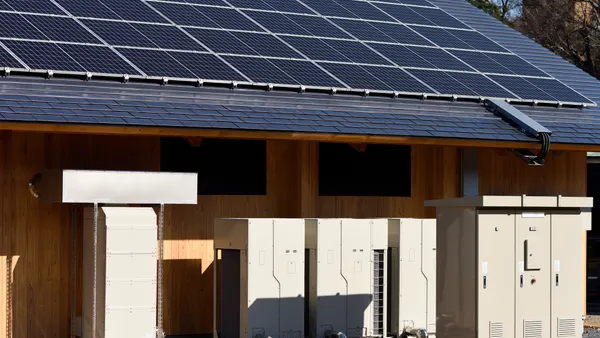
- The proposal targets up to 150 MW of behind-the-meter energy storage capacity that can reliably discharge during dispatch events called by the four electric distribution companies, which will administer capacity enrolled in their service territories. The BPU will host a virtual stakeholder meeting on Sept. 3 to solicit feedback.
- The procurement is the first capacity block of the second phase of the Garden State Energy Storage Program, a statutory framework that requires New Jersey to deploy 2 GW of bulk and distributed energy storage capacity by 2030. The BPU is halfway to meeting that goal after procuring a combined 1 GW of transmission-connected storage in the program’s two-block first phase earlier this year.
Dive Insight:
In a statement, BPU President Ben Hertz-Shargel tied the Aug. 17 proposal to an executive order signed by Democratic Gov. Mikie Sherrill shortly after taking office on Jan. 20. It directed the BPU to issue solicitations for new solar and storage capacity and to begin developing a virtual power plant program open to third-party energy suppliers.
“The Garden State Energy Storage Program advances Governor Sherrill’s Executive Order No. 2 by growing energy storage deployments in-state to meet growing energy demand while improving affordability and resilience,” Hertz-Shargel said.
Residential and small commercial batteries would be eligible to participate in a temporary, technology-neutral VPP program that will begin next year and run for two years before transitioning into a market-based, open-access VPP tariff in 2029, the BPU said last month in a separate straw proposal.
The BPU refers to the capacity discussed in last week’s straw proposal as “Distributed Storage Capacity Block 1.” Its primary objective is to reduce peak demand on New Jersey’s electric distribution system through coordinated discharge, which “will help avoid future capacity obligations and system costs, thereby accruing savings to all residential customers,” according to the straw proposal.
Block 1 will provide a “temporary incentive” and near-term capacity to support the transitional VPP program, along with already-deployed behind-the-meter storage systems eligible for legacy incentives, according to the proposal. Once opened for enrollment, Block 1 will be the sole incentive framework available for new residential storage resources, though enrolled capacity will be eligible for “additional incentives or compensation mechanisms” that become available through a future tariff, the BPU said.
The proposal also frames Block 1 as a large-scale test for possible future blocks of distributed storage capacity. Those blocks could differ in “compensation mechanism design, eligible resources, and operational frameworks, based on market evolution and lessons learned from Block 1 implementation and other BPU workstreams,” it says.
The proposal envisions the four electric distribution companies calling dispatch events to mitigate local congestion, distribution-level thermal constraints and other abnormal grid conditions. The BPU said it looked at similar programs in other states and conducted its own gap analysis to arrive at the $200/kW maximum annual incentive, which it said factors in “the private resilience value of residential energy storage systems.”
“This decision reflects [BPU staff’s] assessment that many consumers have some willingness to pay for resilience and thus do not require an incentive high enough to render the net cost of battery back-up power [to] zero,” the BPU said.