The Department of the Treasury released long-awaited proposed guidance for the One Big Beautiful Bill Act’s foreign entity of concern rules on Thursday, establishing initial guidelines for developers and manufacturers to assess whether a project or component includes material assistance from a prohibited foreign entity.
The law applies to entities controlled by or subject to the jurisdiction of China, Russia, Iran and North Korea. Relying on material assistance from such an entity can prohibit eligibility for certain tax credits, including the section 45X advanced manufacturing tax credit, the section 48E clean electricity investment tax credit and the section 45Y clean electricity production tax credit.
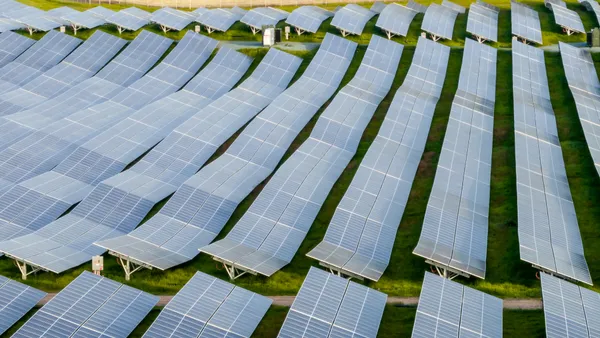
The proposed guidance offers interim safe harbor guidance for calculating a project or component’s material assistance cost ratio, or MACR, and provides relevant MACR thresholds — for instance, it says that the “eligible component MACR” for any solar energy component sold during calendar year 2026 “cannot be less than 50%.”
“The notice also provides that Treasury and IRS intend to propose regulations and other further guidance with respect to the definition of a [prohibited foreign entity] and the material assistance rules, including new safe harbor tables as authorized in the OBBB,” said Treasury and the Internal Revenue Service in a joint release.
The guidance is “primarily focused on material assistance safe harbors, and it explicitly flags that Treasury/IRS intends to issue more comprehensive proposed regulations and other guidance on PFE definitions and ‘material assistance,’” said a blog post from Crux, a finance technology company that connects tax credit buyers and sellers.
“While the notice is not a formal proposed regulation, it addresses several of the most pressing compliance questions facing clean energy developers, manufacturers, and tax credit buyers, particularly around supply-chain tracing, cost allocation, and supplier certifications,” said Crux.
Further guidance will provide new safe harbor tables, as well as rules for assessing FEOC compliance when there are “constructive ownership mechanics, subsidiaries, debt, or specialized public-company ownership tracing,” Crux said.
The clean energy industry has been awaiting FEOC guidance since the OBBBA passed in July.
Hasan Nazar, Crux’s head of policy, said in a post on X that the release brings “meaningful clarity, especially on supply chain tracing and certifications. Safe harbors should reduce compliance friction in the near term. But some key questions remain for forthcoming proposed regs.”
“We’re still digesting the guidance, but our initial read is that this is in-line with expectations and doesn’t create any unanticipated obstacles to FEOC compliance,” Mike Hall, CEO of Anza, a marketplace for solar and energy storage products, said in an email to Utility Dive. “The interim safe harbor rules look like they provide an actionable pathway for project owners to qualify for the [investment tax credit].”
Treasury and the IRS are accepting comments on the guidance through March 30.