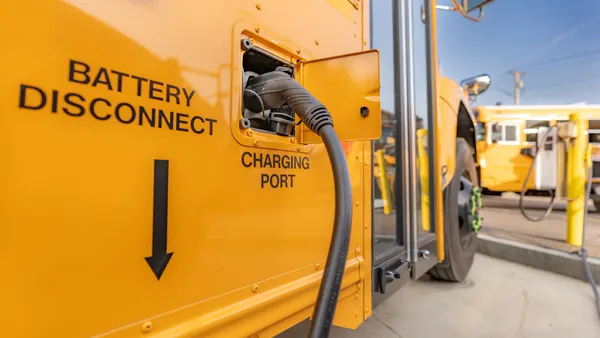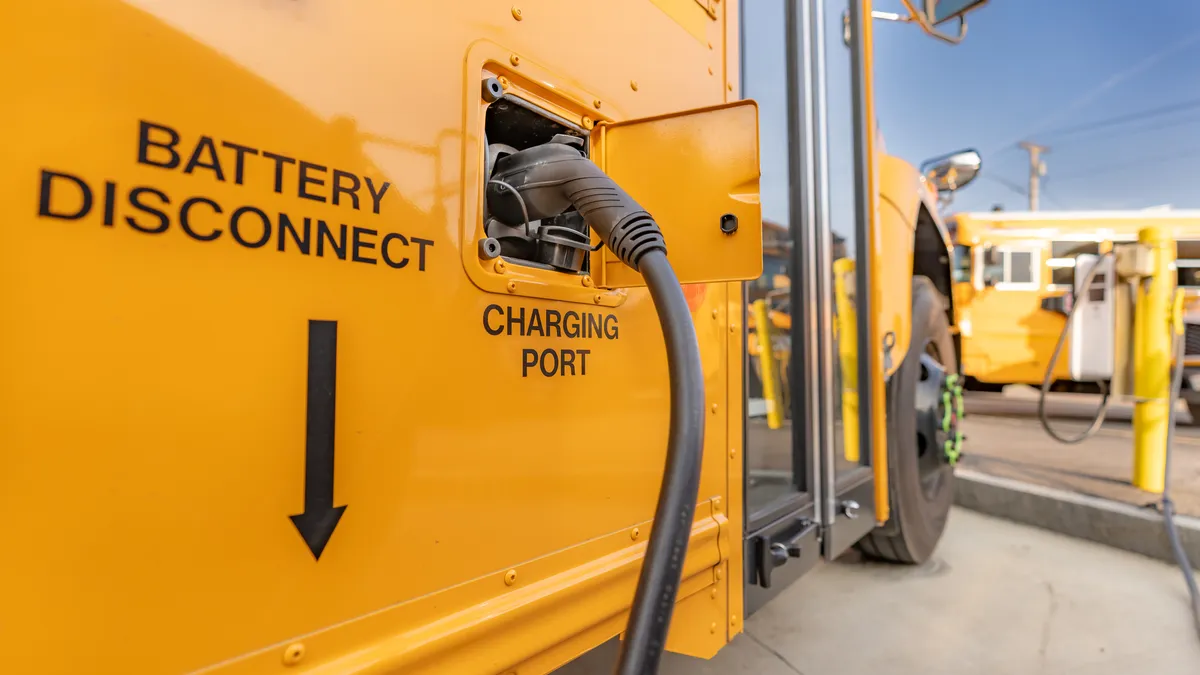
In the summers of 2021 and 2022, a single electric school bus discharged about 10.8 MWh of electricity into the suburban Boston electric distribution grid to offset load peaks. National Grid’s ConnectedSolutions virtual power plant program paid nearly $12,000 per season for its efforts.
The Beverly Public Schools pilot showed that bidirectional-capable electric school buses can provide real value to local grids, said Elijah Sinclair, senior program manager for clean transportation with the Massachusetts Clean Energy Center. He added that MassCEC now has more than 20 buses participating in a broader vehicle-to-grid pilot that includes other types of commercial vehicles and private light-duty vehicles. The effort has tens of millions of state dollars behind it.
“Beverly was crucial proof, but now we’re helping to scale,” Sinclair said.
National Grid and Massachusetts are not alone. At least 26 utilities and 19 states have enacted vehicle-to-grid programs that enable bidirectional-capable passenger and commercial EVs to inject energy into the grid for demand response, ancillary services or other purposes, according to the World Resource Institute’s Electric School Bus Initiative. U.S. school districts have more than 230 “V2G-enabled” buses in use with hundreds more V2G buses on the way, initiative spokesperson Tom Meyer told Utility Dive.
Though that’s a small fraction of the more than 14,000 “committed” electric buses in use or planned by upwards of 1,550 districts, the deployments are nonetheless earning income for districts or fleet owners, helping to offset the high upfront purchase cost of electric school buses compared to diesel buses. They are also proving to districts and utilities that, per WRI, electric school buses have “potential as grid assets at a time when increased storms, wildfires and extreme heat, as well as increased load, are adding stress to the current power system.”
California hosts largest V2G bus programs
Many of those V2G-enabled buses are in Pacific Gas & Electric Company’s Northern California service territory.
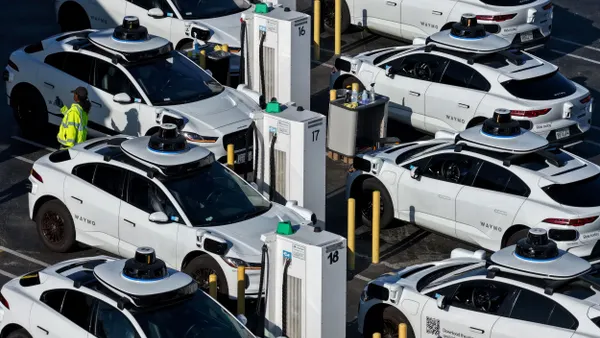
The biggest deployment is a 74-bus fleet operated by Zum on behalf of Oakland public schools. Each bus pairs with its own bidirectional charger, supporting 2.1 GWh of annual discharge from the fleet, according to PG&E.
Rudi Halbright, a PG&E product manager who supports the utility’s vehicle-to-grid integration pilots, told Utility Dive the biggest value for both the Oakland fleet and the utility comes through the Emergency Load Reduction Program.
“What’s the value of keeping California out of brownouts and blackouts? That’s where they make the most guaranteed revenue,” Halbright said in an interview.
The Oakland fleet also has access to an hourly flexible pricing pilot that allows participants to control energy costs by charging when prices are low and discharging when they rise. Halbright said the pricing scheme is “still a work in progress” as PG&E figures out how to value participants’ energy contributions without spreading program costs to other customers.
“[We give] a lot of credit to Zum for just going for it, which is awesome … they’ve created this serious power plant, effectively, and we’re having to catch up with them,” Halbright said.
Zum is now “going for it” across the bay in San Francisco, where Halbright said it plans to deploy 238 electric school buses at three depots over the next two school years. It will be the biggest electric school bus fleet in the country, possibly the world, and the depots’ location on high-need circuits could make it significantly more impactful for the local distribution grid than Oakland’s buses, Halbright said.
Southeast of Oakland, the Fremont Unified School District has a smaller but still impactful fleet of 14 electric school buses, with another eight on order. Of its current fleet, four buses are providing vehicle-to-grid services, said Erny Epley, the district’s transportation manager.
On a typical school day, those buses return to the depot around 4:30 p.m. with batteries about 60% full, Epley said. The timing coincides nicely with PG&E’s usual evening peak. For the next five or six hours, the buses are available to discharge power into the grid if and when the utility calls for it. By 10 or 11 p.m., demand has fallen enough that their services are no longer needed, and they’re free to charge up during PG&E’s “super off-peak” overnight pricing window. By 6 a.m., the batteries are full and the buses are ready for another day, Epley said.
Much of the required work is automated.
“I half-joke that I’m just a school bus driver with a tie, sitting behind a desk,” Epley said. “This V2G capability is not necessarily within my wheelhouse.”
The Mobility House, a charge management provider that works with more than 150 commercial electric fleet operators, handles all the intricacies, Epley said. They provide the charging hardware and the software platform that manages power flows, ensuring the buses can do their thing after hours.
The Mobility House also works with Porterville Unified School District, in California’s Central Valley. The district’s 35 planned fast chargers will draw power from the grid and from a microgrid supported by an onsite 763 kW solar array and 408 kW/1,632 kWh battery energy storage system developed by ForeFront Power, TMH said in June. Two bidirectional-capable buses will support Southern California Edison’s distribution grid.
East Coast opportunities for connected buses
School districts and utilities in other states also see potential in large-scale electric school bus deployments. Many are in places with relatively high power costs and robust demand response frameworks, like New England.
Zum said in February it would outfit the public school district in Branford, Connecticut, with 46 electric buses in time for the 2026-27 school year. All will be bidirectional-capable, Zum said.
Branford’s electric bus fleet is New England’s largest. Boston Public Schools said last year it would use a $35 million federal grant to purchase more than 100 electric buses, adding to its existing fleet of about 40 as it works to fully electrify student transportation by 2030. In February, one of its vendors said it would install 105 fast chargers to support the growing fleet. Ten of Boston’s chargers are part of MassCEC’s vehicle-to-grid program, Sinclair told Utility Dive.
“If each one of [Boston’s buses] is earning $12,000 per summer, that is a pretty big chunk of cash to pay back the marginal cost of those buses,” he said.
Not every bus will reliably earn $12,000 per year, even through a robust virtual power plant program like ConnectedSolutions, cautioned Duncan McIntyre, CEO of Highland Electric Fleets, which operates Beverly’s buses and ran the proof-of-concept pilot. (“We headquartered the company across the street from that depot so we could be close,” he said.)
“More like $6,000 per year is the norm” in Massachusetts, due to differences in discharge patterns and other factors, McIntyre said. To earn significant revenue from grid services, districts should expect to pay more upfront for bidirectional-capable fast chargers and software integration, and more over time on people and processes to keep things running smoothly, he said.
The upside is that Highland can find vehicle-to-grid revenue opportunities just about anywhere, including vertically integrated utility territories, McIntyre said.
Two of Highland’s roughly 100 client districts (with 50 more on the way this year, McIntyre said) are in Georgia, where Georgia Power has a monopoly and there’s no wholesale energy market for Highland to participate in. But there’s always an opportunity to commit capacity from an energy storage asset that’s available precisely when it’s needed most, McIntyre said.
“A [vertical] utility is well-positioned to actually put cash on the hood and say we’ll buy half the battery in your bus and you give us 10 years of load shifting in the summer. That’s a simple way to do it where there’s no revenue but there’s a capital offset, which is just as good,” he said.
Whether it’s recurring revenue or an upfront payment, that cash ultimately “can result in cheaper electrified fleets for cities and schools we serve,” he added. “Vehicle-to-grid is at the core of how we roll out our entire business.”
Room for improvement
Which is not to say the rollout has been smooth from the beginning, nor that utilities, school districts and fleet operators won’t see bumps in the road ahead.
In November, Dominion Energy and the Electric Power Research Institute put out a report on a multi-year electric school bus demonstration in the company’s Virginia territory. It had some bright spots: 11 of the 15 feeders studied had enough capacity to host a fully electrified electric school bus fleet without upgrades, for example. And it answered the basic technical question of whether bidirectional buses are capable of providing grid services affirmatively.
It also noted some room for improvement, however, in areas like dispatch reliability. In some cases, low state of charge in the buses’ 12-volt batteries prevented the vehicles from engaging with the bidirectional charging system and dispensing power when called upon.
Alex Magerko, an engineering scientist with EPRI, said that may have been a “systemic design hurdle” in particular bus models that left vehicles unable to charge the 12-volt battery, even when plugged in. Districts can “spec electric buses from multiple makers, as well as charging stations from multiple companies to ensure interoperability, competition, and backup” and improve dispatch reliability, Magerko said in an email.
It’s unclear how widespread this issue is or was, Magerko added.
“Alternative power supply designs and/or firmware updates to address this shortcoming may mean the issue was vendor-specific and/or potentially resolved by now,” he said.
John Halliwell, a principal technical executive with EPRI, said load-serving entities should be cautious about reading too much into the early experience of a single utility. Variations in climate, energy markets and distribution system dynamics, among other factors, make it difficult to generalize, he said in an email.
Likewise for distribution system upgrades, the need for which depend on constraints specific to individual substations and feeders, Halliwell said. He advised utilities to consult eRoadMap, an EPRI transportation electrification planning tool.
And “fully electrifying a school’s bus fleet, where tens or hundreds of buses might be involved, would require a study of the overall locational power and energy needs of the fleet to assess grid impacts,” he cautioned.
Electric school bus proponents say the benefits — a stronger grid, backup power on standby, and revenue or at least lower costs for schools — are worth the effort.
In Massachusetts, Sinclair said electric buses are already boosting local resilience by, for example, standing in for diesel generators at critical facilities on offshore islands like Martha’s Vineyard. Not long from now, districts like Boston might be in a position to send buses that would otherwise sit idle to support communities hit by summer storms, he said.
“The potential is immense … you have this huge battery on wheels,” Sinclair said.