Dive Brief:
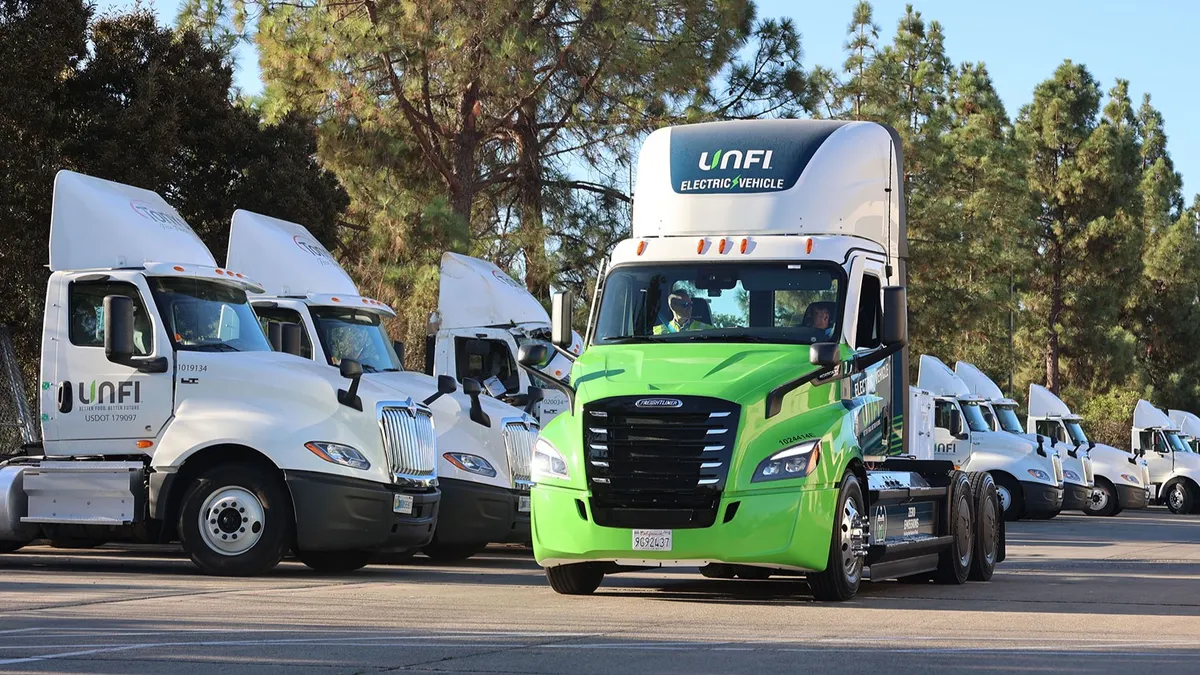
- Electrified medium- and heavy-duty trucking fleets could reduce residential electric rates up to $20 per year in northern California by 2035, according to a new report funded by Powering America’s Commercial Transportation and the Edison Electric Institute.
- The beneficial impact on rates is greater in a “conservative” managed charging scenario where fleet managers try to avoid charging during periods of peak electricity demand, the report said. The effect is less beneficial for customers in scenarios involving “unmanaged” charging, where fleets fuel without regard for time-of-use rates or grid conditions.
- The report looked at the impact of trucking electrification by 2028 and again by 2035 on customers of Pacific Gas & Electric Co. and Georgia Power. It found the overall impacts would be greater for PG&E customers than for Georgia Power customers due to expected higher trucking electrification rates in California during the study period.
Dive Insight:
Energy & Environmental Economics, or E3, a San Francisco-based economic consultancy, conducted the research for PACT and EEI.
In E3’s baseline scenario, medium- and heavy-duty vehicle electrification reduces average PG&E rates systemwide by 0.7% in 2028 in both unmanaged and managed charging scenarios. In 2035, average systemwide rates are 4.4% lower in the unmanaged charging scenario and 4.5% lower in the managed charging scenario.
The 2035 reduction equates to $15 or $20 in annual savings for a typical PG&E residential customer with a 600-kWh monthly load under the unmanaged and managed charging scenarios, respectively.
The impact is more muted for Georgia Power customers, E3 found. In the baseline scenario, the average residential customer saves 20 to 30 cents per year in 2028 and $1 to $1.10 in 2035, faring slightly better both years under the managed scenario.
Sam Vercellotti, a policy adviser to PACT, said in an interview with Utility Dive that E3 used a “regulator-backed methodology” in its analysis that could reassure state regulators and ratepayer advocates about the impact of localized grid upgrades for electric truck fleets.
“The assumption is that medium- and heavy-duty vehicle electrification will automatically increase costs, and this is our counterpoint to that,” he said.
Ratepayer impacts depend, to some extent, on the pace and scope of fleet-related investments, Vercelloti said. Utilities “just going out and making significant grid investments” may not be in ratepayers’ best interest, however, if those investments are not done in alignment with fleet demand, he added.
“That’s where we’re doing a lot of work as a convener” of fleet managers, charging equipment manufacturers, utilities and regulators, he said, “[and] saying, ‘here is the speed at which we need to deploy infrastructure.’”
E3’s analysis found that the “timing and certainty” of fleet electrification is a factor in its effect on rates: Delayed or overall lower transportation electrification rates create a smaller sales base from which utilities can recover early investments in transmission and distribution upgrades.
Actions that could help fleet electrification drive down customer rate include siting charging infrastructure at strategic points on the grid, flexible interconnection strategies and active load management, as well as “smart” tariff design with combination of time-of-use rates and subscription or grid access charges; timely regulatory upgrades to cost allocation frameworks for fleet-related grid upgrades; and early coordination between fleets and utilities’ integrated system planning processes.
Already-established freight logistics hubs are one factor working in favor of utilities, fleet customers, regulators and other stakeholders seeking a proactive approach, Vercelloti said. Those can indicate where fleet-scale charging will be needed in the future, he said.